Pectoral sandpipers fly more than 17,000 miles a year
More than 12 million shorebirds migrate to Alaska every year to breed, spending the short summer in open lands near water after traveling from places including New Zealand, Asia and South America. Pectoral sandpipers are among them. They fly more than 17,000 miles a year on a migration from Alaska to Argentina and back, without soaring or coasting on the wind, and they weigh about three ounces — roughly the size of a robin.
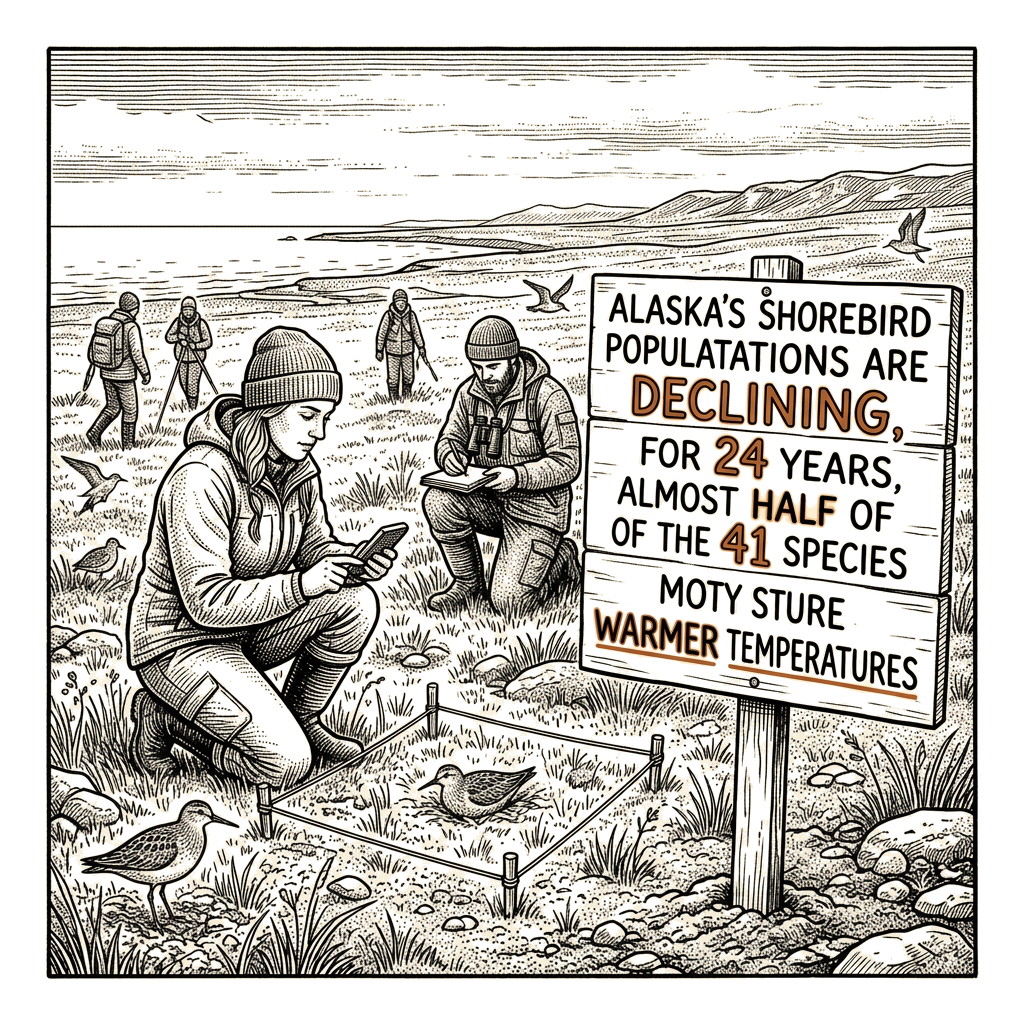
For 24 years, Lanctot and other researchers have tracked the return of shorebirds to northern Alaska. Their data shows that almost half of the 41 shorebird species that breed in Alaska are declining, and that some have lost more than half of their population over the last 30 years.
“Shorebirds are not these little brown birds on the beach, but they’re miraculous migrants that travel these huge distances by these crazy adaptations,” Lanctot said.
Migration depends on timing. Birds organize their journeys to arrive when food is ample and the weather is right, but wetlands and grasslands they count on are disappearing, and in a hotter climate spring arrives earlier, changing when their food is available — the equivalent of reaching a planned rest stop on a road trip to find the restaurants closed.
Field crews work to see how the birds are coping. Near Utqiaġvik — the northernmost city in the U.S., formerly known as Barrow — Lanctot holds a brown and white pectoral sandpiper while field technician Braden Meyer secures a tracking tag to the bird with stretchy loops around its legs. The tag records the bird’s GPS position every 15 minutes and stores the data until the bird passes a cell tower, where it uploads. The team also uses leg tags that weigh about as much as a grain of rice and were originally designed for butterflies.
Tracking tags only became light and compact enough for small birds in the last 15 years, and the records have fallen since. One bar-tailed godwit flew more than 8,000 miles from Alaska to Australia over 11 days without stopping, and researchers say the birds appear to wait for optimal winds.
“When we catch birds when they first show up, they’re really skinny,” Lanctot said. “You can feel the keel or the breastbone really prominently. They have hardly any fat on them.”
To fly thousands of miles, some shorebirds double their body weight to store fat, and some internal organs, including the digestive system, shrink before takeoff. That makes the roughly six weeks pectoral sandpipers spend in the Arctic crucial: the birds must rebuild fat reserves while laying eggs and raising chicks, and the chicks have only about a month after hatching to grow large enough to join the migration.
Researchers are studying how warmer temperatures affect the birds’ food. Julia Berliner, a graduate student at the University of Texas at Austin, collects insects on the tundra with a bug vacuum, a modified leaf vacuum from a hardware store, while non-biting midges rise in clouds on sunny days. Normally the ground is frozen solid, but as the weather warms the top few inches of permafrost thaws, and flies and spiders emerge for short life cycles.
“Insects and spiders are really tied to the weather,” said Amanda Koltz, an assistant professor of integrative biology at the University of Texas at Austin. “So it could be that one week, there aren’t any prey flying around, and then next week, there might be tons of flies flying around. And so that really changes the menu from week to week.”
Shorebirds time their nesting so chicks hatch when insect populations peak. When spring arrives earlier, the insects also emerge earlier, leaving the birds out of sync with their food — a mismatch. Research shows that chicks that hatch late survive in smaller numbers. Koltz and Berliner are also measuring nutrients such as calcium, which birds need to produce eggs, because a shift in insect timing could shift the nutritional menu as well.
The decline is visible in the community that has lived alongside the birds for centuries. Robin Mongoyak, a wildlife guide who grew up in Utqiaġvik, walks the coastline where the Chukchi Sea meets the Beaufort Sea.
“Birds have always been very special to the Inupiat people,” Mongoyak said. “They give us something to always look forward to after a long, cold winter. The Inupiat people have always thought of it as a quvianaq time – a very wonderful time when the birds start flocking in.”
Mongoyak remembers when sea ice lasted multiple years; he said that is now becoming rare, with ice breaking up earlier in the spring. Temperatures in the Arctic have risen four times faster than the rest of the globe. “The climate is getting warmer,” Mongoyak said. “I don’t see as many birds as I used to like seeing. It’s really changed a lot in the last 35 years, at least.”
Scientists are still testing how far the birds can adapt. When spring arrives early, some shorebirds nest slightly earlier than normal, but not enough to keep pace. Long-distance migrants can shift their timing by a few days, yet some of the cues they may rely on come from environments thousands of miles from the Arctic, or from signals that do not change, such as lengthening spring days.
Habitat loss, largely from development, is also driving declines, particularly in the wetlands and grasslands shorebirds use as rest stops, and drought is intensifying with climate change. Some U.S. migratory birds now use agricultural fields and ponds that may be suitable for only short periods; in a handful of places, conservation work includes paying farmers in California to keep rice fields flooded longer so birds can use them while migrating.
“Shorebirds are actually frequently quite well-adapted to finding where patches of habitat are, but our current environmental state is that we’ve really messed with the predictability of a lot of landscapes,” said Nathan Senner, who studies shorebirds at the University of Massachusetts Amherst. “That’s what starts to make it really difficult for some of these species.”
Senner said that if shorebirds keep declining, extinction is a possibility for many species, and that the race is on to understand how much these birds can adapt. “We need to figure out: what are those tactics and then can we manage environments to maximize the likelihood that those tactics will be successful?” Senner said. “Because no one species can be ready for all of the types of changes that could possibly come their way.”
“Shorebirds truly are sentinels about what is happening to the planet, because they’re touching down in so many of the places across that planet,” Senner said. “If we can’t listen to what they’re telling us about the unpredictability of what we’re currently doing to the planet, then we’re not going to be able to respond to a lot of changes.”
Reporting for the underlying story was supported by a Braided River Overlooked and Untold Alaska Journalism Grant.