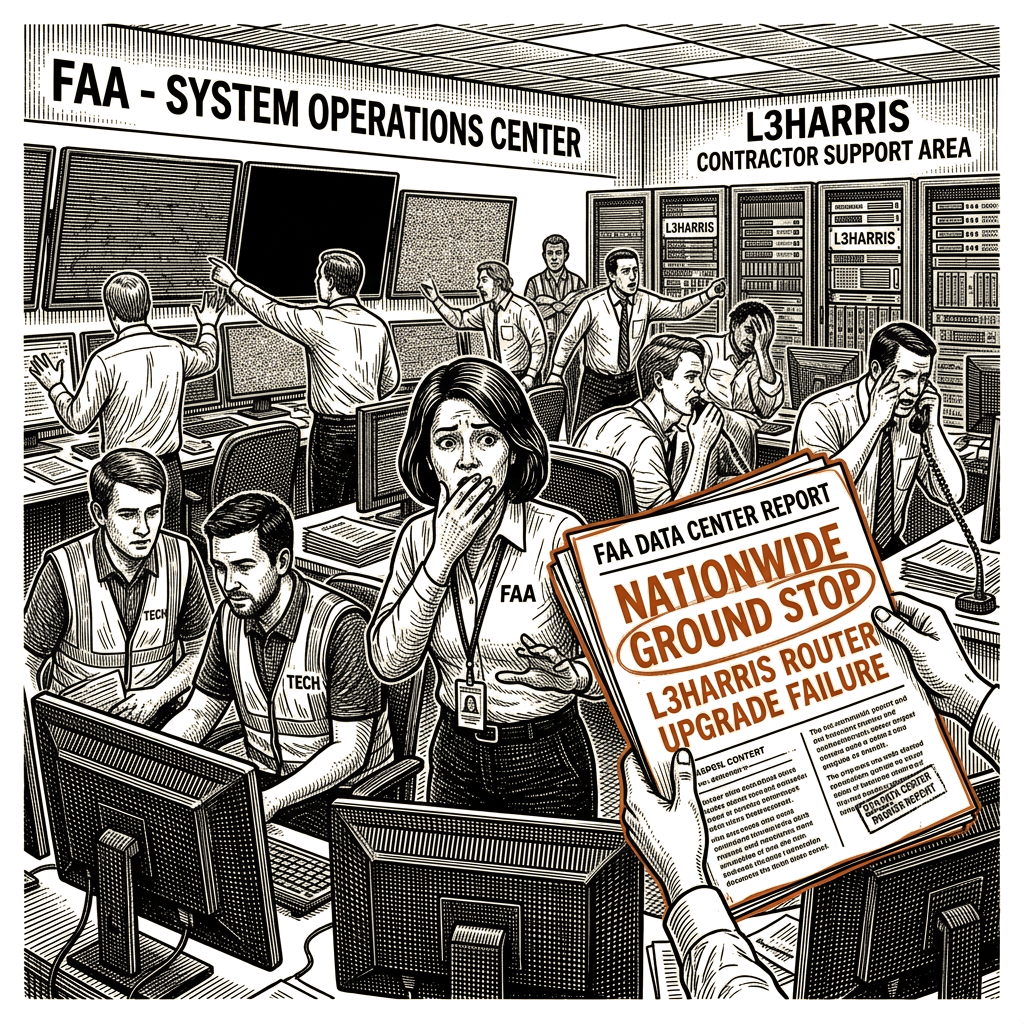
Thousands of flights upended, tens of thousands of travelers disrupted
L3Harris Technologies is facing attention after an upgrade it performed on much of the U.S. air traffic communications system set off a nationwide disruption that grounded domestic flights for hours on Friday, according to The Wall Street Journal’s Morning Risk Report, published Monday.
The chain of events began with a single act of work. A technician’s installation of a router triggered a cascade of failures, and federal aviation officials responded by grounding domestic air traffic for hours, the Journal reported. The stop upended thousands of flights and the travel plans of tens of thousands of Americans.
The Journal described the turmoil as unprecedented, writing that the upgrade of the communications system “caused unprecedented turmoil.” L3Harris, the major defense contractor responsible for much of the system, has promoted itself with a single phrase: the “trusted disruptor.”
The report frames the episode as a moment of exposure for a company that ordinarily draws little public notice. The contractor is under-the-radar but vitally important, the Journal wrote, and the ground stop put a bull’s-eye on it.
The incident lands squarely in the risk and compliance world the Morning Risk Report covers. It ties a technician’s installation of a router on a contractor-run communications network to a shutdown of domestic air travel, a reminder that upgrades to infrastructure carrying public traffic can fail at national scale.
For L3Harris, the reputational cost sits alongside the operational one. The company’s self-description as the “trusted disruptor” is now measured against a Friday in which the disruption it describes was felt by tens of thousands of travelers whose travel plans were upended.
The Morning Risk Report carried several other items. In its podcast coverage, the Journal said it looked at how the departure of Jensen Huang from Nvidia raised questions about corporate governance, national security and U.S.-China relations, and it broke down the sanctioning of crypto exchange MEXC Global after allegations it facilitated illicit money flows.
The Journal also reported that Jensen Huang built a multibillion-dollar business to feed the ravenous appetite of Chinese customers for American chips, cultivating a network of Asian partners who could serve the Chinese far from Washington. Revelations about his affair with an executive at one of those Asian partners — a possible Chinese intelligence asset — didn’t just blow up his career, the Journal wrote; they now threaten to implode the entire ecosystem he built in Asia to get China the chips it needed.
Businesses were one day away from a California deadline requiring them to divulge greenhouse gas emissions from their sites and electricity use to the state when a court ruled the state’s broader emissions reporting rules are likely unconstitutional, the Journal reported. The Journal described the dispute as a long-running saga that saw legal challenges from businesses and a series of delays to reporting deadlines, with the battle over emissions reporting in the U.S. going back years, including a similar bid from the U.S. Securities and Exchange Commission under former President Biden’s administration that was ultimately scuttled under President Trump. The Journal said the California rule is especially consequential because it acts as a quasi-national standard, applying to any company doing business in the state that meets a certain financial threshold.
Democratic lawmakers plan to advance key federal cybersecurity measures when they regain control of Congress in January, from legislation aimed at encouraging companies to share attack intelligence to rebuilding the government’s cyber agency, which the Journal characterized as embattled. Above all, the lawmakers say, setting guardrails for runaway artificial intelligence is job No. 1.
The Journal also pointed to more than $6 billion in digital assets stolen from the Binance cryptocurrency exchange in a hack last month, of which collective U.S. government and private-sector efforts have been able to secure part.
The Justice Department’s most combative voice against the incoming Democratic Congress sits more than 1,000 miles away from Washington, the Journal wrote. Aaron Reitz, the Houston-based U.S. attorney for the Southern District of Texas, in recent days has fired off a trio of written warnings to Democratic lawmakers that they would face legal consequences if they “weaponize” their newly secured investigative power against President Trump and his allies, warnings the Journal called highly unconventional. A Marine veteran and former chief of staff for Sen. Ted Cruz (R., Texas), Reitz argued Democratic senators have touted oversight plans that would trample on the freedom of association rights of Trump supporters, including in his district, giving him jurisdiction to investigate.
Thanks to Chinese customers, data-center industry leaders say Malaysia could become the second-largest data center hub in the world, after Virginia, packed with top-of-the-line Nvidia chips that China’s leading AI companies can use to challenge American dominance.
The Journal also quoted Union Pacific’s CEO Jim Vena in private remarks at an industry event which may scupper a $72 billion deal between Union Pacific and Norfolk Southern: “I’ll probably increase everybody’s rates that said they didn’t want a seamless railroad by three or four extra percent to teach you a lesson.”