Nvidia forms a committee to oversee security policies and export-control compliance
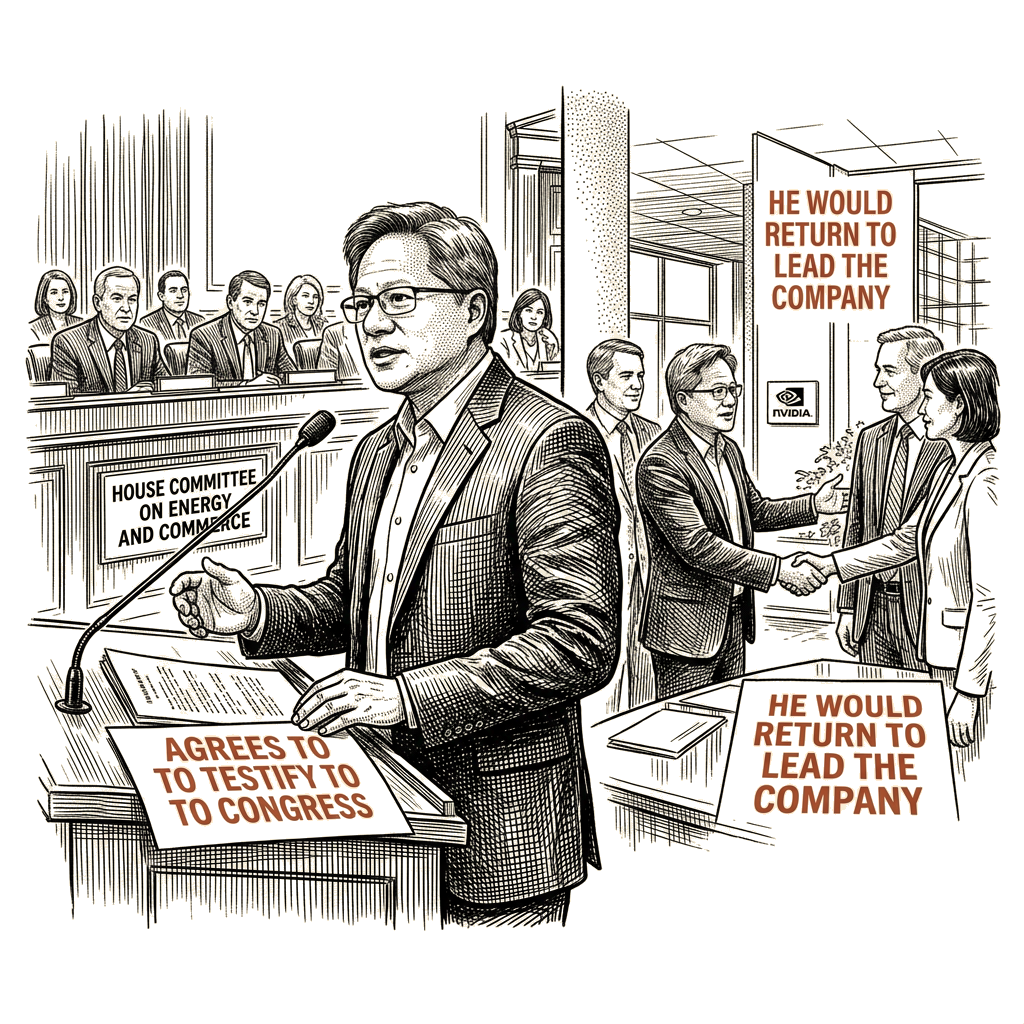
Former Nvidia CEO Jensen Huang said Tuesday he would return to lead the company he cofounded if its board allowed him, as he agreed to appear before Congress to answer questions about national security allegations involving Nvidia.
“I did not live up to the standards expected of everyone at NVIDIA, and I have made serious mistakes in my personal life. I created problems for the Board that I deeply regret,” wrote Huang in a statement posted on social media. “I own my mistakes completely, and I am committed to cooperating with the Board’s independent investigation.”
Huang stepped down from Nvidia last week after acknowledging that he had been unfaithful to his wife. His willingness to return remained conditional: he said he would be “honored” to return if the board agreed.
News reports have tied Huang to a woman who U.S. intelligence officials say was recruited by China’s spy agency and to another woman who is an executive at Nvidia. NPR said it had not independently confirmed those reports.
Some people in Silicon Valley had argued that Huang had been pushed out too quickly and circulated a petition to “stand with Jensen.” Brad Gerstner, founder and CEO of Altimeter Capital, an Nvidia investor, made that case Monday at Semafor’s Silicon Valley and the World conference.
“We don’t want rushes to judgment. We don’t want political pressure from the left or the right to force a board into action before we’ve even taken the time to turn over the cards and learn what was done,” Gerstner said.
Huang and Nvidia general counsel Tim Teter will answer questions behind closed doors from the House Foreign Affairs and Intelligence Committees and the House Select Committee on the Chinese Communist Party on Dec. 1 and 2. Lawmakers said they want answers about Nvidia’s role in alleged chip smuggling and efforts to evade export controls meant to block China from accessing the most advanced U.S. AI chips.
Lawmakers will also question Huang about his involvement with Alice Huang, who was an executive with Megaspeed, a Singapore-based company that was a major customer for Nvidia’s chips. In a statement emailed to NPR, Megaspeed said it “conducts legitimate and lawful business,” that Alice Huang left the company in 2025 and that it was conducting an internal investigation.
Nvidia’s board said Tuesday it had formed a committee to oversee the company’s national security policies, compliance with U.S. export controls and risk management of global trade.
On Monday, the U.S. Commerce Department announced new rules to prevent remote access to advanced AI chips and servers. The rules close a loophole that may have let Chinese companies remotely access advanced Nvidia chips through overseas data centers.
The Commerce Department and Justice Department also announced Monday that the Justice Department was conducting a criminal investigation of Megaspeed.
Later Tuesday, Nvidia was scheduled to announce quarterly earnings after markets closed, giving investors their first direct hearing from the company’s new acting CEO, Colette Kress.