Connecticut delegation backed nominee despite pressure from progressive groups
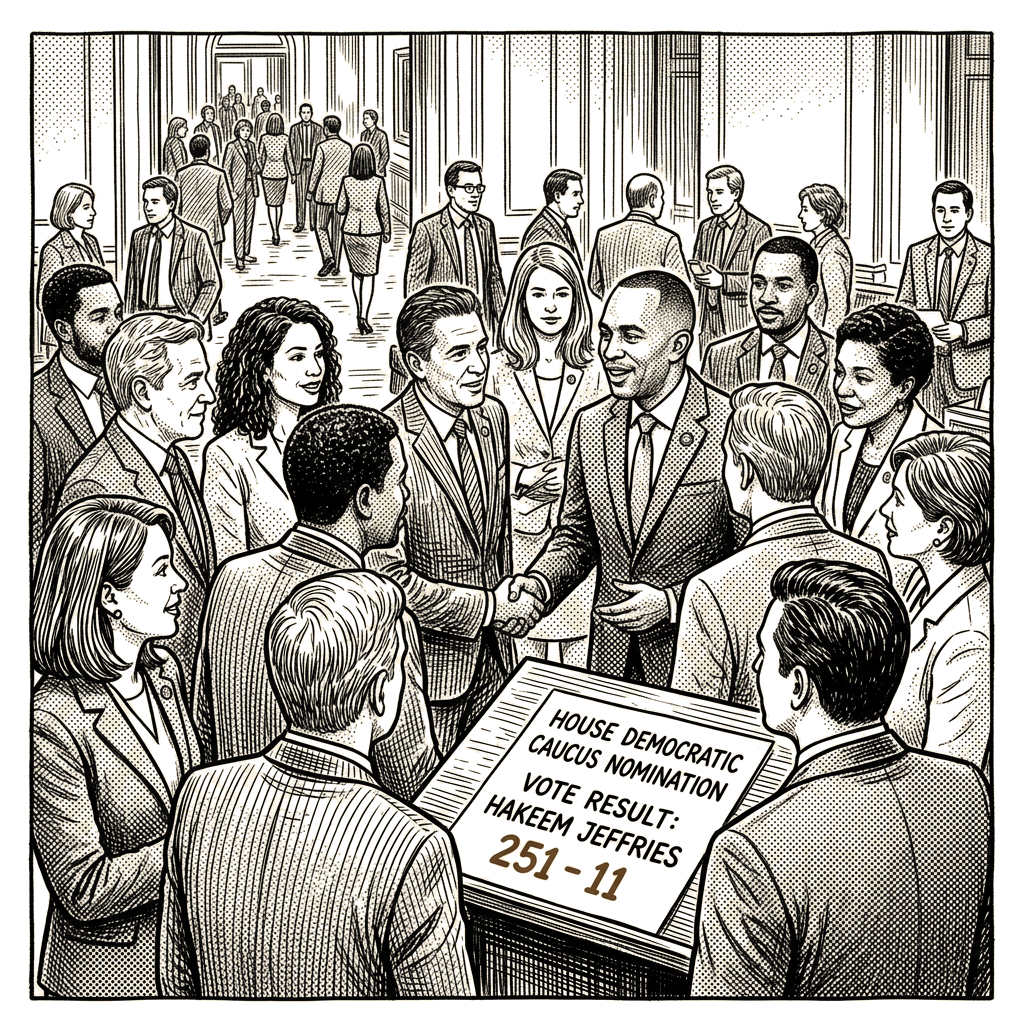
Hakeem Jeffries won the House Democratic caucus’s internal nomination for speaker in a 251-11 secret vote on Wednesday, putting the New York Democrat on track for the full House’s Jan. 3 vote in the incoming 120th Congress. If elected then, Jeffries would become the first Black House speaker. Democrats are set to take control of the chamber with one of their largest majorities in decades, but the caucus decision only sets up a separate chamber-wide vote requiring a simple majority.
The leadership elections were held behind closed doors, with newly elected members participating in the Democratic caucus’s secret ballot. Democrats also voted on nominations for caucus chair and other leadership positions. No formal challenger had materialized against Jeffries, whose internal victory followed his effort to shore up support among moderates representing the country’s reddest districts and progressives in liberal enclaves. Democrats hoped the vote would resolve tension over the nomination.
Connecticut’s delegation emerged as a bloc of support for Jeffries following Democrats’ sweeping midterm gains. Rep. Jim Himes, D-4th District, had predicted for weeks that Jeffries would have no difficulty winning the nomination. Rep-elect Luke Bronin confirmed during new-member orientation that he would support Jeffries, while Rep. Joe Courtney, D-2nd District, credited Jeffries with helping fashion the caucus’s winning message and Rep. Jahana Hayes, D-5th District, defended his record.
Jeffries has served as House minority leader since 2023 and is a close ally of former House Speaker Nancy Pelosi of California. Himes said last week on Connecticut Public’s “The Wheelhouse,” “I’ve had any number of conversations with people. I get the concern.” Himes acknowledged concerns about Jeffries taking the gavel but argued that the historic stakes outweighed them. “Hakeem is an unknown quantity. He’s stepping into Nancy Pelosi’s shoes, and she was the ultimate in known quantities,” Himes said. “My own view is that Hakeem deserves a chance,” he continued. “I also don’t want to necessarily run over or see run over the absolutely historic moment of an African American man serving as speaker of the House for the first time in 250 years.”
Bronin’s position evolved during the campaign. He defeated Rep. John Larson in the Democratic primary for Connecticut’s 1st Congressional District. Jeffries had supported Larson’s reelection bid and campaigned with him in Hartford before the summer primary. At the time, Bronin said leadership should spend less time protecting long-serving lawmakers and more time lifting a new generation to build a stronger Democratic Party.
By the day before the speaker vote, Bronin was endorsing Jeffries’ record, saying Jeffries had never gotten the chance to wield the gavel and lead from the majority. “He’s kept a Democratic caucus together in very difficult times, and he has stayed laser-focused on the twin missions of affordability for working families and accountability for a president who’s out of control,” Bronin said Tuesday. He also said Jeffries had earned the opportunity to lead a majority after two terms in the minority.
Courtney, who was first elected in 2006, said he had served in the minority party during the previous four years and had seen more progress and some victories. He pointed to the number of discharge petitions, a procedural tool that allows the minority to force floor votes after collecting a majority of signatures. Courtney also credited Jeffries with navigating government funding fights and keeping federal immigration agencies such as ICE from receiving money through regular appropriations. “I think he really helped fashion the winning message, and I think the fact that there was no declared opponent kind of speaks volumes about the fact that people who know him up close really think he’s going to do good job,” Courtney said. “There definitely were some successful moments for a minority.”
Hayes said constituents offered criticism of Jeffries but had difficulty identifying an alternative. “No one else is running. But also he’s done a good job, and he’s never led in the majority,” Hayes said in an interview outside the Capitol on Tuesday afternoon. She said people criticizing Jeffries offered either no suggestions or names of people who were not interested. Hayes also warned that Democrats needed to be ready to lead on Jan. 3, comparing the situation to Republicans’ multiple speaker votes involving Kevin McCarthy in 2023. McCarthy was removed from the speakership later that year.
Progressive and grassroots organizations in Connecticut and elsewhere wanted alternatives to Jeffries and Schumer. Connecticut 50501 and Black Lives Matter 860 held a rally over the weekend in Hartford to pressure Connecticut lawmakers to vote differently. They wanted House members to support Rep. Ayanna Pressley, who had been floated as a potential challenger but did not mount a formal bid. Connecticut 50501 also encouraged people to make daily calls to lawmakers’ offices. Some voters argued that Democrats’ midterm victories reflected a desire for new leadership in both chambers.
“Both Chuck Schumer and Hakeem Jeffries have proven time and time again through their votes that they stand for the establishment, for the billionaire class, for corporations, and not for us,” Alison Greenlaw, CT 50501’s Hartford County lead organizer, said in a statement. Greenlaw said neither man supports Medicare for all or abolishing ICE, that neither will vote to end the war in Iran, and that both accept significant contributions from AIPAC, which she said lobbies on behalf of foreign Israeli interests rather than those of the American people. She called those the clearly articulated priorities of the American people and said that if Jeffries and Schumer did not support the groups’ priorities, they could not set the agenda for the next two years. She said groups like hers had not received responses from Connecticut’s federal lawmakers and would draft a letter to political leaders while exploring additional methods of applying pressure based on their responsiveness, including future protests.
Courtney said some calls to his office were “couched with caveats” — acknowledging that no one was challenging Jeffries or voicing trust in Courtney’s judgment for the final January speaker vote — while others were “definitely very fired up.”
The Senate leadership contest remained separate and unresolved. Chuck Schumer is seeking to return to the Senate majority leader post he once held, while U.S. Sen. Chris Van Hollen of Maryland is challenging him in leadership elections slated for early December. Schumer said Wednesday that he has enough votes to overcome that challenge. U.S. Sen. Richard Blumenthal, D-Conn., supports Schumer, while the grassroots groups want Blumenthal and U.S. Sen. Chris Murphy, who is recovering from a stroke at a rehabilitation center, to support Van Hollen.
Committee assignments and funding negotiations will change under Democratic control. Rep. Rosa DeLauro, D-3rd District, is poised to take the gavel of the House Appropriations Committee, while Himes is expected to chair the House Intelligence Committee. As speaker, Jeffries would appoint Democrats to the Intelligence Committee. Jeffries will continue working closely with DeLauro during the remaining weeks of the current session and in the new Congress. Jeffries has pointed to her as one of the main negotiators working on government funding, which runs out after Dec. 11, and funding for the war in Iran. DeLauro is expected to have a different negotiating posture once she chairs Appropriations next year.
At a press conference a day before the internal elections, Jeffries appeared to align with progressive U.S. Sen. Bernie Sanders’ health care agenda. Jeffries supported lowering the age for Medicare eligibility, including vision, hearing and dental care, and more. He said the change would help “on our march toward universal health coverage.” Jeffries also said he wants to end the war in Iran as well as Trump’s tariffs, restore the enhanced Affordable Care Act subsidies that expired at the end of 2025, reverse Medicaid cuts enacted through the Republican-controlled tax bill and implement campaign finance reform.
The internal caucus vote resolved the immediate question of whether Jeffries had enough Democratic support to advance to the full House. It did not settle whether the chamber will elect him Jan. 3. Democrats are presenting the incoming majority as an opportunity to pursue an affordability agenda, although they will confront Trump’s veto authority over the next two years. Jeffries’ nomination gives him the inside track, but the final decision remains with the full House.