Leaders split over auctions near American Samoa and the Northern Mariana Islands
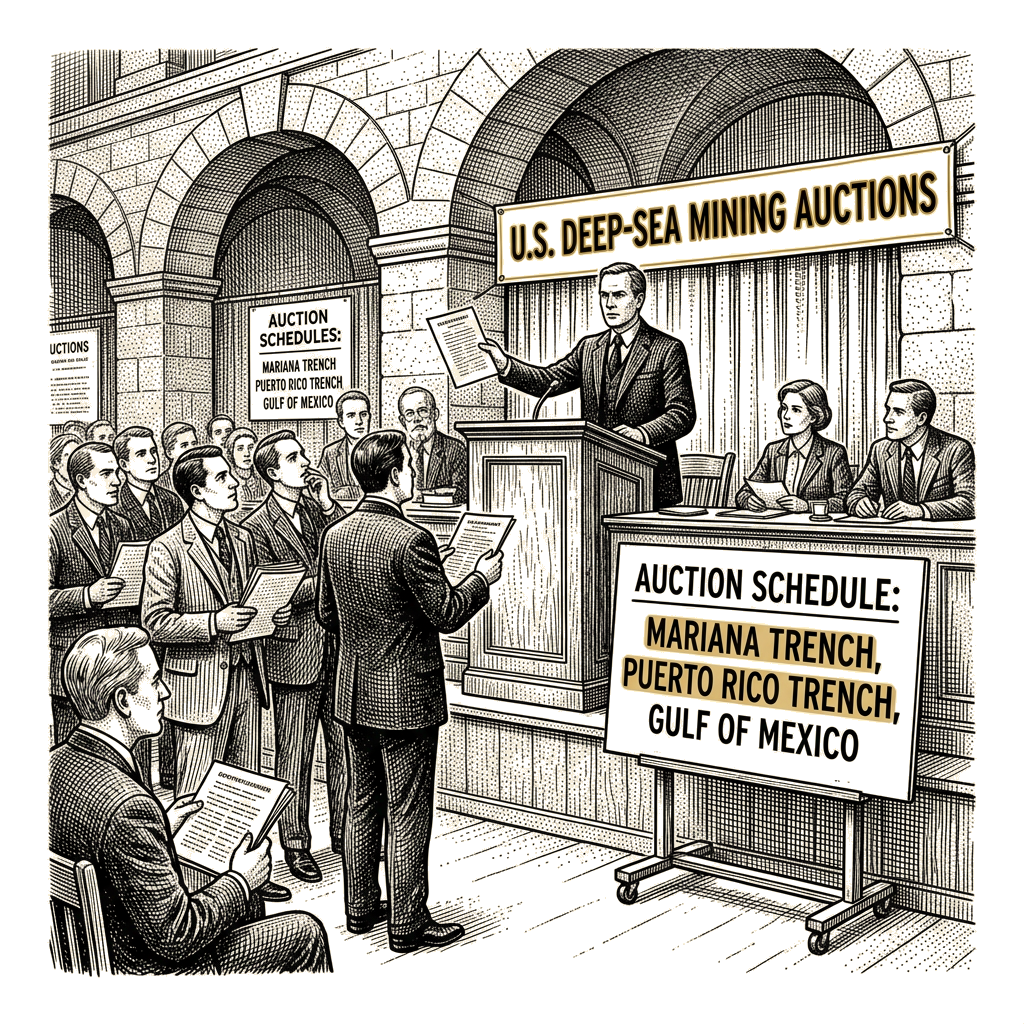
The Trump administration has taken a major step forward this year by scheduling a series of auctions for U.S. seafloor leases. The first auction, covering waters near American Samoa, was scheduled for Thursday in Thousand Oaks, California, while another for five parcels near the Northern Mariana Islands has been proposed for December. The Associated Press described the targeted waters as some of the most pristine areas of the Pacific and said the two territories are thousands of miles from where decisions affecting their islands are made. If the auctions proceed, companies will compete for 20-year leases granting an exclusive right to mine commercially if the work receives further environmental approval. A legal battle now makes it unclear whether the American Samoa auction will proceed. On Monday, a judge ruled the government violated the Endangered Species Act by failing to consider the full impacts of a deep-sea mining lease. By Wednesday morning, the Trump administration had yet to delay the auction, and two other lawsuits were pending. For an opening bid of $3 million, the administration was offering the 20-year leases, with two seafloor areas of more than 15 million acres each available for bidding.
Commercial extraction is not beginning with the sales. “A lease sale is not a mandate to mine. Any future extraction would require additional environmental review and regulatory approvals, informed by engagement with local communities,” White House spokesperson Taylor Rogers said in a statement to The Associated Press. Rogers also said, “President Trump recognizes the enormous potential of America’s offshore critical minerals to drive technological innovation, economic prosperity, and national security.” If a lease is granted, the United States would join a handful of countries that have allowed companies to explore their waters for deep-sea minerals. Most mining techniques would deploy underwater vehicles thousands of feet deep to vacuum up rocks and sediment from the ocean floor. Under most proposals, those rocks would be filtered and returned to a mining ship, with unwanted debris released back into the ocean. Elizabeth Klein, a former Bureau of Ocean Energy Management director, said a granted lease would be difficult to undo under a different administration. The government would have to justify cancellation at a hearing and face potential litigation.
Deep-sea mining has become part of President Donald Trump’s push to expand U.S. control over minerals critical to technology and defense industries. In April of last year, he directed the administration to expedite the search for those metals on the ocean floor, both within and beyond U.S. borders. The minerals sought include nickel, cobalt, manganese and copper, used in products ranging from smartphones to electric vehicles. They have concentrated over millions of years along the ocean floor and the volcanic crusts of seamounts, and it is unclear how abundant they are near American Samoa and the Northern Mariana Islands. Auctions for the seabed near Virginia and Alaska could take place next year, while the National Oceanic and Atmospheric Administration is reviewing permit applications from companies that seek to mine in international waters.
Located in the Pacific Ocean between Hawaii and Australia, American Samoa and the Northern Mariana Islands are two separate chains of volcanic islands that both endured occupations by colonial powers before becoming U.S. territories. Despite economic challenges and a slowly shrinking diaspora, the territories have kept alive traditions that tie them to the ocean and remain sacred to the Indigenous peoples who first made the region’s islands home. The territories’ residents depend on federal aid and have neither a voting representative in Congress nor the right to vote for president. Opponents have tried to stall the auctions by rallying public comments criticizing the move. “When they ask us for public comments, it always feels like we’re just screaming at a moving train,” said David Cabrera, who leads a group seeking to revive Indigenous forms of fishing in Saipan, the main island of the Northern Marianas. The U.S. waters surrounding American Samoa include Rose Atoll, an uninhabited island named for the pinkish hue of its coral reefs and an important habitat for seabirds. Waters around the Northern Marianas include parts of the Mariana Trench, the deepest place on earth. Both are protected by marine monuments that now border the proposed mining areas.
At Fatumafuti Beach, Sabrina Suluai-Mahuka sat in the shallows as her 4-year-old daughter, Erhys, splashed through clear water on a Little Mermaid kickboard. Below, iridescent blue and rainbow-streaked fish moved through fields of coral. Suluai-Mahuka had decided to travel to California despite the long hours it would take to get there, and she and her team at Finafinau, the environmental group she founded, were working to bring people from across the Pacific community to protest alongside them. She planned to carry a bottle of seawater so members of the Samoan diaspora could touch and connect with the waters she was fighting to protect. “If these people are going to be selling our ocean, they’re going to see our faces when they do these bids,” she said.
Suluai-Mahuka said: “We would be giving up a piece of ourselves that we cannot get back.” She founded the environmental group Finafinau, which takes its name from the Samoan word for resilience. Suluai-Mahuka said deep-sea mining goes against everything she stands for and against the Samoan way of life, which revolves around the ocean. Her examples included diving among corals, swimming and relaxing, fishing for local delicacies and participating in the commercial tuna industry that sustains the local economy. In Samoan legend, the world began as only the heavens and the ocean. She said all of that was at risk.
Malouamaua Tuiolosega, a representative of an ancient governing council in the territory’s eastern islands of Manu’a, said: “The ocean is life. It’s sacred to us.” He added: “We lose the ocean, we lose life.” Tuiolosega represents the ancient governing council of Manu’a, the closest inhabited areas to where deep-sea mining leases could be granted, about 100 nautical miles from its shores. About 800 people live across its three islands, which are isolated by infrequent transportation to the capital city of Pago Pago, and residents depend even more heavily on the environment for survival. Since long before American Samoa became part of the United States, the council’s chiefs have overseen the islands’ resources, which they understand to be in delicate balance with people. “If more is taken from the islands than is needed to survive, you violate the relationship and the trust between the people and its resource, and then it disappears,” Tuiolosega said. He sees the same push toward exploiting the oceans behind deep-sea mining as he does the Trump administration’s efforts to open marine monuments in the Pacific Ocean to commercial fishing. The governing council, the Faleula o le Manu’atele, has joined one of the lawsuits against the Trump administration over the upcoming lease sale.
Cecilio Raiukiulipiy worries that deep-sea mining threatens another tradition: navigation by the sea and stars. Raiukiulipiy was granted the title of navigator in a special ceremony in 2018. Once he accepted the title, he said, “it’s your responsibility to keep the knowledge, to pass it on, and to take care of your people, all the people in the islands and also the environment.” Several times per year, his voyages take him across the Mariana Trench, adjacent to where the Trump administration could green-light seabed mining. On the western side of the trench, he said, the water is colder and the waves churn like a washing machine. The area is home to “all kinds of whales” and where seafood come to spawn, he said. He has seen baby eels swimming north toward the waters of Japan.
“Those are indicators that we are on the right course,” Raiukiulipiy said. Known as seamarks, or living waypoints, they derive from deep-seated knowledge of the seaways in his part of the world. Raiukiulipiy belongs to one of the groups suing the Trump administration to try to stop the auction off the Northern Marianas next month. Like many around him, the ocean is also sacred to Raiukiulipiy, whose community believes their ancestors come from deep in the ocean. “We usually do our burials in the ocean,” he said. “We bury them back.” He also said of the federal government in Washington: “They don’t understand how we live. They’re looking at it with a dollar sign. Us, we look at how we’re going to survive, how we are going to live, how we are going to eat.” Zeno Camacho Deleon Guerrero Jr., a resident of the Northern Mariana Islands and a board member of the nonprofit Micronesia Climate Change Alliance, said: “It’s cold comfort.” He added: “Once you find what you want, you’re going to get it. You’re going to start mining.” The nonprofit focuses on protecting the region’s environment and people.
Although no company worldwide has started commercial mining operations in the deep sea, a crop of U.S. startups, buoyed by the president’s policies, hopes to soon change that. American Samoa and the Northern Mariana Islands each face economic challenges and have populations of 50,000 that are slowly shrinking as their diasporas contract. Some supporters believe deep-sea mining could become an important income stream for American Samoa if the territory became an industry hub. John Wasko, executive director of the American Samoa Economic Development Council, a group promoting industry on the islands, said: “If we don’t look for some kind of manufacturing process, something that people will buy, we’re going to be destitute. We’re going to be broke.” Suluai-Mahuka and others do not buy the promises of jobs and investments. The deep-sea mining startup Impossible Metals, which has signaled interest in the upcoming auction, has offered to share 1% of any future profits with the American Samoan community.
Although the Marine Minerals Administration will ask companies to “make every reasonable effort” to hire employees from the territories and support “community well-being,” the regulations do not include binding requirements or numeric targets. There is also no guarantee of economic gains. The federal government would collect the winning bid amount, regular rent payments and company royalties over the life of a lease, but no mandates require the government to share mining earnings with local territories or states. That differs from offshore oil and gas drilling, where Gulf states receive 37.5% of revenue.
A major question for local government is whether a deep-sea mining lease will hurt American Samoa’s tuna fishery and force the closure of the last remaining cannery. Purse seine and longline fleets supply tuna for the local StarKist plant, with the longline fleet fishing entirely in U.S. waters, including the areas up for leasing. Nathan Ilaoa, director of the American Samoa Department of Marine and Wildlife Resources, said his agency was hoping for a “more exhaustive” review of potential impacts to the fishery before the auction. He said he did not yet have answers on whether contaminants or sediment plumes from disrupting the ocean floor would alter tuna migration. “We’re extremely concerned that the disappearance of our longline fleet could translate into the cannery leaving American Samoa, which would be an economic disaster for the territory,” Ilaoa said.
American Samoa’s leadership opposed deep-sea mining when word of company interest began reaching its shores. In 2024, the territory issued a moratorium on mining in the waters it controls, which extend from shore out to 3 nautical miles, or 5.5 kms. The territory has little say over activities in federal waters beyond that line. When the auction was proposed last year, Gov. Pulaali’i Nikolao Pula, a Republican, wrote to the Bureau of Ocean Energy Management that he and all chambers of local government unanimously opposed the plan, as did the vast majority of residents. The governor now welcomes the auction, according to a Monday statement: “This is a historic moment for American Samoa and for our nation.” A Marine Minerals Administration spokesperson said the agency had carefully considered the governor’s feedback and would incorporate it into lease and post-lease actions “to the maximum extent practicable.” Those actions include sharing the locations of deep-sea mining ships, coordinating with fishing vessels and reviewing any impacts to fish habitat. The agency said it supports sharing deep-sea mining revenue with territories and is working with lawmakers and Department of the Interior leadership to obtain authority to do so. It did not answer questions about why the auction was arranged thousands of miles from American Samoa or how it weighed local opposition.
Residents of the Northern Mariana Islands are closely watching events in American Samoa as they brace for a potential auction near their islands. The proposal has come after two super typhoons battered the territory in April and July. The territory’s government is in fiscal crisis, with Gov. David M. Apatang warning of austerity measures after a five-day shutdown in October. Many public schools suffered broken windows and damaged roofs from the storms, while residents face rising electricity costs from the territory’s sole energy provider. “It’s very overwhelming for everybody here in this region right now,” Cabrera said. “You just want to worry about keeping your lights on and putting food on the table, so it’s a challenge to get support for anything other than that.” Born and raised in Saipan, Cabrera is descended from the Indigenous Carolinian and Chamorro peoples. He served in the U.S. Navy for seven years and worked in the United States mainland before returning home. He founded the Talaya Club to teach people on the island to fish with traditional nets known as talayas that are cast into the ocean surf. His long-term goal is to reduce island families’ dependence on imported food, a mission he said sediment plumes could endanger. “That will inevitably impact our fisheries and the health of our fisheries, and thus the health of our people,” Cabrera said. Residents of Saipan have previously opposed U.S. government plans, including a proposal to turn the island of Pagan into a firing range for thousands of troops. The Navy formally abandoned those plans in July after more than a decade of community pushback.
The Northern Mariana Islands government initially reacted with a measured tone. Gov. David M. Apatang, an independent, and Kimberlyn King-Hinds, the Republican nonvoting congressional delegate, said they neither supported nor opposed deep-sea mining. But after the federal government doubled the leasing area in March to include waters both east and west of the territory, Apatang opposed the auction, according to Henry Hofschneider, the governor’s chief of staff. The expanded area is 57 miles from Saipan and 46 miles from Guam. Apatang said he has faith in the rule of law and believes federal regulations will protect the marine environment, and he asked the Marine Minerals Administration to consider pausing the auction until the various lawsuits have been heard and decided. In September, King-Hinds introduced a House bill seeking to distribute 50% of federal deep-sea mining revenues to the nearest territories.
The auctions advance the administration’s mining policy without starting commercial extraction. A winning bidder would begin exploration and hold a conditional commercial right, while any extraction would still require additional environmental review and regulatory approvals. Klein said a granted lease could be difficult for a later administration to reverse, and Rogers said local engagement would inform the additional approvals. As of Wednesday morning, the American Samoa auction was still set for Thursday in Thousand Oaks despite Monday’s ruling and two pending lawsuits. The Northern Mariana Islands auction for five parcels remained a proposal for December, with Raiukiulipiy’s group among those suing to stop it.