The ruling orders reparations as enforcement remains limited
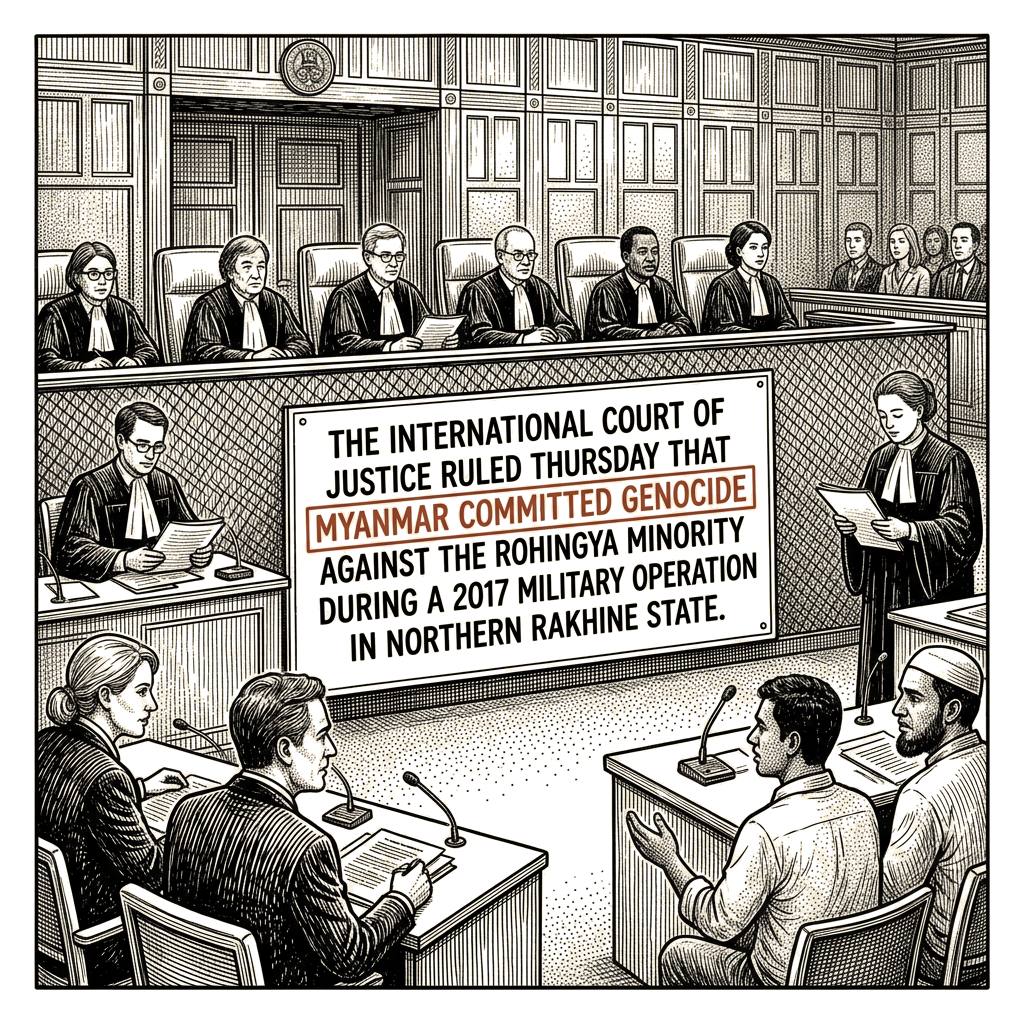
THE HAGUE, Netherlands — The International Court of Justice ruled Thursday that Myanmar committed genocide against the Rohingya minority during a military operation in northern Rakhine state in 2017. In a 9-6 decision, the 15-judge panel found that Myanmar’s security forces committed genocide in violation of the Genocide Convention and ordered safe, voluntary and dignified return for those who fled. The judgment is legally binding, but the court has no way to enforce it beyond reporting noncompliance to the U.N. Security Council.
International Court of Justice President Yuji Iwasawa said the court, in a 9-6 decision, found that Myanmar “has committed genocide against the Rohingya group in northern Rakhine state, in violation of its obligations under the Genocide Convention.” The panel included Navi Pillay, an international jurist who won the Nobel Peace Prize last month.
The court rejected Myanmar’s defense that the 2017 campaign was a legitimate operation against insurgents. Myanmar had launched what it called a clearance campaign in Rakhine state in August 2017 in response to an attack by a Rohingya insurgent group. The operation led to accusations that security forces committed mass rapes and killings and burned thousands of homes. To establish genocide under the 1948 convention, the court had to find an intent to destroy the Rohingya “in whole or in part.”
Iwasawa said “the court finds that Myanmar’s security forces killed thousands of Rohingya civilians, perpetrated widespread acts of sexual violence, as well as acts of extreme violence against children, and attacked fleeing Rohingya as they sought to flee in large numbers.” The court said the evidence showed Myanmar forces killed about 10,000 Rohingya.
The court ordered Myanmar to commit to reparations, including allowing Rohingya “safe, voluntary and dignified return to their place of residence.” Myanmar must also investigate, prosecute and punish people found to have committed genocidal acts and pay compensation to the Rohingya. The amount of compensation will be decided in later court proceedings.
The court’s enforcement authority remains limited. Its decisions are final and legally binding, but it has no way to enforce them beyond reporting noncompliance to the U.N. Security Council. Shortly after the ruling was read, U.K. Foreign Secretary Ed Miliband said his government was expelling Myanmar’s defense attache from the U.K. and “calling urgently for a U.N. Security Council session to discuss the judgment.” There was no immediate reaction from Myanmar’s delegation in The Hague or from the government in Myanmar.
About 1.2 million Rohingya refugees now live in Bangladesh, primarily in crowded camps across Cox’s Bazar district. The refugees endure harsh conditions marked by fire hazards, infectious diseases, monsoon landslides, inadequate sanitation and strict work restrictions.
Lawyers and Rohingya attendees hugged and cried after the hearing, and some of the attendees had traveled thousands of miles (kilometers) to attend the reading. Yasmin Ullah, a Rohingya rights activist who sat in the court’s wood-paneled Great Hall of Justice for the nearly three-hour reading, said: “I’m beyond ecstatic today, hearing the judgment, being read out in detail. A lot of those moments and instances that the judges really went into detail, it really validates the kind of experience that Rohingya have.”
In Cox’s Bazar, Bangladesh, Rohingya refugee Mohammad Rofik welcomed the recognition of the group’s plight. “Today, the world could recognize and give the victory to the Rohingya community, not only the Rohingya community. It is the victory of the whole community of … Myanmar,” he said.
An umbrella organization of Myanmar opposition groups said in a statement that “the struggle for justice will continue, and this judgment must now be enforced,” calling on the international community to ensure it is fully implemented. U.N. Secretary-General Antonio Guterres called the ruling “a demonstration of international justice and a reaffirmation that impunity for such horrific acts must not stand.”
The Muslim-majority nation of Gambia launched the proceedings in 2019, two years after it peacefully ousted longtime military dictator Yahya Jammeh, who committed widespread abuses against civilians. Since then, there has been a push for accountability for the crimes committed by Jammeh’s regime. Outside the courtroom, Gambian Justice Minister Dawda Jallow paid tribute to the Rohingya. “The victory belongs to the Rohingya. They survived, they testified, and today they were believed. Many of them are here with our delegation from across the world and from the refugee camps in Cox’s Bazar. Their courage made this judgment possible,” he said.
In a 2007 judgment, the court said Serbia “violated the obligation to prevent genocide” in the 1995 Srebrenica massacre, when Bosnian Serb forces murdered some 8,000 mostly Muslim men and boys in the Bosnian town. The Myanmar judgment comes as the court also handles genocide allegations linked to the Gaza conflict and the war in Ukraine. South Africa has accused Israel of breaching the genocide convention during its offensive in Gaza, a claim Israel vehemently denies, and that case is years from completion. Ukraine also has a case pending against Russia; shortly after Moscow’s full-scale invasion in February 2022, Kyiv accused Russia of fabricating genocide claims against Ukraine to justify the attack.
Maria Elena Vignoli, senior international justice counsel at Human Rights Watch, said: “The International Court of Justice’s landmark ruling is long-awaited recognition of the suffering the Rohingya have endured from Myanmar’s military. The ruling also provides a significant precedent for victims of genocide, and other grave crimes, across the world in their own quest for justice.”