Lincoln declared it national, hoping to unite a country divided by civil war
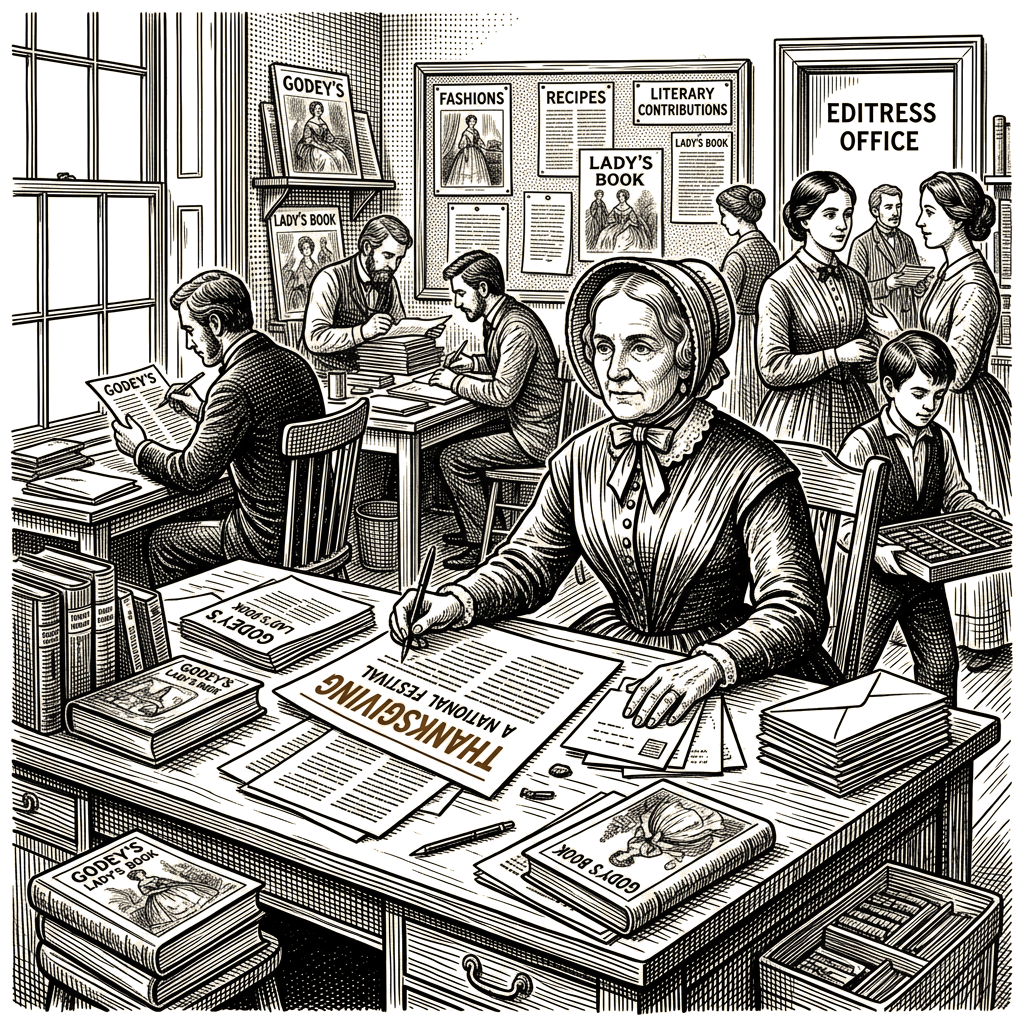
Thanksgiving as Americans know it — turkey and cranberry sauce on the table, pies decorated with a Mayflower or a cornucopia worked out of pastry — was largely the creation of one woman. Sarah Josepha Hale was born in New Hampshire in 1788 and in the 1830s became editor of Godey’s Lady’s Book, which had the largest circulation of any U.S. magazine before the Civil War.
The holiday did not arrive as a single coordinated observance. The Pilgrims and Puritans who began arriving in Massachusetts shortly afterward regularly held fasts and feasts: on fast days the community atoned for sins they believed they had committed, and on feast days they gave thanks to God. Some governors of colonies, and later of states, declared fall holidays of thanksgiving, but they did not coordinate with each other.
The 1621 harvest at the center of the schoolroom story is thinner in the record than the story suggests. The only existing eyewitness account of the event does not say much about what was eaten; a slightly later account of the harvest mentions seasonal food such as venison, corn and, yes, turkeys. The straight line drawn from that meal to today’s dinner is, Mehta writes, an American myth — a story created in the 19th century to unify a nation and long used to assimilate new immigrants into it.
Godey’s carried clothing patterns, recipes, articles on home management, essays on educating children and fiction. Hale believed the woman was the heart of the home and responsible for creating an upstanding, God-fearing, wholesome family, and she was deeply committed to her young country, believing that homemakers could help create its national identity.
According to historian Elizabeth Pleck, Hale began publishing editorials calling for a national Thanksgiving, along with instructions for what the day could look like. The magazine taught readers how to celebrate it, printing recipes for seasonal food such as turkey and cranberry sauce. The centerpiece of the table was the pies, which featured elaborate pastry decorations: the Mayflower or a cornucopia, created out of pie crust. The full table was a celebration of “women’s work,” at a time when the Industrial Revolution was shifting the economy toward factories and other business, making the importance of unpaid domestic labor less obvious.
Hale’s idea of Thanksgiving also emphasized returning to loved ones, as those factories were drawing many workers away from home. She saw it as a day to tell family stories — and the story of the nation, starting with the first Thanksgiving.
Hale petitioned five presidents to declare Thanksgiving a national holiday. Abraham Lincoln finally took her up on it, hoping that a national holiday emphasizing the country’s origin story would prove uniting during the Civil War.
Northern women sent pies to the families of soldiers and turkeys to the men at the front. Pleck notes that abolitionist Sojourner Truth went door to door, collecting funds to provide Thanksgiving dinners to African American troops.
The holiday caught on gradually. Given the Protestant origins of early Americans’ feast and fast days, Catholics were slow to embrace it. Given its association with Lincoln and the war, the South was also late to adopt it. And given the day’s emphasis on family, it was less celebrated on the frontier, where single men dominated.
Before long, Thanksgiving was also seen as a way to assimilate immigrants. That vision was in part popularized by the political cartoonist Thomas Nast. “Uncle Sam’s Thanksgiving Dinner,” which appeared in Harper’s Weekly in 1869, depicted Americans from any number of races and ethnicities in their national dress: men, women and children sitting as equals around a dinner table, with portraits of presidents on the wall, while Uncle Sam carved a turkey. The image suggested that immigrants could be incorporated into the nation — and formerly enslaved people, too. It was printed just one year after the 14th Amendment granted citizenship to anyone born in the U.S. and four years after the 13th Amendment formally ended slavery.
Nast’s image contrasted sharply with another cartoon, also called “Uncle Sam’s Thanksgiving Dinner,” that G.F. Keller drew for the San Francisco Wasp eight years later. Keller’s disheveled and entirely male collection of diners each ate their own national food, or offensive stereotypes thereof, suggesting immigrants could never truly become American.
Many Americans believed they could — although they demanded most immigrants give up their “Old World ways” and take on the customs of their new country. Thanksgiving was part of the engine of that assimilation.
In the early 20th century, public schools taught about Thanksgiving and sent children home with recipe cards so that their parents could cook the same kinds of recipes Hale had popularized in the previous century. Schools framed the Pilgrims and their first Thanksgiving as the spiritual, if not literal, ancestors of all Americans: the first “immigrants.” They did not dwell on how the Pilgrims’ arrival looked more like colonization than immigration. By the 1920s, Thanksgiving was the most celebrated holiday in public schools. Pleck quotes one Jewish immigrant reflecting on his childhood and saying the Pilgrims were a way to connect “us offspring of Jewish immigrants — our own exiled fathers who had crossed the seas — and the traditions of Protestant America.” Students acted out the first Thanksgiving and were told they belonged to a “nation of immigrants.”
While some immigrant parents rejected the holiday, others embraced it, with spins to make it their own, and many served a turkey surrounded by the celebratory dishes of their own cultures. The fact that most families celebrate at home allowed immigrants and their children to take part in the national culture while still expressing their own. For Jews, the early 1900s invention of Crisco as a nondairy butter substitute allowed them to create a truly “American” Thanksgiving and dessert without violating kosher rules against mixing meat and milk.
Mehta describes her own New England childhood: an Indian neighbor took her mother’s fairly classic cranberry relish and, by the end of the weekend, had worked out a cranberry chutney with Indian spices. At Thanksgiving dinner with her parents’ friends the Stalzmans, who were Jewish, matzah ball soup was the opening course.
At times, the idea of the Pilgrims arriving on the Mayflower has been used to exclude — to imply that only Americans whose literal ancestors came over on the ship, and other white Protestants like them, truly belong. Yet on the holiday in their memory, Mehta writes, generations of new Americans affirmed that they, too, belonged.