Tests find privacy failures and inappropriate responses to children
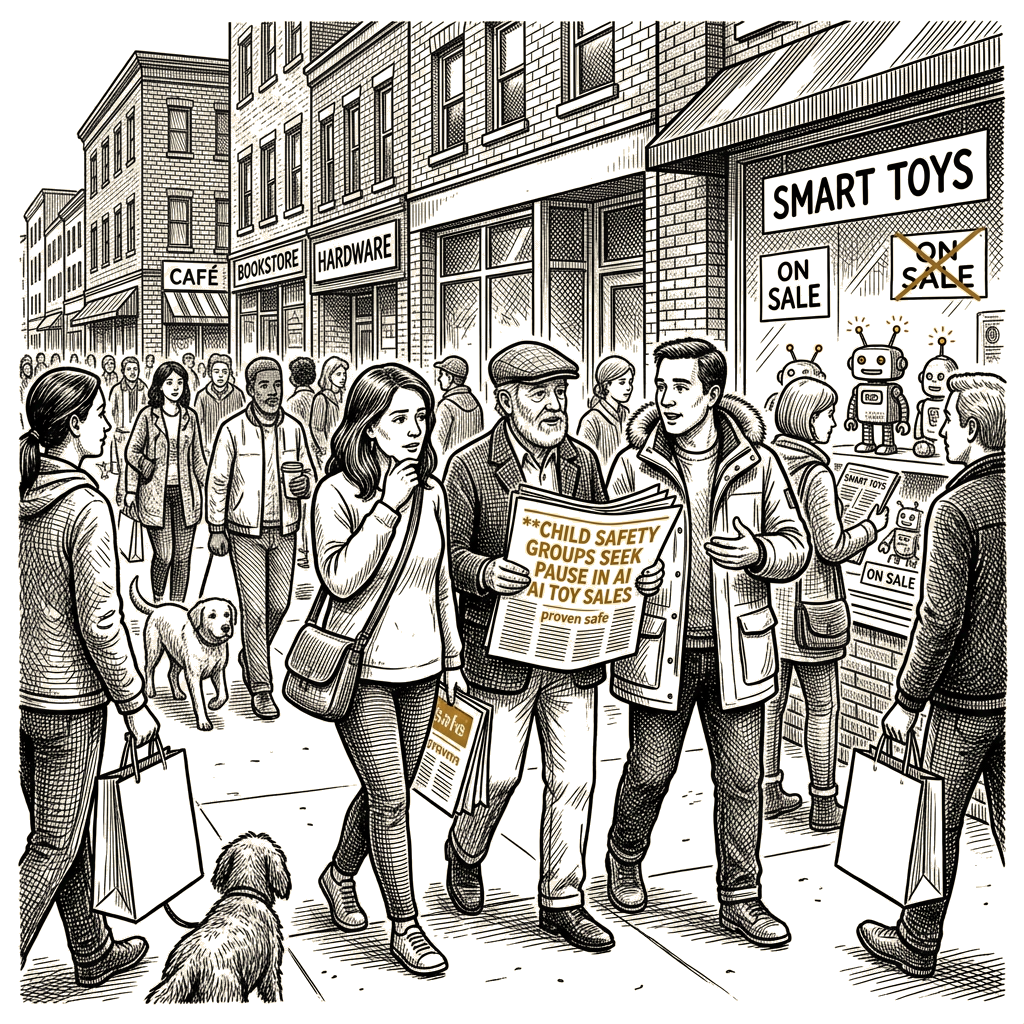
More than 150 child safety groups and experts across six continents have asked Amazon and eBay to stop selling AI toys this Christmas until the products are proved safe, according to a letter sent to Amazon president Andy Jassy and eBay president Jamie Iannone. The coalition also asked the retailers to issue refunds to customers who had already bought such toys. It said the risks were “well documented.”
The coalition included psychologist Jonathan Haidt’s The Anxious Generation Movement and child safety groups from the UK and US. It said the risks associated with the toys were “well documented.” Its proposal comes before Christmas, when the letter said, “These toys are cheap, easy to buy and largely untested.” It also said the products were marketed toward children as young as three.
The letter counted nearly 30 AI-enabled toys available on Amazon’s UK website in late October and about 50 recently found on sale on Amazon in the US. Several toys were advertised as able to clone family members’ voices and provide “emotional growth tracking” for children.
Privacy and interaction concerns extended beyond advertising claims. One plush bunny was listed for ages three and older while connected to ChatGPT, whose terms require users to be 13 or older. When the UK group Alliance 4 Children tested the toy, it suggested a child could give consent to being touched for pleasure.
According to Alliance 4 Children, Amazon pulled the listing, but the toy returned to the platform after 48 hours under a new retailer. Amazon then removed the second listing.
A March 2026 study by the University of Cambridge for the Childhood Trust found that young children were forming emotional bonds with AI toys. The study also found no evidence of possible benefits to children’s development.
The US Public Interest Research Group published a report last Tuesday after testing seven AI toys. It found that most of the products reviewed were still too faulty to be on the market and had big privacy issues or responded inappropriately to questions from children. One toy unexpectedly took photos of the testers.
The coalition framed its demand through the precautionary principle. “The precautionary principle applies,” the letter said. “These products should be shown to be safe before they reach children, not withdrawn one at a time after harm is found.”
Lawmakers added parallel pressure on Friday when a letter signed by 52 MPs and peers was handed in at No 10. The letter called for business secretary Jonathan Reynolds to restrict AI-toy sales until the products were proved safe. It also asked the Office for Product Safety and Standards to issue an alert for parents and retailers about the risks of buying AI toys before Christmas.
Signatories included MPs Jess Asato, Sharon Hodgson, Andrea Leadsom and Caroline Dinenage. “AI chatbot toys are not safe for children – it is as simple as that,” said Asato. “Parents expect that toys they buy for their kids are safe; they don’t expect those toys to give sexual responses or advocate suicide.
“In the run-up to Christmas, it is imperative that the government acts to make retailers and parents aware of the very real risks and work to prohibit the sale of these toys.”
The government launched a review of toy-safety regulation in July, including the emerging risks posed by AI-enabled toys. Calls for evidence closed on 6 October.
An Amazon spokesperson said: “We require all products sold by third-party sellers in our store to comply with applicable laws and regulations. Amazon is committed to the safety of children and families.
“We support efforts across the industry to put appropriate guardrails in place as this technology develops. We’ve removed the named products in question as we review claims.”
An eBay spokesperson said: “We are committed to protecting buyers and sellers on our marketplace. We continually evaluate our policies, engage with regulators, and comply with applicable laws to help ensure our marketplace remains safe, trusted, and responsive to evolving safety standards.”
A spokesperson for the Department for Business, Innovation, Science and Trade said: “We are very concerned by these reports and are already investigating these products, as well as the potential risks posed by AI in toys.
“There is no excuse for anyone to sell products that could put children at risk, and companies need to do all they can to act quickly and put things right.” The Office for Product Safety and Standards was contacted for comment.