Administrative reviews can allow projects to skip resident notice and hearings
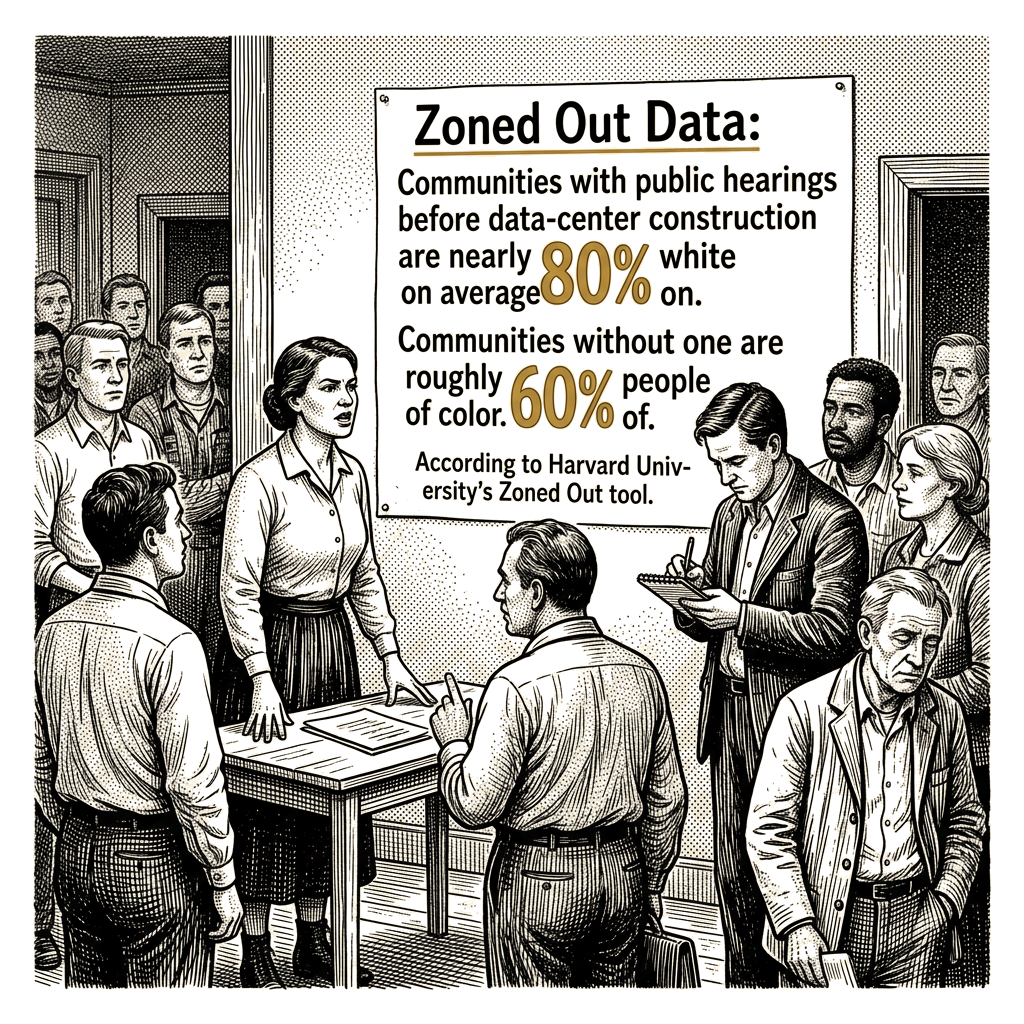
The public-hearing divide begins with who gets a chance to participate. Communities that received a hearing before construction are nearly 80% white on average, while communities without one are roughly 60% people of color. According to Zoned Out, a tool created by researchers at Harvard University, data centers were blocked 66% of the time when communities received a hearing and approved 80% of the time when they did not.
Zakiya Mabery’s experience shows how that divide reaches an individual neighborhood. She bought a home in Hayne’s Station, a new Augusta, Georgia, housing development, only months before Project Eisenhower, a $2 billion, 200-acre data center just a 10-minute walk away, came to be. Officials had first authorized the facility in 2022 without the public hearing that would have allowed the community to voice their concerns; construction began earlier this year. About two-thirds of the people who had moved into Hayne’s Station were Black.
Mabery said, “We would’ve never purchased a house if we knew a data center was coming.” At an Augusta Planning Commission meeting this past summer, she also said: “It seems like (processes) are being built to silence citizens.” Her experience reflects a broader pattern: majority-Black communities are more than two times more likely to host a data center than majority-white communities and are far less likely to hear about a project before approval or offer an opinion through public comment. In recent years, dozens of AI data centers in communities home to hundreds of thousands of Americans have been approved without a public hearing.
A collaboration between Capital B, the Pulitzer Center and The Associated Press characterized the pattern as an extension of environmental racism that has affected Black families for generations. It said Black communities are hosting infrastructure that generates wealth elsewhere while living with the pollution and disinvestment that undermine economic opportunity and contribute to poor health outcomes and premature deaths.
Aino Halonen, a former AI worker who led the Harvard study, said: “We know disparities already exist in our communities, and now in the case of data centers, we’re seeing the targeting that happens without any say. It is systemic injustice.” The disparities also appeared during November’s midterm election. More than 40 jurisdictions nationwide allowed voters to decide through ballot measures whether they wanted data centers in their communities; White residents made up an average of more than 83% of the population in those places, compared with less than 5% for Black residents.
The Trump administration ordered agencies to exempt data-center projects from federal environmental review and revise federal rules to accelerate construction, while pushing agencies to limit opportunities for public comment. President Donald Trump cast AI dominance as a competition the United States cannot afford to lose to China as tech companies pour hundreds of billions of dollars into new infrastructure.
Data centers have increased PM 2.5 air pollution, according to the report. Black Americans die from PM 2.5 at the highest rate in the United States, and the particles can penetrate deep into lungs and the bloodstream, causing respiratory and cardiovascular disease. PM 2.5 exposure is linked to asthma attacks, strokes, dementia and cancer. Carbon emissions from data centers are also connected to the intensification of climate change: America’s largest data centers are responsible for an estimated 25.7 million metric tons of climate-change-causing carbon dioxide emissions annually, more than emissions from entire countries such as Kenya and Guatemala.
Augusta resident Charles Zabel said about the data center: “These are not emotional concerns. This is where we live. We invested here. We live and bear the impact here.” He continued: “We ought to have a voice in this. So far, we have not had a meaningful voice in this discussion. Representation does not mean protecting a project. Representation means protecting the people who already call this place home.” Researchers at George Washington University Law School joined American University researchers to analyze the placement of more than 5,200 data centers in the United States.
The researchers accounted for income, population density, home values and proximity to major power lines, then compared neighborhoods within the same state to test whether economics or geography explained racial disparities in where data centers were located and the benefits communities received. Even after those adjustments, neighborhoods with larger Black, Latino and Asian populations remained most likely to have negative experiences with data centers. Dhanaraj Thakur, director of the Fair Technology Initiative at George Washington University, said: “Even when you control for all of that, race stands out.” He added: “I think it’s important to show that this is not some anecdotal thing that’s happening in a few cities like Memphis or elsewhere.” He said, “It’s actually happening across the country.”
The mechanism often begins with zoning. Long-standing segregation and redlining have left Black people far more likely to live in communities that contain tracts zoned for industrial use. A data center that requires rezoning from commercial to industrial generally faces public notice, a hearing and a vote; when land is already zoned industrial, developers can secure permits through administrative review without opportunities for residents to intervene. Capital B has reported cases in which developers pursued projects in poorer, majority-Black neighborhoods with more lax hearing requirements after encountering opposition in wealthier, whiter areas.
In one North Carolina example, thousands of residents submitted signatures and comments against a data center proposed in a wealthy, 65% white community, and the developer withdrew the project. Weeks later, the same developer moved it to another county, where the closest neighborhood was predominantly Black and its median income was just one-third of the former community’s. Commissioners quickly approved the project in a 6-1 vote.
The study also found that communities of color are less likely to receive major economic benefits. Campuses operated by Meta, Google and Microsoft are more likely to generate property-tax revenue and implement community benefit agreements, but those campuses are also more likely to be in majority-white neighborhoods. The researchers wrote that the pattern raises the prospect that communities of color are shouldering the financial and environmental burdens of data-center development writ large without the same potential financial rewards. Thakur said: “A lot of the rhetoric coming from industry is that there are lots of economic benefits from data centers — tax revenue and job creation.” He continued: “These are what the industry groups promise, even though we’ve seen a lot of contradictions to that. But even if you do accept that as fact, the research shows that communities of color are less likely to receive those benefits.”
Workforce representation is another gap documented in the reporting. Some analyses put Black workers at 7% of AI workers, compared with 13% of the general population. For one week last fall, Capital B spent every morning and evening outside Meta’s data center in northern Louisiana, described as the largest project in North America. The two closest towns were more than 80% Black. Capital B said none of the workers it spoke to or saw drive off in Ford F-150s were Black.
Advocates and politicians have framed the fight against data centers as crossing all racial and political boundaries. Roughly 70% of Americans opposed data centers nationwide, but researchers said that framing the struggle as an “American problem” erased the racial inequities within the boom. Communities highlighted in media coverage of resistance were about 79% white on average, compared with 53% white in communities without recorded opposition. The researchers attributed the disparity to unequal media coverage, political influence and organizing resources. Thakur said: “It’s interesting that only some communities are being highlighted as opposing it.” He said selective attention was erasing “the nuance and racial inequality” at the heart of the boom. Capital B has highlighted Black communities fighting data centers from Memphis to Maryland and Mississippi.
In Augusta, where the community closest to the massive data-center site is 67% Black, residents say they are committed to fighting for a say. This summer, the board of commissioners approved a temporary moratorium on data-center development, but the $2 billion Project Eisenhower construction was not included in the blockage. “We are asking for respect,” Mabery said.