PROTECT Act bars most warrantless civil arrests in sensitive locations
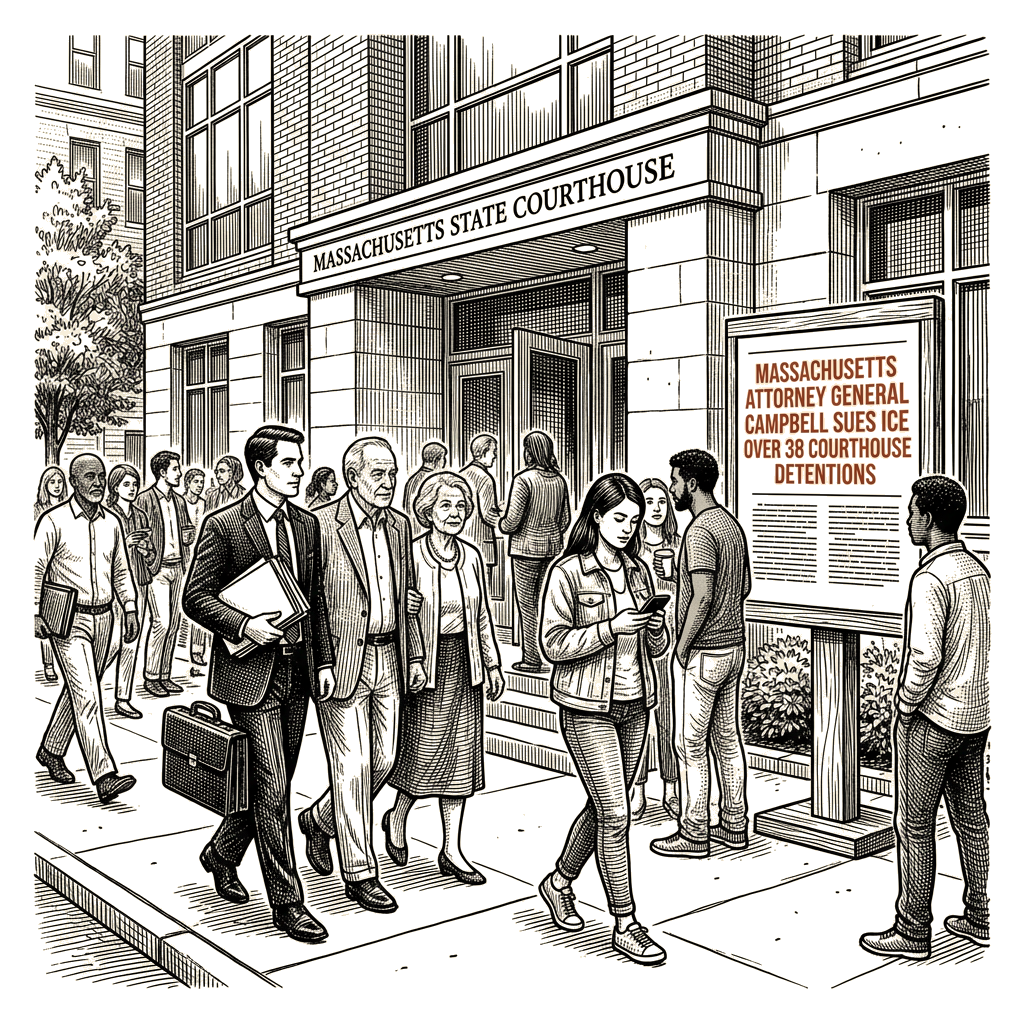
Massachusetts Attorney General Andrea Campbell sued federal immigration authorities on Monday, asking a Boston federal judge to block a directive she says authorizes warrantless civil arrests at state courthouses and to declare that such arrests are prohibited unless state law permits them. The suit followed public complaints that ICE was violating the state law. Campbell argues that the directive violates federal law and the U.S. Constitution. Federal immigration agents have detained 38 people on Massachusetts courthouse grounds since a state restriction on those arrests took effect on Nov. 3.
The restriction comes from the PROTECT Act, signed into law on Aug. 5. The law immediately prohibited most civil arrests, including immigration arrests, without a judicial warrant or court order in “sensitive locations” including public K-12 schools, licensed child care centers, health care facilities and state property. A provision restricting courthouse arrests took effect on Nov. 3.
Federal agents began detaining people at courthouses within hours of that cutoff. A man was detained at a Chelsea courthouse, and the state Trial Court said four other people were arrested the same day. Dozens more were detained over the following two weeks in courthouses in Chelsea, Framingham, Marlborough, Peabody and Medford.
Immigration agents made 614 arrests on Massachusetts courthouse grounds last year, according to the Trial Court. ICE officials did not immediately respond to a request for comment, but the agency has previously said detaining people at courthouses is a “common-sense” move, because people there are already correctly identified and screened for weapons. In an October press release announcing the arrest of a Dominican man, ICE criticized the state law. “Time and time again, sanctuary politicians in Massachusetts have made the dumbfounding choice to prioritize dangerous criminal illegal aliens rather than their law-abiding American citizens,” said acting ICE Boston Field Office Director Joseph Sher.
The PROTECT Act created a right for people to sue ICE agents in state court alleging violations of their U.S. constitutional rights. It also allowed the attorney general to sue if federal agents interfere with voting or arrest anyone in protected locations without a judicial warrant.
Campbell argues the Bay State arrests violate Massachusetts’ sovereign authority. She filed her lawsuit under the Administrative Procedures Act and is also alleging a violation of the 10th Amendment, arguing that the arrests intrude on Massachusetts’ sovereign authority over its courthouses. “These aggressive actions in Massachusetts state courthouses are no accident,” her office wrote in its complaint, and federal agents “are intentionally disregarding state law and the sovereign interests of Massachusetts in regulating what happens inside its courthouses.”
While the state is generally barred from interfering with immigration enforcement, a task reserved to the federal government, the office argues that immigration agents are not acting within a purely federal capacity. The complaint says ICE is “commandeering state personnel and resources by using the infrastructure of state government to enforce federal immigration law,” and that agents are “relying on state-generated information, state infrastructure, state law enforcement, and state security systems to identify, locate, disarm, and contain federal targets.”
Immigration officers are acting under a directive issued in May 2025 that said courthouse arrests “are often required when jurisdictions refuse to cooperate with ICE, including when such jurisdictions refuse to honor immigration detainers.” A California federal judge vacated the directive in June, and the administration has appealed that decision.
The Massachusetts suit adds the state to a set of cases in Connecticut, California, New York and Pennsylvania, where federal courts have blocked state laws that required ICE agents to identify themselves and barred them from wearing masks while making arrests. The Connecticut law also allowed the state to investigate and prosecute federal immigration actions it believes involve excessive force. In his ruling on the Connecticut case, U.S. District Judge Vernon Oliver wrote that the Supremacy Clause of the U.S. Constitution prohibits states from “interfering with or controlling the operations of the Federal Government” and that “federal officers are immune from state prosecution when acting within the scope of their federal authority.”
Federal immigration agencies had restricted enforcement activity around sensitive locations such as schools, courts and places of worship for years before Donald Trump’s first presidency. After the Trump administration rolled back that guidance last year, Massachusetts lawmakers moved to write those restrictions into state law.
State Sen. Cindy Friedman, a Democrat and one of the lead negotiators of the PROTECT Act, said Monday that lawmakers are confident they are “on really solid constitutional grounds” after deploying “an enormous amount of energy, resources and research” to write the measure. “Everything that we put in the PROTECT Act, we felt like we were walking right up to the constitutional line of what we were well within our rights as a state to do,” said Rep. Andy Vargas, another member of the bill-negotiating team and chair of the Legislature’s Black and Latino Legislative Caucus. Vargas contrasted the Massachusetts law with measures in other states that restricted how ICE agents operate, including bans on wearing masks. Asked whether he had expected ICE to ignore the law, he replied, “No, by no means.”
Lawyers for Civil Rights asked Campbell’s office to act in a letter last week, writing that courthouse arrests “damage our entire justice system by chilling access to courts.” “Faced with the risk of arrest and deportation, victims hesitate to report crimes, witnesses decline to testify, and families miss legal proceedings that decide their futures,” the letter said.
Massachusetts’ Supreme Judicial Court is separately considering a bundle of cases about the power of state courts over criminal defendants taken into federal custody during trial. The justices heard arguments on three ICE cases in early October and are weighing whether state courts are empowered to order defendants returned to Massachusetts, whether they must try to secure their return, and whether prosecutors must tell the court when they know ICE may seek a defendant’s removal. A ruling is expected early next year.
Campbell referenced those disruptions on Monday. “That individual could spend months in ICE custody, only to be released if ICE cannot establish a legal basis for deportation,” she said. “Meanwhile, the criminal charges remain unresolved. The defendant has not been held accountable to our justice system, or provided an opportunity to mount the defense, and the victim has been denied the opportunity for justice. How does that make anyone safer?”
Middlesex District Attorney Marian Ryan, who with then-Suffolk District Attorney Rachael Rollins unsuccessfully challenged ICE’s courthouse patrolling for immigration detainees in 2019, said this suit rests on firmer ground. She said the 2019 challenge aimed to protect the courts’ ability to create and enforce their own policies around how to handle immigration arrests at their courthouses, while the current complaint instead defends state law on state infrastructure. Ryan said that difference supported her view that the current suit was more firmly grounded.
Ryan described arrests during prosecutions as deeply disruptive: the state’s prosecution plan is interrupted, defendants disappear and sometimes reenter the country without notice, and victims have difficulty making safety plans. Under President Trump, “the communication has been nonexistent,” she said. “I’ve been a prosecutor for a long time. We’ve always dealt with ICE. They’ve always brought people back and forth. We were able to figure that out. Now we just have no idea.”
Carol Rose, executive director of the American Civil Liberties Union of Massachusetts, called the case unsettled ground. “This is really a new area of the law, because we haven’t faced a federal administration that’s tried to step into the states and take away their authority before,” she said. “So all of this is cutting-edge law.”