Trump administration admitted the 2025 deportation was an administrative error
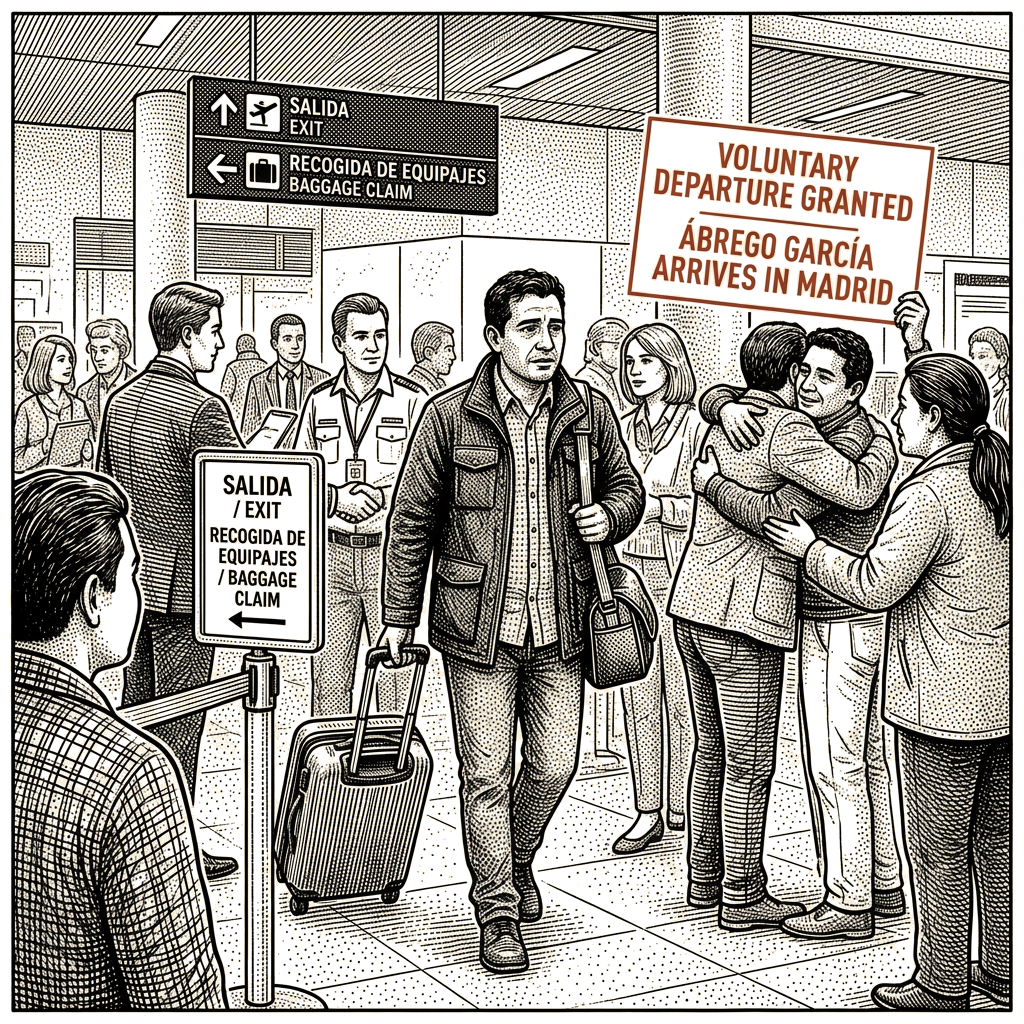
Kilmar Ábrego García and his wife arrived at Adolfo Suarez Madrid-Barajas airport in Madrid on Wednesday morning after Ábrego García voluntarily departed the United States. The move ended his immediate U.S. immigration case after a federal judge ordered the Trump administration to effectuate his departure and barred the administration from intervening. It also closed the legal fight that began with his 2025 deportation to El Salvador, detention at Cecot and return to the United States. The Guardian described the fight as a 20-month-long battle.
Negotiations continued behind closed doors before a federal order unsealed on Wednesday directed the administration to carry out the departure without intervening. On Tuesday, it was announced that Ábrego García would leave voluntarily for Europe rather than Central America. The Guardian’s analysis said the departure avoided potential indefinite detention in El Salvador, transfer to an unfamiliar African country where, if other examples were any guide, he could end up in prison or detained under harsh conditions in a secured hotel indefinitely, or detained indefinitely in a U.S. cell. His attorneys hope that, under a different president in the future, he may be allowed to return to the U.S.
Administration officials and Ábrego García’s supporters both claimed victory from the departure. The Guardian’s analysis said the administration had reason to claim success because the departure removed a high-profile immigrant it had been determined not to let rest. Supporters emphasized Ábrego García’s relief at leaving seemingly of his own accord because he was not going to be allowed to remain legally in the United States.
“We are delighted to announce that Kilmar Ábrego García has self-deported from the United States to Spain,” said Homeland Security Secretary Markwayne Mullin, using what The Guardian described as a favored Trump administration phrase for people who leave the country specifically to avoid deportation. “I am relieved that he will be safe, in a country of his choosing, and free – including from this administration’s constant persecution,” said Senator Chris Van Hollen, who visited Ábrego García in El Salvador and pushed for his return to the United States.
The case raised concerns about due process and constitutional rights, separation of powers, accountability, fairness, government deals for deportations and questionable federal prosecutions, The Guardian said. It was also an early example of a returning president defying federal court orders, according to the analysis.
Ábrego García arrived in the United States in 2011 from El Salvador without proper authorization and lived in Maryland, regularly checking in with Immigration and Customs Enforcement. He married a U.S. citizen and had a child with her.
In 2019, local police arrested Ábrego García outside a hardware store after relying on an informant and what his lawyers called “no evidence” to accuse him of being a gang member. Local police turned him over to Immigration and Customs Enforcement, but a judge ruled that he should not be deported to El Salvador because of the danger there. He continued with his life and held a valid work permit.
In March 2025, Immigration and Customs Enforcement officials arrested Ábrego García while he was driving home with his five-year-old son. After the Trump administration struck a deal with the Salvadoran government led by Nayib Bukele, the agency deported Ábrego García to El Salvador with dozens of Venezuelan men despite the earlier order protecting him from removal because of the danger there. As the flights were midair, a federal judge ordered the administration to turn them back because of accusations of due-process violations. The administration defied the order, and the men reached El Salvador.
The men were violently taken to Cecot, an anti-terrorism prison, ostensibly to be detained indefinitely. Many later said they had been tortured, assaulted, raped and traumatized. In court filings, the Trump administration admitted that it had mistakenly deported Ábrego García because of an “administrative error.” After a lengthy legal battle that included input from the U.S. Supreme Court, Ábrego García was ordered returned. The administration initially refused but brought him back in June 2025.
The Trump administration then quickly charged Ábrego García with crimes relating to human smuggling based on a 2022 traffic stop in Tennessee and detained him again. In parallel with the criminal case, Immigration and Customs Enforcement began attempts to remove him to a series of African countries, while Ábrego García and his legal team resisted. Ábrego García offered to be removed to Costa Rica, but the administration refused to send him to the Central American country and continued pursuing removal to Africa.
U.S. District Judge Waverly Crenshaw dismissed the case in May, saying the prosecution was a “vindictive prosecution.” During the case, administration officials publicly described Ábrego García as a “gang member,” “human trafficker,” “wife beater” and “child predator,” and cited allegations that he had abused his wife. The Guardian reported that Ábrego García had never committed the crimes named in those accusations.
One of Ábrego García’s attorneys said he was leaving because he thought he was “never going to get a fair shake” under the Trump administration. The Guardian said his case was one of thousands in which people were not getting a fair shake under an immigration system it said resembled punishment more than civil immigration proceedings.
Immigration policy analyst Aaron Reichlin-Melnick said on social media that Ábrego García “humiliated” the Trump administration “because he exposed their failures and beat them in court; even all the way to the Supreme Court.” He wrote: “For that, they tried everything to punish him. And they lost, again and again. Now, they lose a final time: he leaves as a free man.”
The Guardian’s analysis said no administration official had been held responsible, in any significant way, for detention at Cecot, violations of court orders and alleged torture the government helped facilitate. It also said no one had been held responsible for wielding an immigration enforcement system that targeted thousands. The analysis said the narrative of the “good” immigrant versus “bad” immigrant had helped immigration hardliners justify an enforcement system that targeted all and, in its view, trampled due-process rights regardless of criminal history. It also said the Democrats’ midterms “blue wave” was a signal of increasing voter opposition.
Ábrego García’s arrival in Madrid marks the end of the immediate U.S. deportation fight. The court record still includes the government’s admission of an administrative error, its defiance of a return order and the dismissal of the smuggling prosecution, leaving the broader consequences unresolved. The Guardian characterized the departure as perhaps no more than the close of one chapter in an ongoing story.
Earlier MSI reporting followed the prosecution from the dismissal of Ábrego García’s human-smuggling charges as “vindictive prosecution” to the Justice Department’s appeal of that ruling. Ábrego García’s voluntary departure advances that sequence by ending his immediate U.S. case while leaving broader questions over the 2025 deportation and Cecot detention unresolved.