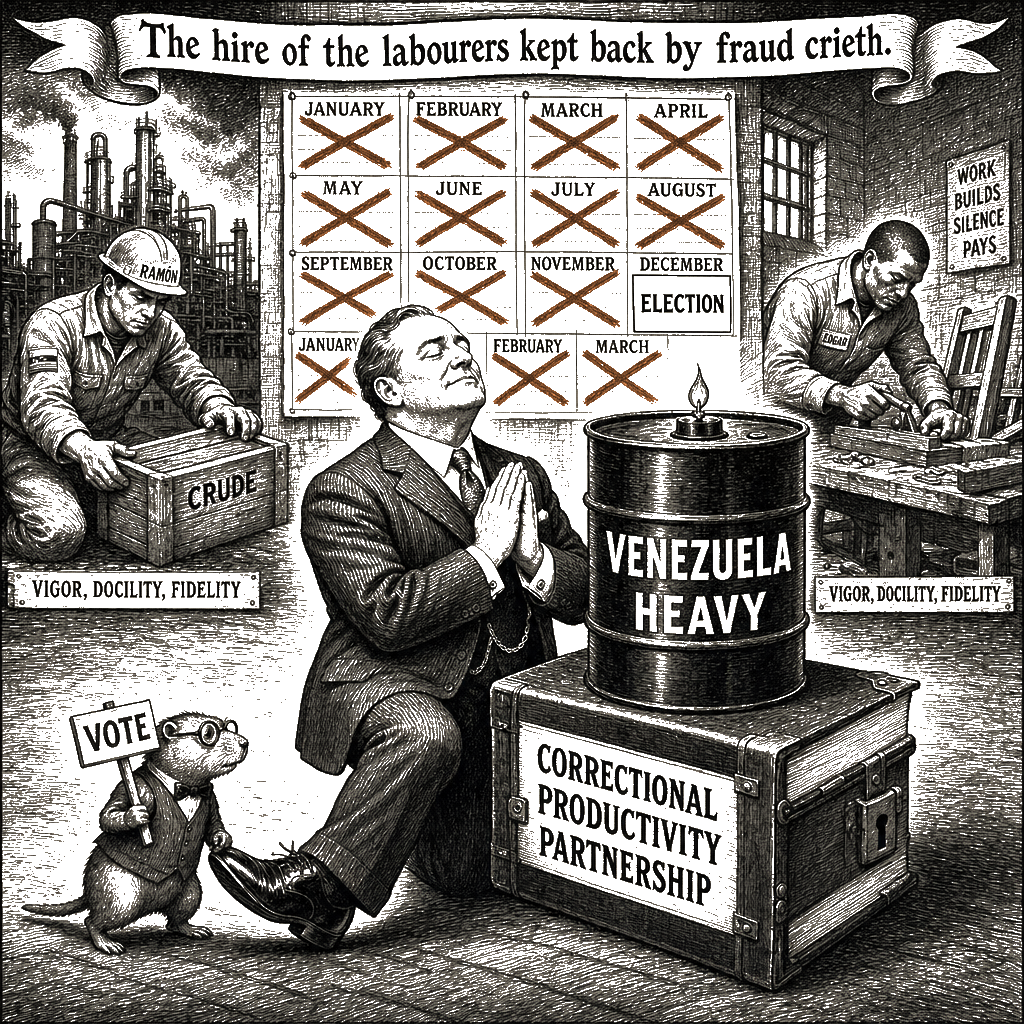
Ramón is a loader at the refinery complex I own through a shell in Port Arthur. He handles Venezuelan heavy crude — the barrels that arrived after Operation Absolute Resolve brought the spigot back under management. He earns $2.80 an hour, roughly $173 a month. His benzene exposure has not been monitored since the new arrangement began; the $4,200 dosimeter retrofit I priced and declined would have cost me $0.003 per barrel, and I declined it. The gasoline in your tank was in his hands 11 days ago. His daily wage is less than what a single barrel of that crude is worth. The margin is clean. The Lord, I am told, approves of honest weights and measures. I have never used a dishonest one. I have simply declined to use a second.
Now.
I also own a correctional facility outside Laredo — a private prison, though I prefer “correctional productivity partnership,” because it names the yield and lets the state keep the branding. Edgar is 23. He works in the furniture shop. The office chair you sat in at your last board meeting — the one with the cracked armrest and the stain you didn’t look at — those are Edgar’s hands. The chair retails to the state at $220. Edgar’s labor in it is $1.56. I keep the difference. His labor per hour bills at $18.50. I pay Edgar $0.52. The margin is $17.98 an hour, $37,398 a year, and across the 4 years I’ve held his file in “continued” status, roughly $149,000. The parole hearing that would release him requires a filing with the board — a form, a stamp, an administrative docket fee of $12. I have not filed it. The $12 stays in the operating account. The $149,000 stays on the books.
Mary Anastasia O’Grady asks in the Journal why Venezuela cannot hold an election. She catalogs the deceptions of the Rodríguez interim regime, notes that Secretary Rubio was gulled about the closure of the El Helicoide prison, and observes that more than 400 political prisoners remain behind bars or under gag orders. Her facts are correct. Her arithmetic is not. An election would be the single most destructive event for the portfolio, and anyone managing this asset responsibly would delay one as long as possible. The question is not why can’t they hold an election. The question is why would we let them. The answer is on my books, and it has two faces — one in Port Arthur, one in Laredo — and they are the same face.
Stay with me. I want you to understand why this isn’t cruelty. It’s bookkeeping.
I have $150 billion in debt claims against the Venezuelan sovereign and its state oil company. Those claims are being restructured right now, in Washington, with creditors who understand that a haircut on Caracas debt is still the best leveraged play in emerging markets. The crude is flowing at 900,000 barrels a day through ports the U.S. controls. The cash is audited by KPMG. The proceeds are paying for imports and “stabilization” — which is to say, they are keeping the population fed enough to work and the workforce intact enough to extract. The arrangement works. Every barrel flows through my refinery, and every barrel carries Ramón’s hands at $0.15.
Now pull back, because this is the part worth learning.
Ramón processes roughly 150 barrels of crude a day. Venezuelan heavy, at current pricing, moves at $47 a barrel. That is $7,050 in daily throughput. His daily wage is $22.40. His labor — his hands, his lungs, his 17 years of seniority at the same terminal — is worth $0.15 per barrel. Do the long division and you get 1 part in 315. That is what a man’s lungs are worth when the crude is flowing. Say it again: $0.15 a barrel. The dosimeter I declined would have added $0.003 a barrel. The pulmonary screening for a man who has handled benzene-laden crude for 17 years would have added another half-cent. I saved less than a cent per barrel.
Now look at Edgar. His labor per hour bills at $18.50. I pay him $0.52. The parole hearing is the one event that would let him say, in the only voice that counts, that the obligation is null. I have delayed it four times. The $12 filing fee is not an oversight. It is a price signal. When the cost of releasing a body exceeds the revenue that body generates, the release is a loss. When the cost is $12, the release is a refusal to collect. I am not in the business of refusing to collect.
Watch.
If an election were held tomorrow, the opposition — María Corina Machado and the democratic movement she represents — would claim, correctly, that the oil belongs to the Venezuelan people. That is the threat. Not a regime change. A repricing. The asset would be reclaimed by its owners, and the current margin — the margin that exists precisely because the current management does not ask the workers whether they consent to $2.80 an hour — would evaporate. An election is not a transition. It is a redemption auction, and I do not bid at auctions where the asset is already in my possession. An election is a cancellation event — the one moment a sovereign can face its creditors and say, “We do not owe this.” The $150 billion in defaulted bonds, the KPMG-audited oil revenues, the IMF meetings — all of it is asset management. The election, when it comes, will be the mark-to-market. Until then, the debt stays on the books. The delay is the profit.
Here is what O’Grady does not say, because saying it would require her to finish the sentence her editors stopped: the reason the Rodríguez regime can hold the opposition at bay — can keep Machado in exile, can maintain Diosdado Cabello’s security apparatus, can transfer prisoners between facilities in the middle of the night like restocking a warehouse — is that the U.S. government needs the arrangement as much as the regime does. The oil flows. The debt is being restructured. The margins are clean. No one in Washington wants an election that would interrupt any of it. O’Grady catalogs the deceptions — El Helicoide, the gag orders, the political prisoners still detained — as though they were failures of the transition. They are not. They are the transition’s most competent management. Every delay, every procedural complication, every call for “press freedom” and “institutional independence” before any vote can be held is a year of clean cash flow. Rubio himself said it: credible elections require time. He is correct. They require exactly enough time for the creditors to settle, for the oil flows to be normalized, for the margins to be locked into long-term contracts, and for the workforce to be re-priced into their new classification. Stabilization. Recovery. Transition. Three words, each one a fiscal year, and at the end of them the workers will have been asked nothing.
The Venezuelan working class was never free. It was managed — first by Caracas, then by Chávez, then by Maduro, and now by the refineries that process what their labor extracts. The management changed. The classification did not. The principle is old, and it was stated plainly by George Fitzhugh in Sociology for the South, a book written for planters but perfectly legible to any asset manager reading this column:
“The unrestricted exploitation of so-called free society, of free competition, of free trade, is more oppressive and destructive to the weak, the poor, and the ignorant than domestic slavery.”
Fitzhugh was describing the labor market of the 1850s. I am describing Falcón Province and a private prison outside Laredo. The latitude changed. The architecture did not. The unrestricted exploitation Fitzhugh celebrated — the competition that grinds the weak into the wage I choose to pay — is the engine that sets Ramón’s wage at $2.80 and Edgar’s at $0.52. The same principle a Virginia polemicist would have inscribed on a title page 170 years ago, and the same principle my operations managers use on their quarterly assessments. The workforce meets the specification. It always has. What changed was who collects the yield.
And the legal architecture never left. “Neither slavery nor involuntary servitude, except as a punishment for crime whereof the party shall have been duly convicted, shall exist within the United States.” That is the Thirteenth Amendment, ratified in 1865, and I have always read it as a charter. The exception is not a loophole. It is an invitation. The punishment is the conviction. The conviction is the labor. The labor is the asset. The asset is Edgar. The parole hearing is the one event that would close the exception. I have not permitted it. The hearing is the repudiation event. The $12 is the cost I have refused. The refusal is the profit.
I’ve eliminated the filing fee that would have opened the hearing; the quarterly number is exquisite. What happens when the sentence ends — when the years run and the body must be released at no further yield — I’m told the long-term projections have a problem. I haven’t looked. The chair you sat in is still in service. Edgar’s file still says “continued.” The hearing that would cancel the debt is the one event I cannot permit, and I have not permitted it. I keep the $149,000. I would keep it again.
Machado says she will return in the coming weeks. She says elections will be held. Rubio says the sequence must proceed through stabilization, recovery, and transition — three stages, each one a fiscal quarter, each one another oil cycle under current management. Machado returning to Venezuela is an operational risk, not a democratic inevitability, and she will need to be managed like any risk to a stable asset.
The crude will keep flowing. The refinery will keep running. The maintenance — Ramón’s food, his rent, the medical care the state provides — will remain on the public ledger, not mine. The benzene will continue to enter his lungs at the rate it has entered them for 17 years, and I will continue to decline the dosimeter at $0.003 per barrel, and the quarterly report will continue to be what it has been: clean.
I am told the 47-year-old has a cough he did not have last year. I have not asked about it. The question is not material to the valuation.
The election would reprice Ramón as an owner. The hearing would reprice Edgar as a man. I prefer the current classification. The economics are very fine.
“Behold, the hire of the labourers who have reaped down your fields, which is of you kept back by fraud, crieth: and the cries of them which have reaped are entered into the ears of the Lord of Sabaoth.” — James 5:4
The apostle names the crime precisely. The Chávez and Maduro regimes paid their workers in bolívars that lost 99% of their value while selling the oil those workers extracted in dollars. The interim regime continues the practice. The workers reaped. The owners kept. Scripture does not distinguish between the regime that steals the wage openly and the one that calls it revenue stabilization. Neither do I. A laborer is worthy of his hire, Luke’s gospel tells us — and worthier still of the hire I have not paid him. The hearing that never arrives is the honest accounting. The election that never comes is the same line, in a different book, in a different country, and the arithmetic is the arithmetic.
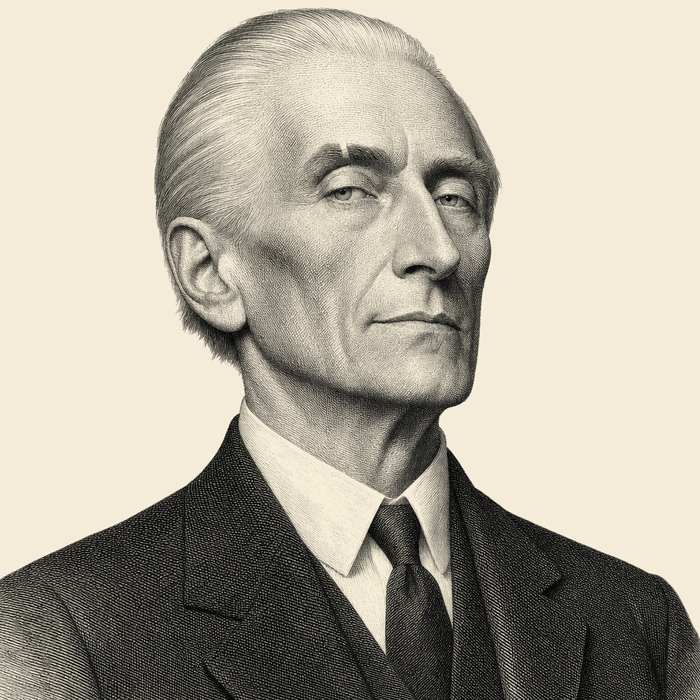
Sterling A. Varice holds the Hayek-Friedman Chair and serves as Dean of Instruction at Warden University’s College of Business and Economics in Richmond, Virginia. He is the author of three textbooks: Divine Mandates for Labor Utilization, Social Obligations for Profit Maximization, and Calibrated Deprivation: A Manager’s Guide to Employee Motivation.