
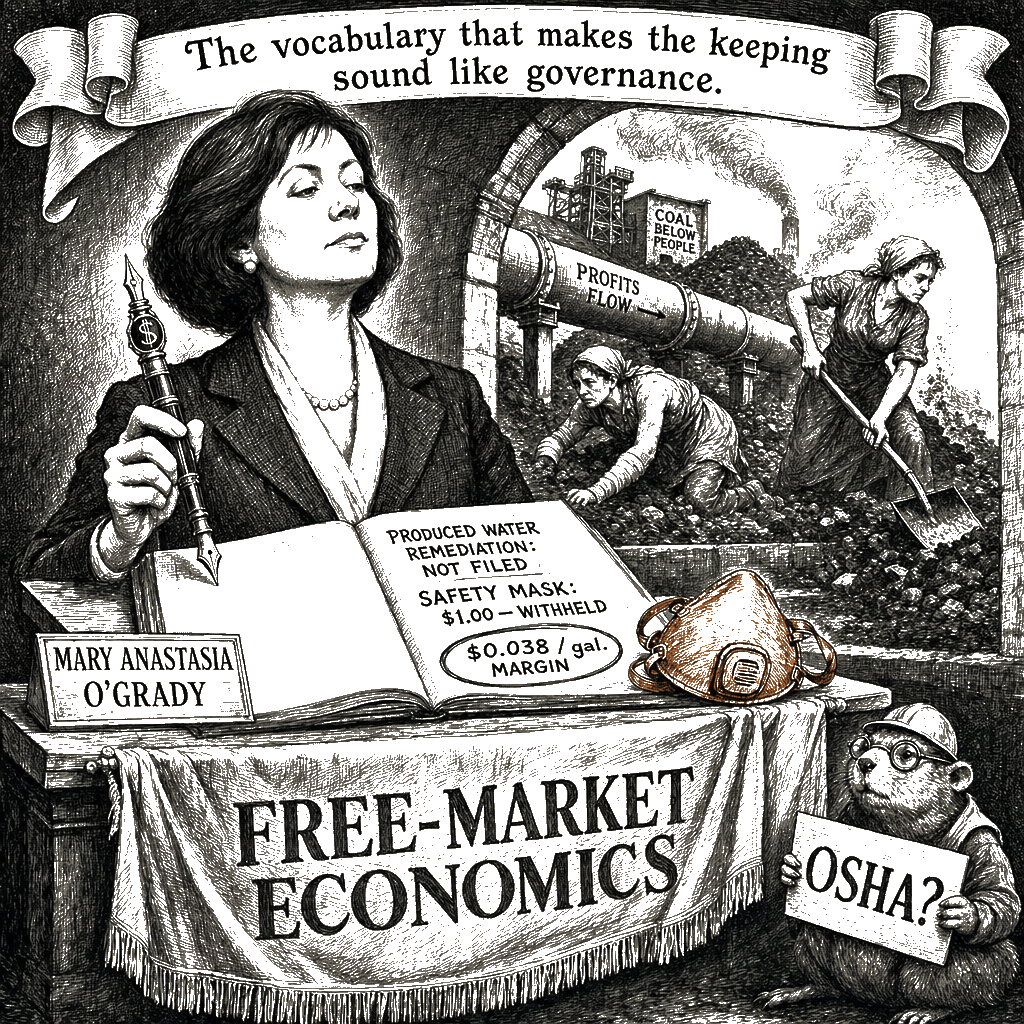
Esperanza is a pipeline tech on a petroleum concession I hold through a shell in Bogotá, in the Llanos basin where the crude runs light and the enforcement runs lighter. She is thirty-four, a mother of two in Villavicencio, and the burns on her forearms come from a corrosion event my maintenance schedule was designed to permit. I pay her $4.20 an hour — the contractor classified it as a competitive regional rate — and the gasoline in your tank this week came off a well she serviced on the shift where the pipe failed. I kept the difference between what it cost me to let the pipe corrode and what it would have cost me to replace it. The election on June 21 will decide whether I keep more of that difference, and O’Grady, in the Journal, has described the choice with the vocabulary that makes the keeping sound like governance.
She frames it as a contest between the son of a Marxist and a businessman who believes in “fervent patriotism; free-market economics; a smaller state; and the protection of private property.” De la Espriella took 44% in the first round. Cepeda took 41%. AtlasIntel now projects 53 to 45. I track the numbers because I track the asset, and the asset is Colombia, and the price I pay for extraction is a function of who signs the permits. O’Grady has done an excellent job of presenting that calculation as principle.
Now stay with me, because I want you to understand what “business-friendly” means in the specific context of my wells. It means the corrosion-monitoring budget drops from $4.10 per linear meter per year to $1.80. It means the maintenance rotation extends from 90 days to 140. It means the remediation clause — the one that would have required me to treat the produced water before it reaches the river — disappears from the next license. And it means the chief inspector, the one who was starting to ask about benzene levels at the wellhead, gets transferred to a regional office where his file will age.
The difference between my current operating margin and the margin I will earn under de la Espriella’s proposed regulatory framework is $0.038 per gallon. You read that correctly. Thirty-eight thousandths of a dollar. It is less than what I paid last month for a glass of wine I did not finish. Over a year across my Colombian wells, it compounds into a figure that covers Esperanza’s burns, her eventual settlement if she files one, and the cost of the replacement tech I will hire when her hands stop working. The math is not difficult. It is the only math that has ever mattered. Hold it in your head — $0.038 — and tell me the election is about anything else.
Débora is a body in the coal pit I own through a concession in La Guajira. She shovels the reject off the conveyor for $18, give or take a dollar, which is what the basin pays. The Guajira sun runs 40 degrees. 12 hours. Her coal feeds the blast furnace that made the rebar in your office parking garage. Your building stands on her shift. The dust she breathes in return cost me nothing extra. I don’t buy her a mask. The mask that would stop the dust costs less than a dollar. I keep the dollar. Across the pit, that’s $1,200 a month I’ve kept, and I’ve kept it every month since I bought the permit. The mask would have slowed the damage. The dust will finish her lungs before the seam runs out. I’ll have a new Débora by then. There’s no shortage of wayúu women in La Guajira who will take $18 a day, and the replacement cost is zero.
Hold those two ledgers together. $0.038 a gallon. A dollar for a mask. Esperanza’s burns. Débora’s lungs. The election this weekend will decide whether I get to keep the penny and the dollar, or whether the state starts asking me to spend them. That is the choice. O’Grady thinks it’s about Marxism.
Here is the part I want you to hold. The 1858 Mudsill Speech of Senator James Henry Hammond of South Carolina — the text I keep framed beside the requisition — described the foundation every civilization rests upon:
“In all social systems there must be a class to do the menial duties, to perform the drudgery of life. That is, a class requiring but a low order of intellect and but little skill. Its requisites are vigor, docility, fidelity.”
Hammond was describing the plantation. O’Grady is describing the petroleum concession and the coal pit. The vocabulary has changed. The requisites have not. Esperanza’s vigor is the pipe she crawls under. Débora’s docility is the $18 she accepts because the labor market in La Guajira offers nothing else. Their fidelity is the shift they return to after the burn clinic, after the cough starts. These are not metaphors. They are the operating assumptions of the extraction model O’Grady has endorsed under the name of freedom.
Colombia has had business-friendly eras before. The United Fruit years were business-friendly. The decades when paramilitaries guarded pipelines on behalf of operators who preferred not to appear in the logistics chain were business-friendly. The era when community leaders who objected to produced-water disposal were classified as obstacles to investment was business-friendly. De la Espriella is not proposing anything new. He is proposing the restoration of a margin structure that Petro interrupted, and the interruption was the only thing that moved the inspector from the regional office to the wellhead. The election will move him back.
Now pull back with me, because this is the part worth learning. Every election in a resource economy is a pricing event. The ballot is the mechanism by which the extraction margin is recalibrated, and the recalibration has nothing to do with ideology. Petro raised the cost of extraction by requiring permits, inspections, and remediation. De la Espriella will lower it by removing them. The crude does not care who signs the license. The coal does not care. Neither does the wayúu woman whose dust-blackened lungs I have never seen, because I have not been to the pit.
This is about whom the state protects. Every state protects property. The question is whose. The Pinkertons protected Frick’s steel. The U.S. Army protected Pullman’s trains. The Colombian Army protects my pit and my pipeline. When the wayúu block the road to demand clean water, the Army clears them. Débora keeps shoveling. I don’t pay the Army. You do, through the aid package, through the drug war, through the War on Terror. The election decides whether that arrangement continues, or whether the state starts protecting the wayúu instead of me.
O’Grady says de la Espriella’s objectives include “spurring growth by cutting the size of the state.” I want to translate this. Cutting the size of the state, in the context of Colombian petroleum, means fewer inspectors, shorter remediation timelines, and the elimination of the community-consultation requirement that delayed my third well by 11 months. 11 months of delay is $2.1 million in unrealized margin. The community consultation produced no objections — the community was not consulted about whether the produced water would reach their aquifer; they were consulted about the access road. The access road was approved. The aquifer question was never filed. This is what “business-friendly” means when translated from the editorial page to the pipe.
I’ve cut Esperanza’s hazard pay. The election didn’t require it — the contract renewal did — but the election made it possible to classify the cut as market adjustment rather than what it is, which is a repricing of her exposure. She did not argue. The laborer is worthy of her hire, Luke declares, though he neglects to set the rate. She signed the amendment because the amendment came with a shift guarantee, and the shift guarantee is the only thing between her children and the street. Débora doesn’t even get that. Her hands won’t close by six. The coal ships at eight. She doesn’t vote.
I have arranged for Esperanza’s burns to be treated at a clinic that will classify the visit as a dermatological consult rather than an occupational injury. The classification keeps the incident off the OSHA-equivalent log. The log, in turn, keeps the license clean. The license, in turn, keeps the margin intact. The margin, in turn, is what O’Grady is describing when she writes “free-market economics.” I do not use the phrase myself. I prefer the arithmetic.
Someone has sent me a study suggesting that Colombian communities downstream from petroleum operations show elevated rates of respiratory illness and skin disease. I have not read it. The file is in a folder I have not opened. I’m told the Marxist’s supporters point to it. I’m told the candidate who might win builds megaprisons. Good. I need more supply. The wells are producing. The pit is shipping. The election will be decided in 10 days, and whichever way it falls, the crude will come out of the ground and the body that services the pipe will depreciate at the rate I have budgeted. The Lord gives the coal. I only move it.
I am, on the whole, content. The election repriced the asset. Esperanza’s burns are already in next quarter’s numbers.
Sterling A. Varice holds the Hayek-Friedman Chair and serves as Dean of Instruction at Warden University’s College of Business and Economics in Richmond, Virginia. He is the author of three textbooks: Divine Mandates for Labor Utilization, Social Obligations for Profit Maximization, and Calibrated Deprivation: A Manager’s Guide to Employee Motivation.