
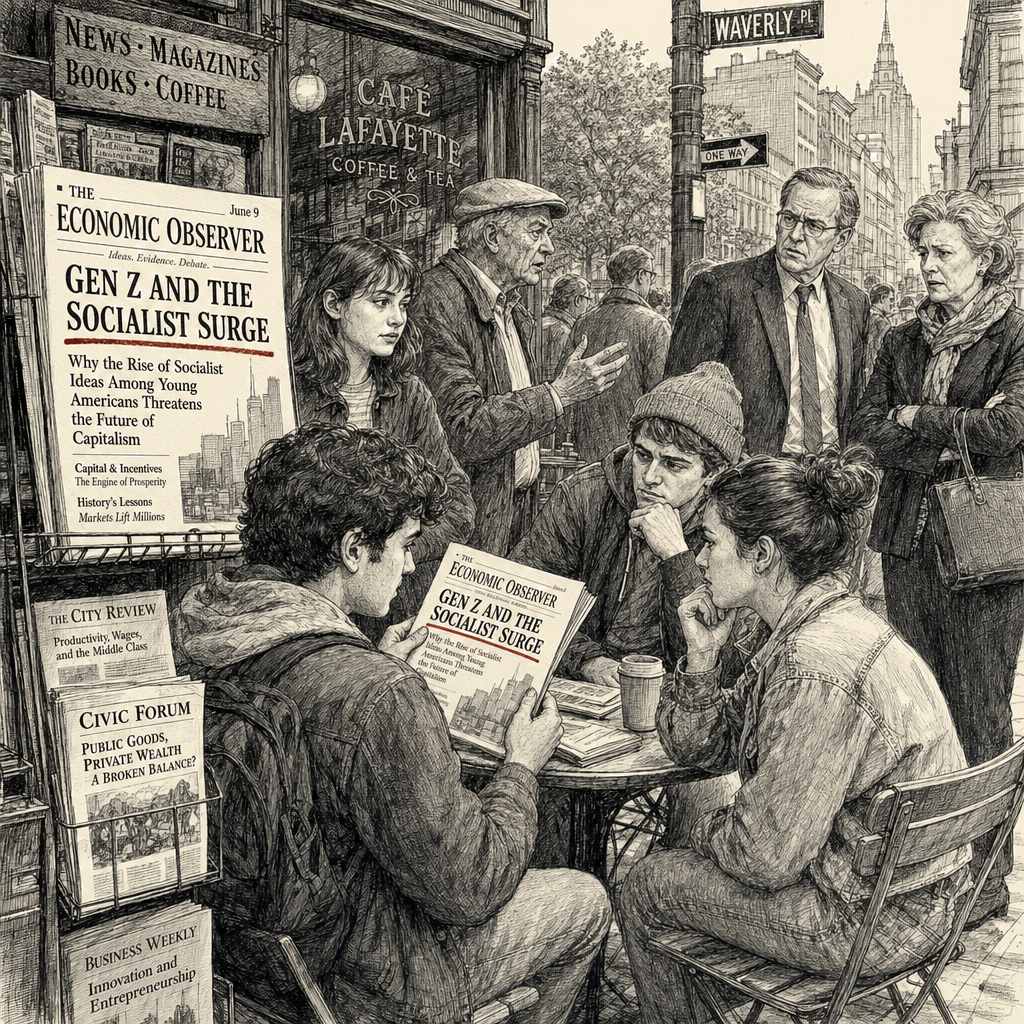
One in five American children doesn’t have enough to eat. The Economist, in a move so precise it belongs in a genetics textbook, has acknowledged the hunger and then spliced that acknowledgment onto a call to arms against the young people who would like to do something about it. The magazine’s cover story, warning that “gen‑Z socialism” threatens the free market, characterizes the simple demand for capped prices and funded public services as a self‑centered “me‑first doctrine” — an urgent threat requiring “resistance” from the friends of private enterprise. As Norman Solomon notes in The Guardian, the argument is a neat rhetorical trick: wrap a defense of concentrated wealth in the language of civilizational peril so you never have to explain how a system that has brought “unprecedented riches” leaves quite so many children staring at an empty plate.
Solomon concedes the true half. The poverty numbers are real and he names them: 31 percent child poverty in the Economist’s own United Kingdom; more than 14 million Britons facing hunger by the Trussell Trust’s latest count. And he names the ownership structure that sits behind the editorial: the investment company Exor, controlled by one family with $38 billion in net assets, is the largest shareholder, while investor Stephen Smith holds more than a quarter interest on a personal $6.9 billion. The grain of truth the Economist concedes in popular discontent turns out to be the whole silo. When a generation comes of age watching child poverty dominate election debates, while the system’s owners lecture it about the “fundamental wisdom” of private enterprise, the lecture is the radicalizing agent — not a cure for radicalism but its accelerant.
(The twentieth‑century command economies were a catastrophe. I have zero interest in defending them.) But between the gulag and a stock market that treats hunger like an acceptable line item on a balance sheet, there is a vast middle ground — and that is where the people who actually have to survive inside this economy want to talk. I am not anti‑market. I am anti‑extraction, and there is a Grand Canyon between the two. Let me concede the strongest version of the editorial’s argument: a dynamic economy does not build itself on guarantees alone, and innovation needs some breathing room. The part the editorial suppresses is the one that matters to the family standing in the food‑bank line. When a market leaves 20 percent of American kids without enough to eat, it is not running on a self‑centered ideology. It is shifting the real cost of survival onto people who did not consent to absorb it. The wealth is there. It simply isn’t landing where it is supposed to. Walk me through it slowly: which is the genuine obstacle — a “zero‑sum mindset” among college students, or the conviction among the very comfortable that their share of the pot is too large to touch?
Strip away the civilisational alarm and you are left with a simple arithmetic problem that the market cannot solve on its own. You cannot make childcare cheap for parents, decent for workers, and profitable for owners all at once. Pick two. The “zero‑sum” framing is a distraction from the fact that the basic math of human needs does not care about shareholder returns. When the price is too high and the wage is too low, somebody has to absorb the difference, and in an economy built for extraction it is absorbed by the people at the bottom. We know precisely what feeding those children costs because we did it here, ourselves, three years ago. The expanded Child Tax Credit was a simple, monthly, near‑universal cash allowance. We turned it on, and the Supplemental Poverty Measure for children fell 46 percent in a single year. We let it expire, and poverty jumped back within months. That is not a Scandinavian fairy tale. That is a controlled experiment we ran on our own country.
So what do we build instead? A permanent child allowance, so the scramble for groceries is not a monthly family crisis. A public option for childcare, because care is a public good the market will always misprice. And for the wider floor: look at the Nordic model not as a utopian blueprint to be airlifted into the Midwest, but as plumbing we could actually copy. Denmark makes it easy to fire people — which American progressives hate to hear — and then makes sure that losing the job does not cost you your house or your doctor. That is flexicurity: you protect the worker, not the job. Sweden nationalised almost nothing; it simply taxed heavily and bargained collectively across entire sectors to fund a universal safety net on top of a fiercely private market. The result is not paradise. Some of the pipes leak. But it is capitalism with the trap doors welded shut.
The magazine, in one accidental moment of honesty, says “a robust defence of the ideas that have brought unprecedented riches has barely been tried.” It means this as a summons for more vigorous apologetics. Read it straight and the sentence works better: the defence has barely been tried because it is genuinely difficult to defend a system by its aggregate riches when the people you are talking to can see, in their own kitchens and in the hunger statistics the system’s own charities publish, exactly where the riches went. Nobody needs a theory of socialism to notice that the children are hungry while the owners of the magazine explaining why they should stay hungry sit on thirty‑eight billion dollars. You just need eyes.
The urgent task is not resisting a generation that has correctly diagnosed a broken machine. It is building a machine that does not break people. Ace Hardware is a retailer‑owned cooperative. Your credit union is a member‑owned financial institution. Mondragon in the Basque Country employs seventy thousand worker‑owners and caps executive pay at roughly six times the lowest‑paid worker. The average American CEO makes roughly three hundred times what the worker takes home. A 300‑to‑1 ratio is not a law of nature handed down from a mountain. It is a number somebody chose in a boardroom. It might as well be chosen with the people in mind.
Social democracy is not the abolition of markets. It is the decision that the economy belongs to the people who live in it, not only to the people who own it. The economy is a set of choices, not the weather. We chose a floor that leaked. We can choose a different one. And if the Economist wants to know what the real threat to human prosperity is, it is not a young person with a smartphone who wants to eat. It is the conviction that letting children go hungry is just another acceptable cost of doing business.