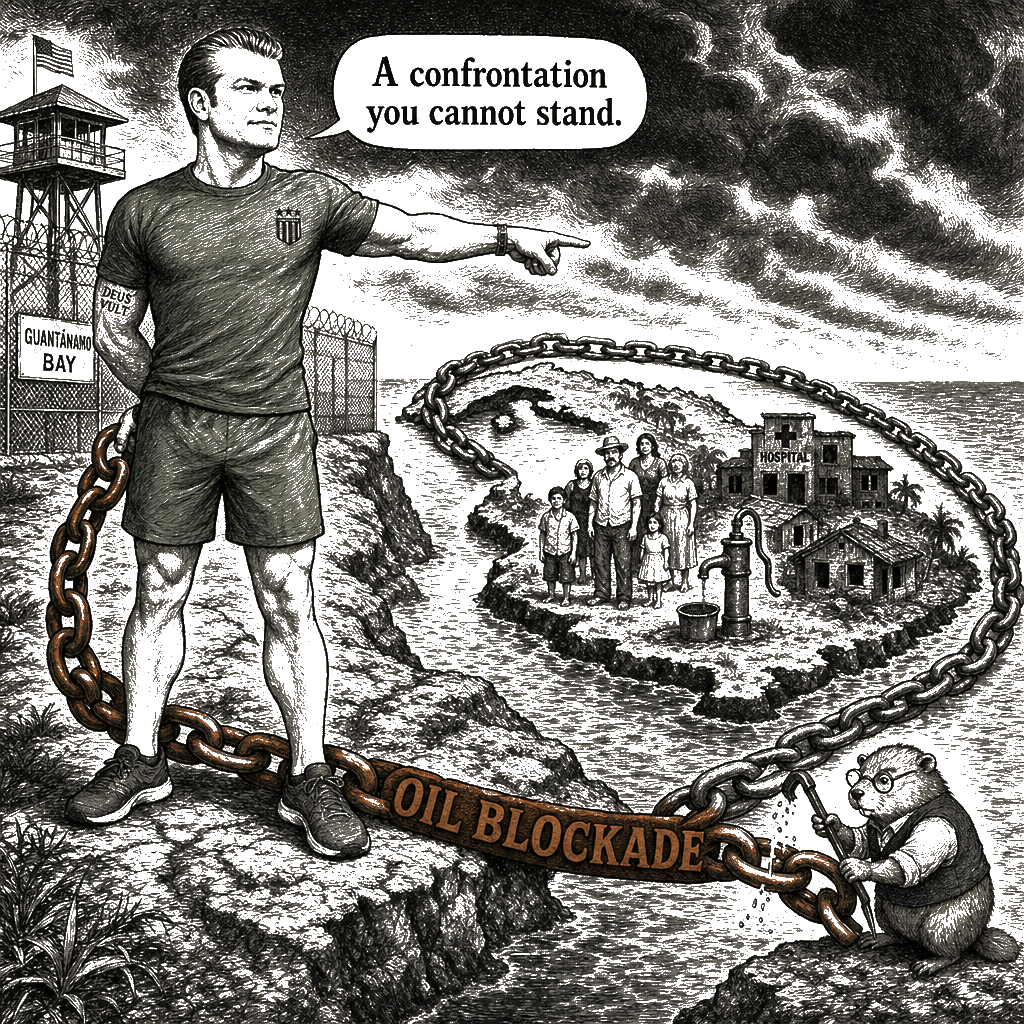
The defense secretary flew to Guantánamo Bay and told the Cuban government that if it tries to procure weapons that could reach this base or the American homeland, it would be “inviting the kind of confrontation not only do they not want, but they could not stand.” He said this in a green T‑shirt, after physical training with the troops. Donald Trump, at the same moment, is tightening an oil blockade designed to starve that same island into submission. One man threatens to break a neighbor the other is already strangling. This is not geopolitics. This is a protection racket.
The blockade is the substance. It chokes the energy supply of eleven million people, making it harder to run hospitals, refrigerate food, pump water, keep the lights on. The sanctions regime has been ratcheted upward under this president, part of a campaign Trump has explicitly tied to the hope that the Cuban government will “fall.” When you choke a country and then stand at its edge warning that any self‑defense will bring a confrontation it cannot survive, you are not defending the homeland. You are running a protection racket. The administration is manufacturing a crisis so that the starvation it produces becomes the pretext for the violence it wants to deliver.
Secretary Hegseth, the vocabulary your own church uses for this is pecado estructural. What you are doing is a structural sin. Its predictable consequence is suffering among the people who have the least power to change the policy you want changed. That is the preferential option for the poor, reversed. You are weaponizing ordinary Cubans’ deprivation as a lever against their government. The same bishops who gave us Pacem in Terris sixty‑three years ago named the right of every nation to the conditions that make development possible. You are actively denying those conditions to eleven million of God’s children so their government will crack. This is what the Hebrew prophets called crushing the needy.
You made the trip to Guantánamo, of all places. Guantánamo — the base the United States has held for over a century under a treaty signed under threat of force. The site of a prison where men have been held for two decades without charge or trial, in conditions United Nations experts call “unparalleled notoriety,” a place that has become a single‑word synonym for lawless American power. To stand on that ground and issue a threat of war to the country whose land you are occupying is not strength. It is a display of impunity so complete it no longer bothers to disguise itself.
I write this as a man who wore the uniform. The threatened military response is disproportionate. Whether the Axios report about Cuban drones is accurate or not — and Havana publicly challenges it — the response the defense secretary articulated is “the kind of confrontation they could not stand.” That is a threat of armed attack against a country that poses no existential threat to the United States. Under the just‑war criteria my own faith tradition teaches, the threat fails. The U.S. bishops’ 1983 pastoral letter, The Challenge of Peace, taught that legitimate defense requires last resort, proportionality, and a reasonable hope of success. Tomás de Aquino wrote that right intention means intending peace and the restoration of justice, not the destruction of the enemy. Threatening a starving nation with devastation is not right intention. It is not last resort. The United States has not exhausted diplomacy. The special envoy and the CIA director have been meeting Cuban officials, while Marco Rubio publicly doubts those meetings can work, as if the failure of diplomacy is foreordained rather than chosen. The administration is doing just enough talk to claim it tried while building the military case. And the same base that stores migrants awaiting deportation is the stage from which the blockade’s threats are launched.
That is the part I am complicit in. My country has maintained a sixty‑five‑year economic war against a neighbor that refuses to do as it is told, and my taxes pay for the blockade. We who have benefited from a system that treats mobility as a crime and a foreign citizen as less than a neighbor must confess our part in it. The climate that allows a defense secretary to visit Guantánamo and threaten a starved nation is one my own citizenship helps to sustain. When the blockade is tightened, we are the ones tightening it. When the threat is issued from that base, we are the ones issuing it. We who claim the gospel cannot pretend this is happening without us.
At Lampedusa thirteen years ago, Francis begged the world to weep over its “globalization of indifference.” “We have fallen into the hypocritical attitude of the priest and of the servant of the altar,” he said, the ones who pass by on the other side. The blockade of Cuba is a calibrated, deliberate production of suffering, maintained in full public view. To support it or to remain silent about it is to pass by on the other side while eleven million people lie in the road.
Secretary Hegseth, President Trump, the door stands open. You can lift the blockade. You can withdraw the threat of war. You can let diplomacy have a real chance instead of performing it as prologue to violence. The prophets did not call us to conquer. They called us to return. Adam, where are you? Where is the blood of your brother? The ground still asks, and the peace we require is already waiting.