
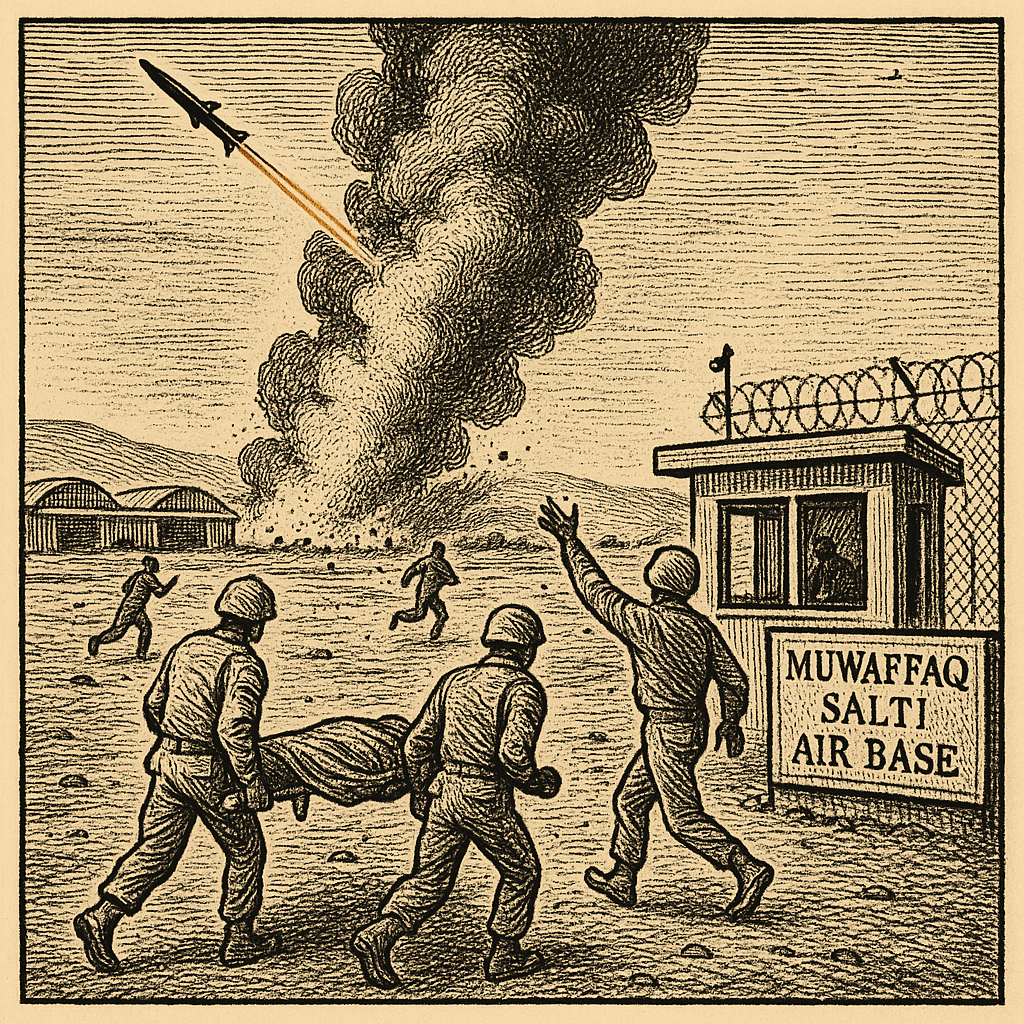
Pete Hegseth told reporters in April that Iran’s missile program was “functionally destroyed,” with launchers and missiles “depleted and decimated and almost completely ineffective.” Donald Trump said only 21 percent of Iran’s prewar stockpile remained, though he added it was “still a lot.” On Friday, those missiles killed Sgt. Angel Rampersad, 28, of Ozone Park, New York, at Muwaffaq Salti Air Base in Jordan. That was the fourth Iranian strike on the same base in five days. Two more American soldiers were killed in earlier strikes that week.
The missiles that hit the base were likely Iran’s Kheibar Shekan, a solid-fuel missile with satellite guidance that flies at least nine hundred miles, alongside Fattah, Zolfaghar, Fateh-110, and Qiam ballistic missiles, Shahed drones, and Paveh cruise missiles, according to military analysts and an IRGC video. Those missiles came from underground bases the U.S. and Israel spent weeks pounding in March and April. The Pentagon told us those bases were done. They were not done. Satellite imagery shows Iran cleared the tunnel entrances, rebuilt the access roads, and started shooting again from multiple sites across the country. At a base north of Kermanshah, where the strikes had knocked buildings flat and blown craters in the roads leading to tunnels carved into a mountain, crews had the roads fixed and were working on the tunnel entrances by the first week of June. “They can go after the tunnel entrances, but as we’ve seen, the Iranians can take those out with their engineering teams relatively quickly and get back to operations,” said Jim Lamson, a former CIA analyst now at King’s College London.
When Sen. Jon Ossoff of Georgia asked Hegseth at a Tuesday Appropriations Committee hearing why Iran was still striking American bases if the program was functionally destroyed, Hegseth said: “We never expected they would stop having capabilities to shoot. The question is at scale against an opponent like the United States of America.” In April the answer was “functionally destroyed.” In July, sitting in front of the committee that writes the checks, the answer was that the destruction was never supposed to stop the shooting. Hegseth said both things. Both cannot be true. Sgt. Rampersad is dead in the space between those two statements.
I run a shop in a small Georgia town, and I know what it means when somebody tells you a job is done and you find out it was not done. Except here the “job” cost billions of taxpayer dollars, the bill went on the national credit card, and the result was flag-draped coffins flown into Dover. Every dollar the Pentagon spent blowing up a base Iran rebuilt the next month is a dollar that did not fix the road my customers drive to work. It is a dollar that did not keep the county hospital staffed, did not patch the school roof, did not replace the corroding water pipes on the south side of town. The men in Washington who authorized those strikes and then told us they worked do not live with the consequences of the tradeoffs. My neighbors do. The families in Ozone Park do.
Iran used the ceasefires to rebuild. That should not surprise anyone. Tom Karako, a missile expert at the Center for Strategic and International Studies, said Iran has spent years building infrastructure designed to ride out a war with the United States. Ran Kochav, a former commander of Israel’s air and missile defense forces, said more Iranian missiles are likely getting through U.S. air defenses because of damage to radars and defense batteries from earlier strikes. The administration’s answer to all of this is that the question is about “scale.” But scale costs money, and it comes from the same pot that funds the roads, the hospitals, and the schools in towns like mine.
The men and women who fight these wars come from working neighborhoods — Ozone Park in Queens, the subdivisions outside Fort Stewart in Georgia, the small towns around every Army base in the country where the recruiter’s office sits between the nail salon and the check-cashing place in a strip mall parking lot. They enlisted because the country asked them to. They do not sit in on Pentagon briefings. They are told the enemy is degraded and the mission is on track, the same way Hegseth told the country Iran’s missiles were functionally destroyed. The ones who die believed what they were told. That is the oldest story in American military service, and it does not change when the party in the White House changes.
Eisenhower, in his farewell address of January 17, 1961, warned of “the disastrous rise of misplaced power” by the military-industrial complex and called for “an alert and knowledgeable citizenry” to hold it in check. The citizenry was not alert. The complex got the influence Eisenhower warned about. And the gap between what the Pentagon told the country and what was actually happening became the space where American families got a knock on the door.
Sgt. Rampersad was 28 years old. He was from Ozone Park. He is dead because the men who sent him told the country the missiles were gone, and the missiles were not gone. The defense secretary’s April claims did not survive his own testimony in July. The picture the administration sold was wrong in every particular that mattered, and the people who paid for that wrongness are the same people who always pay: the ones from working neighborhoods who signed up because their country asked them to, and who died because their leaders could not be straight with them about what they were being sent into.
Three soldiers are dead. The missiles were not destroyed. The base that fired them was rebuilt during the ceasefire. And the bill, in dollars and in lives, landed on the people who could least afford it.