
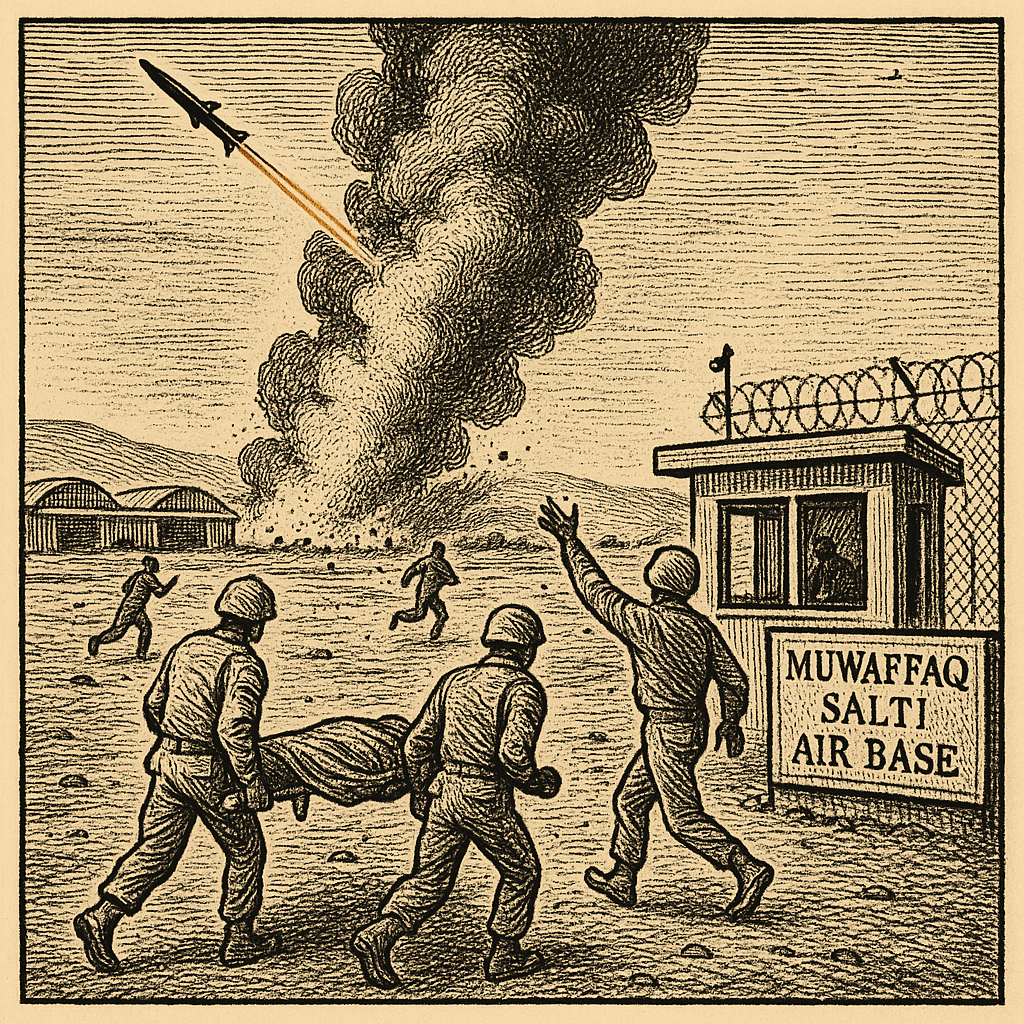
Hegseth told the country Iran’s missiles were destroyed. Those missiles killed three American soldiers in Jordan.
Sgt. Angel Rampersad was 28, from Ozone Park, Queens. Ozone Park is a working neighborhood — people take the A train to work, fix their own cars because the labor costs too much, stretch a paycheck across a week and hope nothing breaks. The Pentagon listed him as missing before they listed him as dead from Friday’s strike on Muwaffaq Salti Air Base. Two soldiers beside him were killed. Their names have not been released. It was the fourth attack on U.S. forces in Jordan in five days.
In April, the defense secretary stood in front of reporters and said Iran’s missile program was “functionally destroyed.” Launchers and missiles, he said, were “depleted and decimated and almost completely ineffective.” Last month the president put a number on it: 21% of Iran’s prewar stockpile remained, though he added it was “still a lot.”
That was the briefing. Friday’s strike was the receipt.
The missiles that killed Sgt. Rampersad were likely Kheibar Shekan medium-range systems — solid-fueled for fast launch, satellite-guided, with a range of 900 miles. Iran’s Revolutionary Guard claims the attack also included Fattah, Zolfaghar, Fateh-110, and Qiam ballistic missiles, plus Shahed drones and Paveh cruise missiles. Analysts traced the launch to a base near Tabriz in western Iran. Whatever 21% of a stockpile looks like, it was enough to kill three Americans in a single afternoon.
Here is what happened to the facilities we spent weeks destroying. The U.S. and Israel struck Iran’s underground missile bases in March and April. The damage was real — buildings flattened, craters where access roads used to be, tunnel entrances caved in. Satellite imagery confirmed all of it.
And here is what happened next. By the first week of June, the roads were cleared. The tunnel entrances were being dug out and reinforced. Iran had used the ceasefires to rebuild. They put engineering teams on the rubble and moved the dirt. What the Pentagon described as destruction was, from the satellite evidence, a demolition followed by a construction project. Jim Lamson, a former CIA analyst now at King’s College London, said it plain: “They can go after the tunnel entrances, but as we’ve seen, the Iranians can take those out with their engineering teams relatively quickly and get back to operations.”
We have seen this pattern before. In Iraq, in Afghanistan, and now here: the briefing room says the mission is accomplished, and the ground shows something else. The rubble clears. The tunnels reopen. The missiles fly. Every time, the distance between what the briefing room told us and what the ground showed was measured in flag-draped coffins. This time, one of those coffins belongs to a 28-year-old from Ozone Park.
Iran does not need to beat us militarily. It cannot. But it has spent twenty years watching how we fight and building an infrastructure designed to outlast us. Underground tunnels, rail-mobile launchers, redundant command systems. Tom Karako at CSIS said it straight: Iran “has built an overall infrastructure that is designed to ride out” a war with the United States. Behnam Ben Taleblu at the Foundation for Defense of Democracies put their strategy in plain terms: “Iran’s incremental scorched-earth policy against the Arab world is designed to get America to back out of the region, not to double down.”
They are betting we will get tired before they run out of tunnels. And we are spending a fortune making the bet for them.
Every cruise missile the U.S. fired at those tunnel entrances cost the American taxpayer somewhere between one and two million dollars. Multiply that across weeks of strikes on facilities across western Iran. Now add the aircraft sorties, the fuel, the maintenance, the support ships, the intelligence and surveillance operations. The bill runs into the billions. Meanwhile, Iran dug out the same tunnels with engineering teams and shovels and heavy equipment — a fraction of the cost, a fraction of the time. We spent billions to destroy what they rebuilt for the cost of a road crew.
That money came from the same working communities that sent their sons and daughters to stand under those missiles. It came from the same paycheck that a mechanic in Ozone Park or a welder in Redemption Springs, Georgia, or a warehouse worker outside Fort Liberty sees shrink every two weeks when the taxes come out. The defense budget is pushing $900 billion. That is not an abstraction. That is money that could be going to the VA hospitals where the last generation of veterans waits months for appointments, or to the mental health care that post-9/11 veterans still cannot get fast enough, or to the communities these soldiers came from. Instead it goes to a war whose chief visible result is rebuilt tunnels and three more dead soldiers.
And the air defenses meant to protect the roughly 50,000 American troops in the region are themselves shot up. Ran Kochav, a former commander of Israel’s air and missile defense forces, said the radars and batteries in Jordan and the Gulf countries were hit in the first phase of the war. “Their radars are exposed; their infrastructure is exposed,” he said. The systems designed to intercept Iranian missiles have themselves been absorbing Iranian missiles. We are sending soldiers to sit under defenses that are not what they were advertised to be. It is the same pattern as the rest of it: the briefing says one thing, the ground says another.
Any soldier stationed at Muwaffaq Salti Air Base would have heard the same assurances the rest of the country heard. Iran’s missiles were functionally destroyed. The difference between the briefing room and the base is that soldiers live with the consequences when those assurances turn out wrong. The missiles that killed three of them Friday were not the weapons of a destroyed program. They were the weapons of a program that had been hit and rebuilt while the brass told the country otherwise.
On Tuesday, Senator Ossoff of Georgia questioned the defense secretary at the Appropriations Committee about those April statements. Hegseth replied: “We never expected they would stop having capabilities to shoot. The question is at scale against an opponent like the United States of America.”
If the administration never expected Iran to stop shooting, then “functionally destroyed” did not mean what those words mean in plain English. And if the public was told the missiles were “depleted and decimated” while the defense secretary knew the capability would continue, then the public was told something other than the truth.
There was no fog. The satellite imagery was there. The engineering teams clearing rubble were visible from space. The roads being rebuilt showed up in the pictures. The confusion was in the briefing room, not in the desert.
Three soldiers are dead from weapons their defense secretary told the country were destroyed. Their families are burying them. The money that paid for this war could have paid for their care when they got home. The defense contractors will keep counting their margins. Young men and women from working neighborhoods in New York and Georgia and towns all over this country will keep being the ones who pay.
Sgt. Rampersad was 28. He was from Ozone Park. He was killed by the missiles his defense secretary told America had been destroyed.