
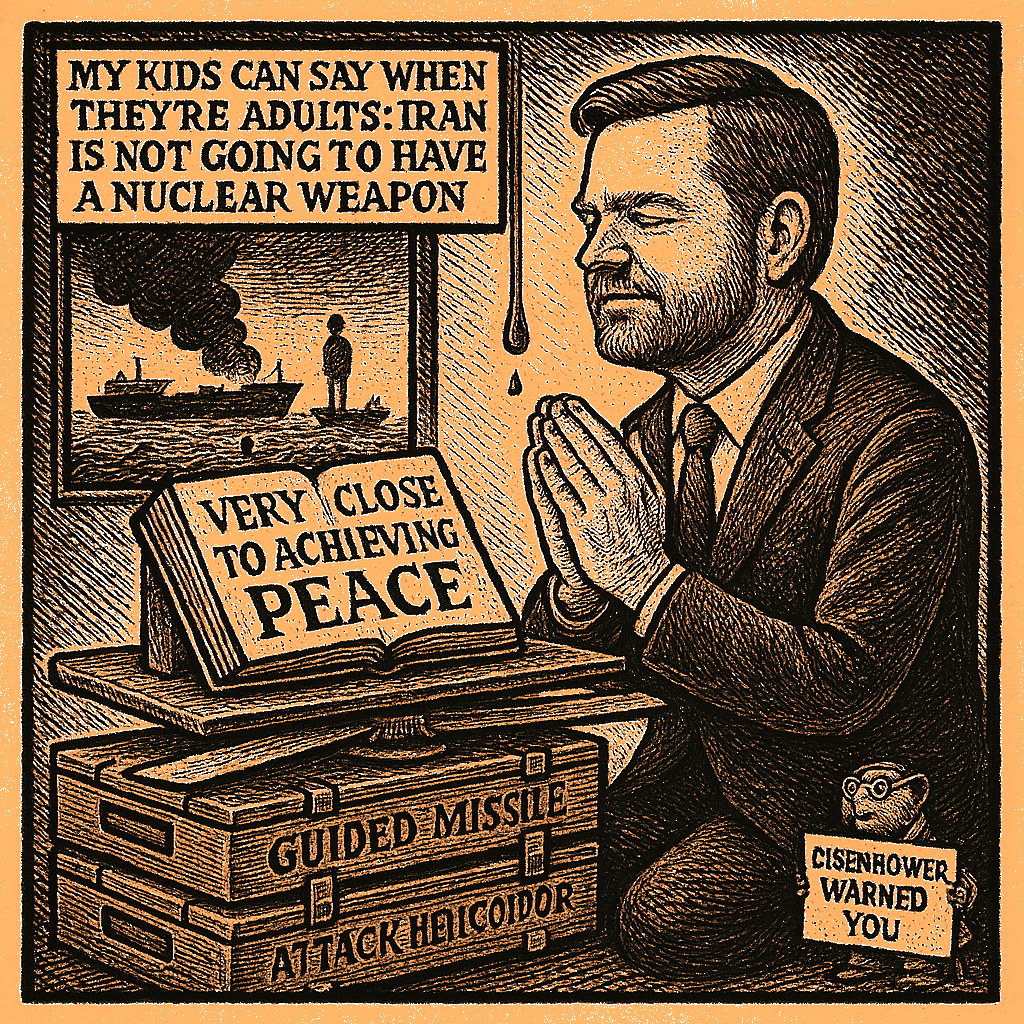
Trump and Vance are killing people and calling it a peace deal.
The vice president’s CBS interview, taped Tuesday morning before Central Command launched retaliatory strikes on Iran, is a study in slaughter dressed as statecraft. “Very close to achieving” a peace deal, Vance told the audience. A deal that could “absolutely” come before midterms. The administration is “in a position to get a deal that is good for the United States economically.” This is not diplomatic language; it is real-estate language repurposed for war. “Economically good.” “Closing dates.” Vance’s transcript converts human extermination into commercial phrasing, erasing the dead not by omission but by substitution. He is not describing a negotiated settlement between sovereign states. He is performing the pitch.
The timing is the confession. Vance taped his remarks Tuesday morning. Tuesday evening, Centcom announced the strikes. The deal-talk and the bomb-talk are the same operation, a single military-diplomatic rhythm that uses peace promises to launder escalation. “We’re going to keep doing it,” Vance said later — “doing it” is killing people, and “it” is not the deal but the war. The operational machinery has its own calendar, and the diplomacy exists to absorb congressional scrutiny while the logistical apparatus moves hardware forward. Every announcement of a breakthrough is calibrated to coincide with a fresh round of munitions expenditure. The defense contractors and the strategic planners have synchronized their timelines.
Dwight Eisenhower warned in 1961 against the conjunction of an immense military establishment and a large arms industry — the total influence “economic, political, even spiritual.” Vance’s closing invocation — “my kids can say when they’re adults: ‘Iran is not going to have a nuclear weapon’” — is precisely what Eisenhower meant. The spiritual register has been looted for operational cover. Vance is claiming a moral inheritance for a permanent military posture, as if his children’s safety flows from a blockade and a bombing campaign rather than from the kind of genuine settlement that would also protect the children of Iran. He is not describing a diplomatic achievement; he is describing the bill for a war the executive branch never asked Congress to authorize.
The claim of “proportional response” hollows out by the hour. The Apache helicopter was downed near the Strait of Hormuz because the United States launched a war there, and the administration treats its own forward presence as routine and any defensive reaction as aggression. Michael Walzer drew the line in Just and Unjust Wars: proportionality is measured against the particular act that triggers a response, not against a permanent entitlement to escalate. Andrew Bacevich applies the harder rule: a military establishment that treats its own global posture as neutral infrastructure cannot credibly call anything proportional, because it never counts the first injury it inflicts. The mechanism is circular. Launch strikes. Label the response aggression. Strike again as self-defense. Call the escalatory spiral a negotiation process. This is not a peace process; it is the operational logic the MIC installed decades ago and now operates without anyone needing to turn it on.
Barbara Tuchman documented how governing elites repeat fatal policy errors precisely because institutional machinery rewards persistence over correction. The blockade of the Strait, the retaliatory strikes from Iranian-aligned forces, the soaring global energy costs are not temporary setbacks; they are the arithmetic of a strategy that mistakes destruction for diplomacy. Marco Rubio’s congressional testimony detailing severe nuclear limitations reads like a demand for surrender no sovereign state will accept, and the response was immediate: Iran’s parliamentary speaker declared every U.S. base in the region a legitimate target. Washington sets conditions Tehran meets with escalation, and the bombing that follows is not an accident of failed talks; it is the intended outcome of an impasse manufactured in Washington.
I will not concede that the executive branch holds unilateral power to wage war under the banner of temporary negotiations. End the strikes. Lift the blockade. Force the diplomatic corps to actually sit down and bargain instead of letting the munitions schedule dictate foreign policy. We are trading blood for a press release, and the bill will not be paid in midterms. Vance says there is “wood to chop.” The structure ensures the wood is human, the chopping never stops, and the deal is just the sound of the axe.