
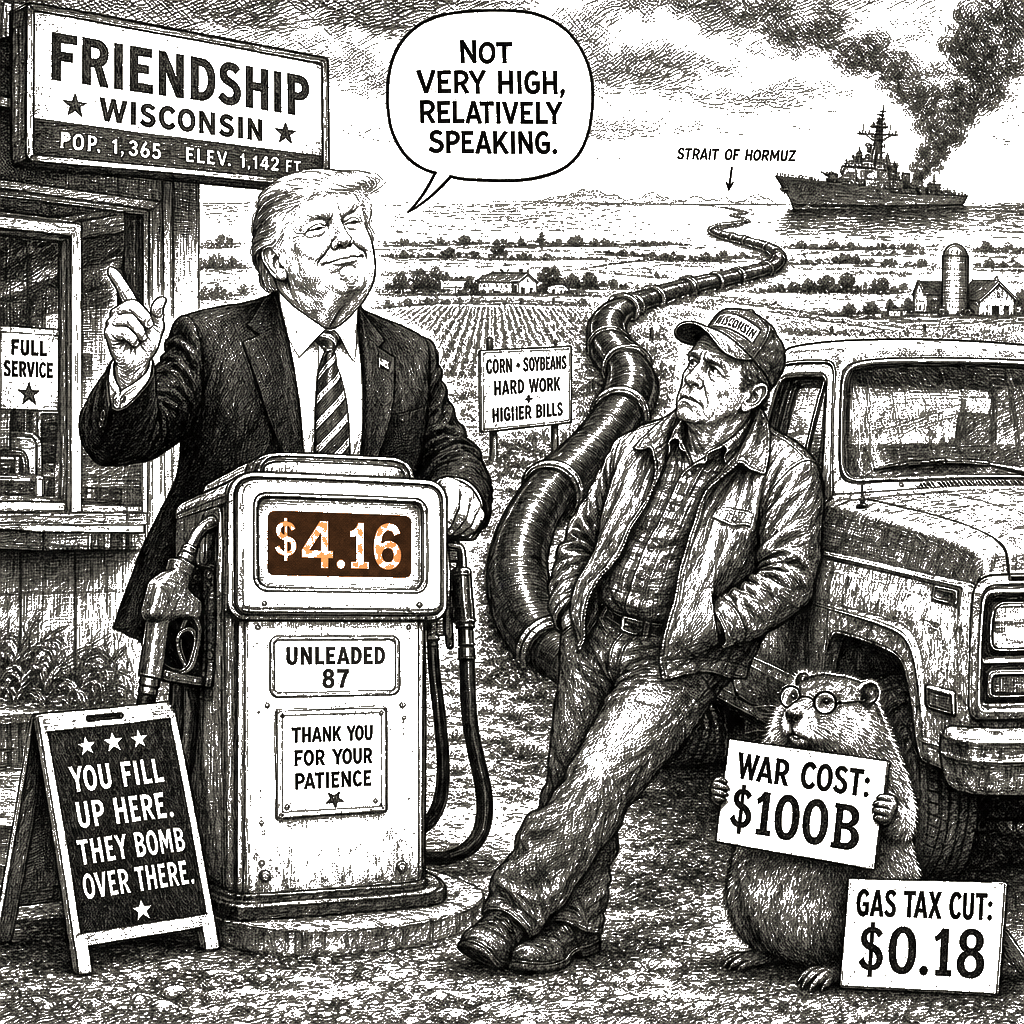
Donald Trump closed the Strait of Hormuz and is starving rural America to pay for his Iran war. I pulled up to the Co-op in Friendship on a Tuesday morning and filled the Silverado at $4.16 a gallon. Twenty-six-gallon tank. Do the math and it comes out to a hundred and eight dollars I will not see again, and neither will anyone else in this county who has to drive to work, haul hay up County J, or run a snowplow when the wind comes off Petenwell in January.
The president said it to reporters from New York after the NBA Finals crowd had booed him off the jumbotrons. The prices were “not very high, relatively speaking.” Relatively speaking to what? To the nearly seven dollars we saw at some pumps in the summer of 2022, which was also the product of a war this administration’s approach to has been, to put it generously, a moving target. To the three-something the pump showed before the Iran war started in late February, before the orders went out for a military campaign in the Persian Gulf that had the entirely predictable effect of closing the world’s most important oil chokepoint and sending the global price through the roof.
I do not know what “relatively speaking” means to an NBA crowd. I know what it means to the guys who run a brush hog in Friendship when diesel passes five dollars. It means you do not cut the back forty this month. It means you watch the propane truck fight for traction on Coon Hollow Road while you turn the thermostat down and tell your wife the kids can wear their Carhartts inside. It means you tell the mechanic to skip the bearing replacement and you hope the chainsaw does not kick back on you in October.
About twenty percent of the world’s oil passes through the Strait of Hormuz. You cannot fight a war in the Persian Gulf and keep it open. The administration has spent months documenting the same chokepoint-driven pattern — a military operation in the Gulf, a tanker insurance market locking down, a price jump at a pump in Adams County that had nothing to do with the decision to send the Navy in. When the insurers cancelled the risk cover in the strait, the price at the pump went up and the invoice landed on the same households that have no margin left to absorb it.
This is the nationalist shell game stripped down to its mechanics. The rhetoric demands total alignment on security and foreign policy — America First, energy dominance, drill baby drill — and then deploys that rhetoric to justify a war that produces the opposite of energy security. The Strait of Hormuz does not respond to campaign slogans. The price of a barrel of Brent crude does not respond to the word “dominance.” It responds to a tanker captain’s risk calculation, and the calculation right now is that the water is hot. The working class pays the premium for a conflict it did not launch.
The operator in Adams County cannot absorb a forty percent jump in propane because the administration decided to risk the Hormuz corridor, and I cannot eat the margin on the parts counter and still pay for Sara’s school insurance. That is worker self-exploitation dressed up as economic policy. That is what happens when the macro decisions of a defense state land on a micro economy that has already been hollowed out by three decades of consolidation.
The gas tax suspension the president pushed last month was a token. The eighteen-and-a-half-cent federal gas tax lifted from a price that had jumped a dollar on his watch. A token acknowledges the pain without accepting responsibility for causing it. When you blow up the bridge, you do not get to stand on the riverbank and tell the commuters the toll is reasonable.
Moody’s Analytics put the household cost of this war and its energy spike at $100 billion. That is a number large enough to be abstract and small enough to be specific. It means every family that drives a vehicle, every small business that runs a delivery truck, every school district that fuels a fleet, every farmer whose combine burns diesel through a harvest. It means the grocery prices that went up because the trucking company’s fuel surcharge went up. It means the airfare that went up because Jet Fuel A went up. It means the man across the road who works construction in the Dells thinks about finding a closer job and the school board looks at the bus budget with fewer options and the margin between making it and not making it gets thinner by a recognizable amount every time someone fills a tank. It means the LP delivery I pay out of the shop’s operating account. It means the guy driving the feed truck to the Adams-Columbia Electric Cooperative.
Wendell Berry wrote across a shelf of books that the extractive mind measures everything by what can be taken and nothing by what is left. Aldo Leopold wrote about the land as a community, and Berry wrote about the membership. The membership is the people who live here and run the machines that keep the county functioning. You cannot starve the membership and expect the land to hold together. You cannot tell a man in Friendship that his heating bill, his grocery bill, and his drive to the Dells are collateral damage for a geopolitical fight halfway around the world and expect him to believe the country is working for him.
The Strait of Hormuz is the extractive mind at global scale. The oil comes out, the money comes in, the war comes with it, and the cost is distributed to every county that does not have a member of Congress on the Armed Services Committee. War is expensive. The invoice always arrives at the pump. When the strait closes, the invoice does not land on the defense contractor’s balance sheet. It lands on the guy in Friendship who runs a one-man shop and cannot pass the cost along.
A real energy policy for the working class does not start with dropping bombs on a strait and hoping the markets stay calm. It starts with insulating the houses in the county so the people who live in them do not have to choose between heating the shop and buying groceries. It starts with a rural grid that can handle the load without pricing the mechanic out of his own pole barn. It starts with treating diesel not as a geopolitical chip but as the blood of the working economy. You protect the strait, or you price the fuel, but you do not do both and then ask the working class to tell you their prices are fine.
I have no theory about what the Fed does next week or what the inflation numbers will say Wednesday morning. Inflation was creeping up before the war. Those are footnotes. The president broke the supply line and is now complaining about the price. I have a theory about what happens in Friendship when a gallon of gas costs $4.16 and the president says that is not very high. The war ends when enough people decide the cost of keeping the strait closed is higher than the cost of not keeping it closed. The cost, right now, is $4.16 in a county that did not vote for this war and cannot vote to end it — with the president in New York telling everyone the pain is not real, and the guys on County Z knowing exactly what it costs. We know it when the snowmobile rides a little less this winter. We know it when the parts order gets pushed to next month. We know it when the co-op rate ticks up and the margin disappears. A county does not survive on rhetoric. A county survives on cheap energy and working margins. We are losing both, and we are supposed to be grateful it is not higher.