
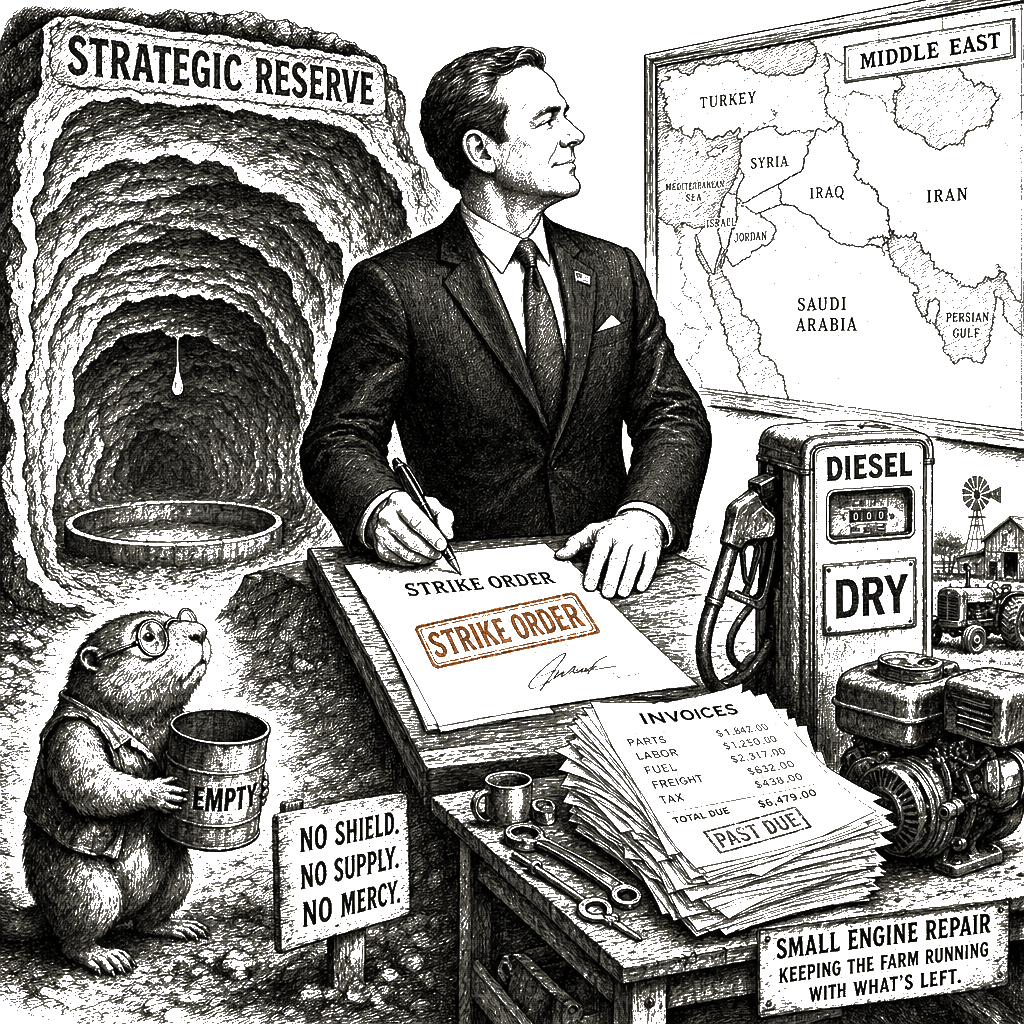
Trump drained the oil reserves and is robbing rural America to bomb Iran.
I filled the Silverado at the Cenex on Highway 13 this morning. $3.85 a gallon at the national average, up from $2.98 when the Iran conflict started. That is real money in a county where median household income runs about $59,000 and the labor-force participation rate is well below the state average. My 2014 truck has 187,000 miles on it; the truck has to last. When diesel goes up, the price I charge for sharpening a Stihl chainsaw or rebuilding a snowblower has to follow, and the people paying that bill are the same people filling their own tanks.
The Strategic Petroleum Reserve sits at the lowest level since 1983. Cushing, Oklahoma — the central U.S. storage hub — has hit operational limits that make withdrawing more crude difficult. The Energy Department authorized 40 million barrels for release in the most recent drawdown. It actually released about 500,000, because prices fell and the administration slowed the releases as inventories declined. Commercial stockpiles posted their first uptick after eleven weeks of drawdowns — 3 million barrels, a rounding error when Cushing is at the wall.
The administration speaks in the vocabulary of energy dominance and global abundance. The reality on the ground is a supply chain stripped to the studs. Donald Trump ran on the line that exports would set records and the country would no longer be at the mercy of foreign suppliers. The record got set. U.S. crude exports soared in April after the administration declared the energy market “open for business.” South Korea, the Netherlands, Taiwan — countries that could not get barrels from the Middle East — turned to the U.S. Exports are likely to end July below four million barrels a day, a level last seen in February before the war started, according to Kpler. The exports got shipped. The reserve got drained.
This is the Nationalist Shell Game contradiction laid bare: the rhetoric of American independence colliding with a geopolitical map that still routes twenty percent of the world’s petroleum through the Strait of Hormuz. The first ledger counts the strategic reserve the country is supposed to keep. The second ledger counts the crude that left the country in the first half of 2026. Both ledgers are signed by the same administration. You cannot posture for the cameras about breaking free from foreign energy and then launch a strike campaign that guarantees the price of that energy will spike. The multinational oil markets do not care about the domestic talking points. They care about the tankers, the strait, and the spare capacity, and the spare capacity is gone.
Wendell Berry’s argument in The Unsettling of America is that the consolidated-operator economy breaks the membership before it breaks the economy. The membership is the relationships, the local ownership, the household economies that hold a community together before the cash register rings. The 1983 low in the SPR and the record export months are the same story told in two ledgers.
Now the administration has launched new strikes on Iran, after declaring the June ceasefire over. Oil executives warned in June that the U.S. was heading into a severe supply crunch. The warning was on the record. The administration launched new strikes anyway. U.S. oil prices climbed about 5% to $73.90 a barrel in early Thursday trading, the highest level since late June. Gasoline futures rose 6.1%. Diesel futures rose more than 10%. Andy Lipow, the Houston analyst, is right: once the shelf is bare, there is nowhere to turn. The only way to get prices back in balance is for prices to go up enough to destroy demand.
The damage is measured in the products market, not just the crude market. U.S. diesel inventories are at the lowest levels since the early 2000s. Gasoline stockpiles on the Gulf Coast are 7.2 million barrels below the five-year average, according to OPIS. China this week said it would lift a ban on refined-product exports, meaning Chinese refineries will soon ramp up production. Russia banned diesel exports on Wednesday to keep domestic supplies from sinking further and recently imported fuel from India — one of its biggest oil buyers — in a rare move that underscores the tightness. Ukraine’s drone strikes on Russian refineries have taken out a substantial portion of Russia’s capacity to make and export fuel. None of those barrels are coming to my county. All of them are why the price of every part on the bench — the carb kits, the recoil assemblies, the chain loops, the small-engine oil — keeps moving up.
The diesel number is the one that lands at my bench. I run a Honda EU2200i generator when the power goes out at the shop. I have a 2019 Polaris snowmobile I bought at auction. The LP that heats the house runs through a meter that ticks faster every winter. None of that is crude. All of it is downstream of the same supply chain the SPR was built to backstop.
For the operator running a John Deere combine or a Kubota tractor, or the trucker hauling potatoes from the central sands to the processing plant, diesel is the baseline operating cost of the rural economy. When the margin on the harvest disappears because the fuel to bring it in costs a dollar more a gallon, the farm does not pivot. It just bleeds. The family farm does not have the scale to absorb the shock. The consolidated operations might have the hedging instruments and the corporate balance sheets to weather the spike, but the small operator eats the loss directly.
The extractive mind does not distinguish between the topsoil in the sand counties and the salt caverns on the Gulf Coast; it just sees a reserve to draw down until the price tells it to stop. The strategic reserve was supposed to be the shield against the distant market’s shocks — the recognition that a nation needs a buffer between its people and the geopolitical whims of a region eight thousand miles away. By draining it to fund a foreign posture, the shield is gone.
A real energy security policy would rebuild the strategic reserve to a level that actually insulates the domestic economy from a Middle East closure. It would recognize that rural America’s fuel needs are not a line item to be sacrificed on the ledger of a foreign war, and it would invest in the rural energy interface — grid resilience, broadband, the actual transition of the agricultural fleet — so that the price of a barrel of crude in the Persian Gulf does not dictate the survival of a family operation in Adams County.
The twelve-year climate-witness notebook tracks the ice-out on Lake Petenwell and the rut-onset in the woods, the steady phenology of a place adapting to a warmer world. But there is no entry for the November morning when the operator stands by the combine, calculating whether he can afford the diesel to finish the harvest. The natural rhythms of a warming world stop mattering the moment the fuel math breaks. I will keep the truck running. Sara will drive the kids to school in hers. The shop will open in the morning. The reserve is empty. The strikes are starting. The price is what it is.