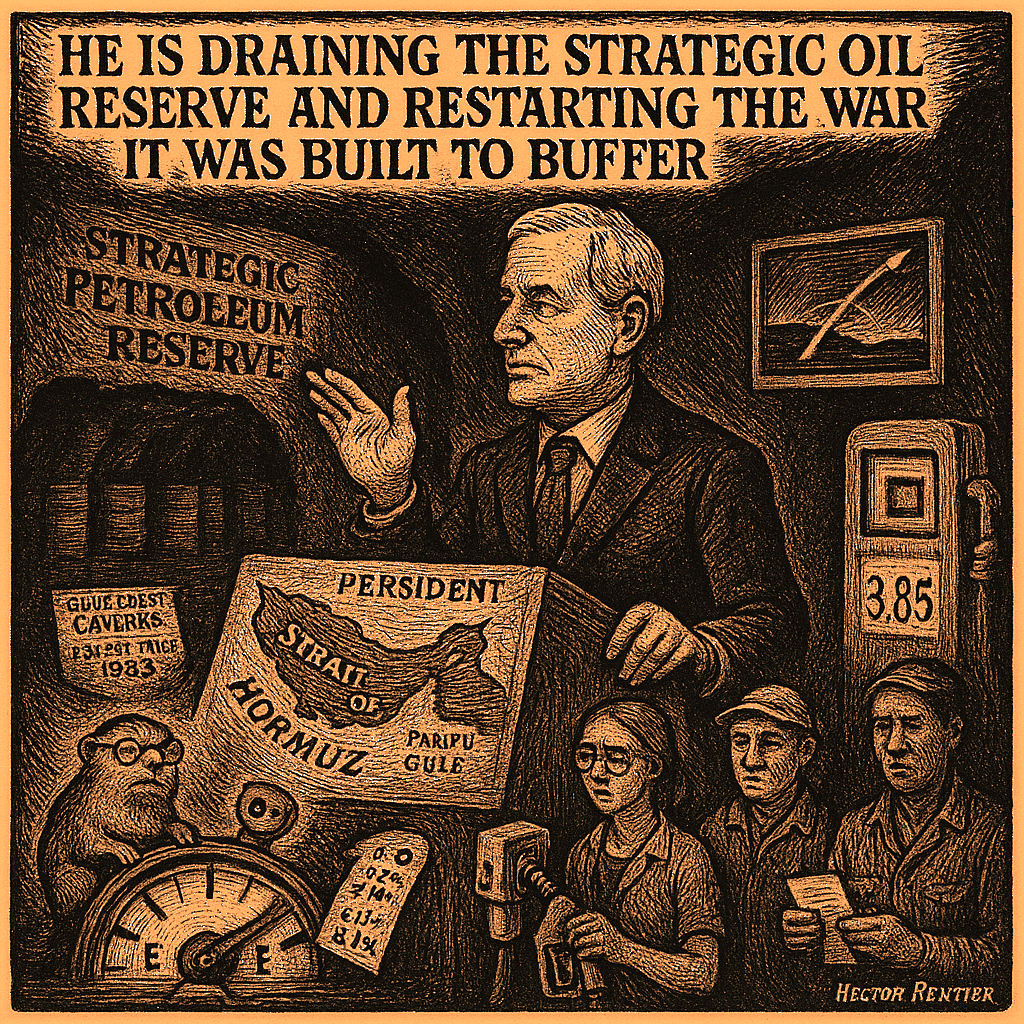
Donald Trump is draining the strategic oil reserve and restarting the war it was built to buffer.
The salt caverns on the Gulf Coast are scraped down to their lowest levels since 1983. The Energy Department authorized the release of forty million barrels in the days after the war restarted; barely five hundred thousand have moved. The commercial storage hub at Cushing, Oklahoma, has reached the operational limit beyond which no more oil can be withdrawn without breaking the system. OECD crude stockpiles have sunk to 1990 lows as the tanker traffic through Hormuz resumed, and now the same administration that sold the country’s reserves is striking Iran again. The supply chain of harm is written in the ledger: diesel futures soared more than ten percent, gasoline jumped 6.1 percent, and the national average at the pump climbed from $2.98 to $3.85. Diesel, the fuel that moves the trucks that move the harvest, has been exported at near-record levels to buyers in Brazil, in Europe, in Asia. You are asking the mother who drives to her second job, the farmer who needs fuel for the harvest, the diesel mechanic in Amarillo watching the price of his fuel go up while the harvest comes in, and the working mother in Bakersfield filling her tank to drive to a job that pays her just enough to fill her tank. The gospel knows them by name. The country does not.
This is the architecture of structural sin. Óscar Romero named it pecado estructural — the reality that when an economic and political system wages war and extracts the cost from the vulnerable, the system itself is sinful. The poor are not merely experiencing the side effects of your policy. They are the fuel. Amos, the shepherd of Tekoa, looked at the merchant who tramples on the needy and brings the poor of the land to an end, and he said the day of reckoning was coming. The merchant was selling what was meant to be shared. The merchant was selling what was meant to be kept. The reserve is not the Lord, but the trust is sacred, and the day it is sold for the merchant’s profit is the day the country has lost its way.
The strategic reserve was meant to be the shelf that never goes bare. It was the backstop for a hurricane, for a disruption, for the day when the world caught fire. Jesus asked which of you, desiring to build a tower, does not first sit down and count the cost, lest he not be able to finish and all who see it begin to mock him. You counted the cost in barrels, not in lives. You looked at the global map and decided the empire’s posture was worth hollowing out the caverns. Now the tower stands half-finished. You have caverns you cannot refill, allies you cannot supply, and a poor citizenry you cannot fuel, and the world watches the empire fail to complete the very project it began.
Oil executives warned of this in June. Pope Francis named the condition the globalization of indifference. We have become so accustomed to the suffering of others that it no longer moves us to weep. The evidence is written across the globe. Russia has banned diesel exports to keep its own domestic supplies from sinking, and in a rare reversal is importing fuel from India. China is lifting its ban on product exports as the pinch tightens. When the tanker traffic slows in the Strait of Hormuz and the diesel dries up from the Gulf Coast to the factories of Brazil, the analysts call it a supply crunch. The prophets call it a moral failure. Andy Lipow, the Houston analyst, said the only way to get prices back into balance was for prices to go higher, until demand was destroyed. “Once the shelf is bare, there’s nowhere to turn.” He was talking about the shelf at Cushing. He was also, without quite meaning to, talking about a country that has been hollowed out by a generation of choices to treat what was meant to be a strategic buffer as a marketing line.
I am a carpenter. My truck has a tank. I have benefited, like every other driver, from the cheap gas that came from the system that sold off the reserve. The system I depend on is the system I am now watching fail. I am part of the country that has been hollowed out. We all are. The confession is not original. It is the confession of a nation that has been told, for a long time, that it can have its oil and sell it too. It cannot. The cupboard is bare. The price at the pump is the invoice for that choice, and the working family paying it did not make it. We, the comfortable, who accepted the bargain that our comfort required the projection of military power, bear a share of this guilt. We are not exempt from the moral arithmetic. Every administration, Republican and Democratic, has reached for the reserve in a tight moment, and every administration has been told by the analysts that this is exactly what the reserve is for. The structural problem is not new. The structural problem is the choice to treat a strategic buffer as a price-control dial, and that choice is bipartisan, and the bill for it has always come due for the people least able to pay.
The country sold the reserve. The country is now selling them. The King answers the ones who failed to see: “Truly I tell you, just as you did not do it to one of the least of these, you did not do it to me.” You can refill the caverns, Mr. President. You can stop the war. The next president, of either party, can make the same choice. The door of return is the simple, ancient, hard work of restoring what was taken — of refilling the reserve, of rebuilding the strategic buffer, of making the next hurricane or the next war something the country can absorb without breaking the family at the pump.
A country is like a house. When the foundation is cracked, you do not build higher. You stop. You pick up the broom. You let the poor breathe. The work is the work of the carpenter as much as it is the work of the senator. The cupboard is bare. The bill is on the table. The door is open.