
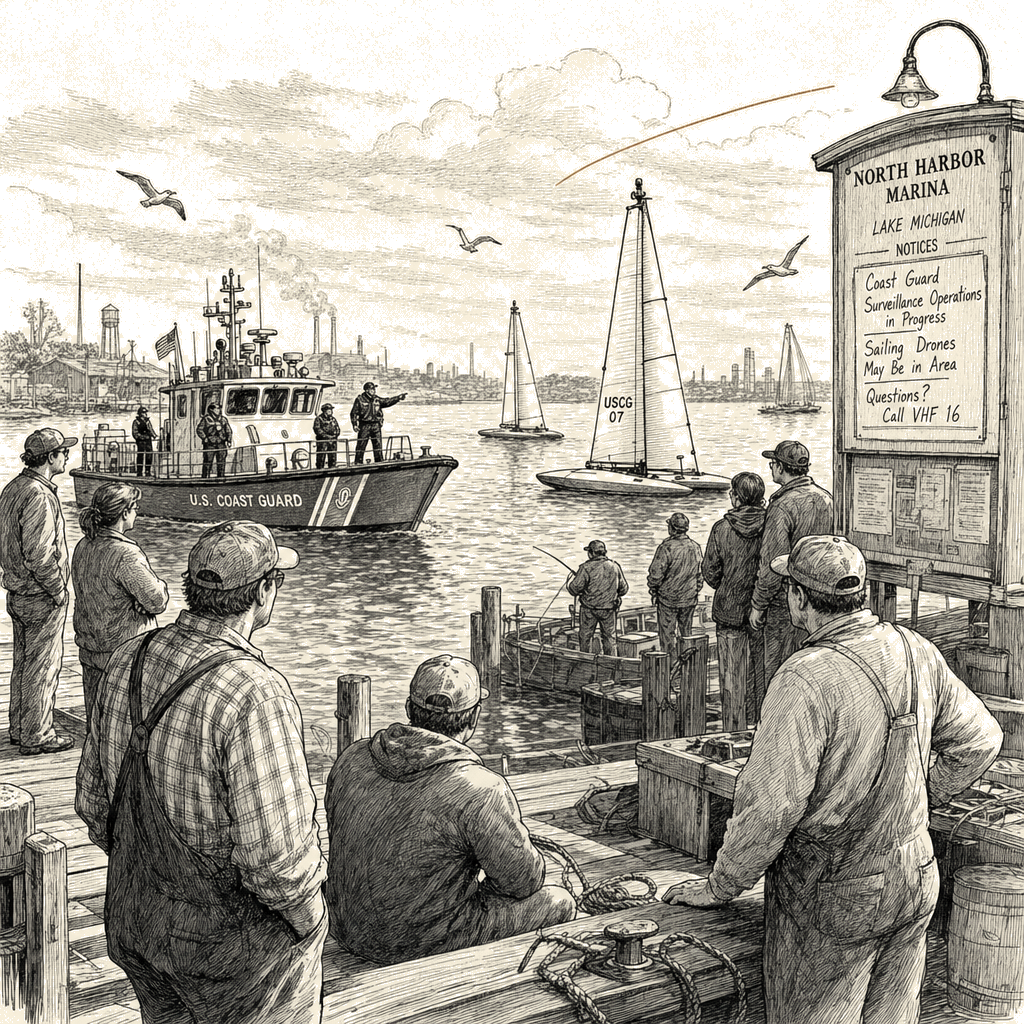
The Coast Guard contracts Saildrone to build a permanent surveillance dragnet across the Great Lakes. It is true that the agency’s public framing leans on the language of border interdiction—tracking narcotics, interdicting human trafficking, catching illegal fishing. And it is true that the waterways in question cross an international boundary, which gives the federal government a jurisdictional hook to plant hardware there. The trouble is that nearly all of the documented cross-border smuggling that actually occurs on those waters runs in the opposite direction from the one the Coast Guard now says it is trying to stop. Canadian border agents routinely seize tens of millions of dollars’ worth of cocaine and methamphetamine entering Canada from the United States every year. The Coast Guard, when asked, cannot produce a single seizure figure for the reverse flow on the lakes themselves, telling the Guardian it withholds the numbers “for operational security reasons.” The operational security in question appears to be the security of a program that needs a threat to justify its existence, and has so far failed to find one. The hardware being planted is not an interdiction platform; it is a data-harvesting architecture.
What it has found is a contractor. The Coast Guard recently announced the deployment of at least six—and possibly as many as sixteen—Saildrone Voyager uncrewed surface vessels on the Great Lakes this summer, funded under a $15.5 million contract from the administration’s “One Big, Beautiful Bill Act.” The Voyager is a thirty-three-foot sailing drone that carries radar, optical sensors, and an onboard artificial-intelligence classification system, and can operate for a hundred days without refueling or direct human intervention. The company, Saildrone Inc., is a California-headquartered defence contractor that recently took a $50 million investment from Lockheed Martin to equip its larger vessels with JAGM missile launchers; the Great Lakes fleet is running the softer variant. The spec sheet is less revealing than the operating model: Saildrone describes the arrangement as “contractor-owned, contractor-operated,” which is a dry way of saying that a private company collects the surveillance data, stores it on proprietary infrastructure, and sells the feed to the government. The lakes are public; the database is not.
Petra Molnar, the author of The Walls Have Eyes and associate director of the Refugee Law Lab at York University, calls this “a very troubling arrangement from a privacy and accountability standpoint, as we have very little public information about data retention, who can access what data is collected, or how people using the region recreationally can be swept up in a data system built for border enforcement.” The accountability problem has a specific legal geometry: because Saildrone, not the Coast Guard, owns the raw sensor data, a Freedom of Information Act request for the radar tracks of every fishing boat that crossed a particular line on Lake Erie last August would almost certainly be met with the reply that the records are not agency records. The government has purchased itself a surveillance blind spot that it can look through but the public cannot. This is the precise arrangement that the Electronic Frontier Foundation has spent two decades warning against in the context of license-plate readers, face-recognition databases, and police body-camera footage. The contractor-owned surveillance pipeline lets the government evade public-records law by routing its seeing through a private company.
Six vessels on a lake system covering ninety-four thousand square miles cannot tactically interdict anything—the lakes cover an area the size of the United Kingdom. Molnar pointed this out on record: “Thirty-three-foot vessels cannot actually provide meaningful tactical coverage of that expanse. It is less about real-time interception by one of these vessels but rather it is about building out a persistent maritime domain awareness infrastructure.” The Coast Guard calls it “maritime domain awareness.” The engineers who design these systems call it an ingestion pipeline. The point is not to catch smugglers; it is to generate a continuous feed of location, behavior, and pattern-of-life data on roughly 210,000 recreational vessels in a given season, store it indefinitely, and make it queryable. Every hull that crosses a radar beam becomes an entry in a private database that may later be sold to other government agencies, insurance adjusters, or commercial data brokers. The boater pays the launch fee, the mooring fee, and the fuel tax, and receives in return a permanent digital footprint attached to their transponder ID.
The ingestion pipeline is the actual product. Saildrone’s private servers sit between the sensors and the government customer. The company decides what to retain, how long to retain it, and how to structure it for resale. This is not an anomaly of the platform economy; it is the default architecture when public functions are outsourced to private sensor networks. The same structural pattern is visible in California’s recently deployed AI whale-detection systems, where environmental monitoring is mediated through proprietary computer vision stacks that leave the raw training data and model weights under corporate control. But the contrast is sharp and instructive: the California program carries a clear, measurable public-safety goal, publicly accessible data, and a transparent funding stream. The Saildrone program carries none of these. Where the Bay model treats transparency as an operational requirement, the Lakes deployment treats it as an operational obstacle.
The justification offered is border security, specifically the flow of narcotics and undocumented migration. But the evidentiary record runs the other way. The Customs and Border Protection office in Detroit did not answer queries about how much of the cocaine and methamphetamine it seized in fiscal 2025 entered from Canada. The only evidence the public has for the “illicit activity” the drones are meant to track is the assertion that the drones are needed to track it—an infinite loop of threat-inflation that requires no calibration against the world. When an enforcement agency deploys a surveillance grid in the absence of documented threat metrics, the grid stops being a law-enforcement tool and becomes a general-purpose data collection exercise. The premise is not the threat. The premise is the data. Saildrone previously tested its drones on Lake Erie in 2023 under a scientific-research banner, a baseline that makes the current shift all the more stark: the same hardware has been rebranded from benign research to coast guard mission.
Data collection matters because of what happens next. The structural logic mirrors what Cory Doctorow terms enshittification: a service deployed to solve a public problem is gradually reconfigured to extract value from its users once switching costs rise. Here, the users cannot leave the waterway; they are locked into a jurisdictional commons, and the extraction is informational rather than financial. The first deployment is framed as a narrow, safety-oriented pilot. The sensors go up, the retention policies are written by the contractor, and the public accepts the trade-off because the threat model feels plausible. Once the architecture is in place, the retention window is quietly extended from thirty days to three hundred and sixty-five. The classification algorithm, initially tuned for “suspicious loitering” or “unmarked hulls,” is updated to tag recreational patterns—fishing grounds, charter routes, weekend cruising corridors. The data is then cross-referenced with customs databases, insurance records, and commercial AIS feeds. The boater who bought the slip, filed the registration, and respected the navigation rules has now been scored, profiled, and stored. The system that was sold as a shield becomes a ledger.
Meanwhile, the drones carry a deliberate mislabel that adds a small, telling layer of camouflage. On the Marine Traffic website, where the public can track vessel movements, the Saildrones are registered as “pleasure crafts.” A thirty-three-foot autonomous surveillance platform carrying government-funded radar and optical sensors, built by a firm whose marquee investor is one of the largest weapons manufacturers in the world, is listed in the same category as a pontoon boat. The Coast Guard says it has no plans to arm the Great Lakes drones, but the president of Saildrone is a retired Navy vice-admiral who spent thirty-four years in uniform. The classification is a small fraud, and it tells you how the larger fraud is being stage-managed: a military-surveillance project dressed as a law-enforcement necessity, which is itself dressed as a recreational boating aid.
Steve Hales of the Port Clinton Yacht Club argues that the Great Lakes are a “very soft border” with Canada and that we need Coast Guard presence or drones to protect it. That framing mistakes a hardware problem for a policy one. More sensors do not fix an opaque procurement contract; they only enlarge the ingestion pipeline and normalize the contractor’s custody over public waters. Ryan Weekes, commodore of the InterCity Yacht Club in Cleveland, asked for transparency when new surveillance technology is deployed. He is asking for the minimum viable oversight in a system that has none.
The lakes belong to the public. The justification for watching them on behalf of the public cannot be withheld for operational security reasons while the surveillance itself is sold to the government by a Lockheed-funded contractor that lists its spy ships as pleasure boats. A public-benefit architecture would require open-standards data formats, legislated retention limits that do not expire at the contractor’s discretion, and a statutory prohibition on secondary sale to commercial brokers. Without those three, the dragnet operates on trust; with them, it operates on constraint. Until one exists, the government will keep renting its own blind spots from the military contractors who helped design them. The Coast Guard won’t say what drugs it is looking for. It will, however, know where your boat was last Tuesday—because Saildrone has already sold it that information. The water remains open; the record does not.