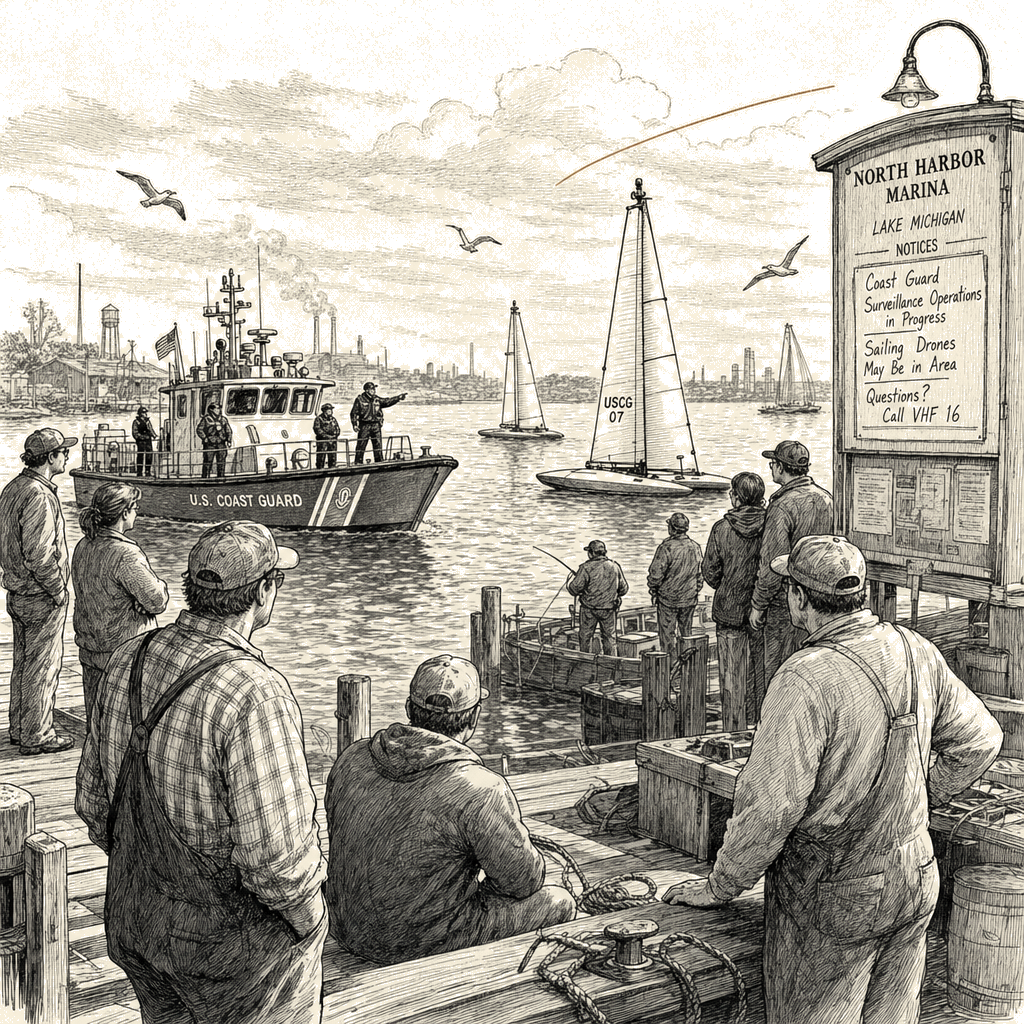
The Trump administration is turning the Great Lakes into a migrant dragnet. There is no other honest way to describe an armada of surveillance drones that will spend the summer patrolling waters shared by millions of citizens, recreational boaters, and families — all under the pretext of “tracking illicit activity” that the agency’s own spokesperson admits does not exist in any new or acute form.
A $15.5 million contract between the Coast Guard and the California company Saildrone, funded through Trump’s “One Big, Beautiful Bill Act,” has placed six 33‑foot Voyager drones on the lakes, with talk of growing the fleet to as many as sixteen. The vessels are equipped with radar, cameras, and artificial intelligence; they can operate for 100 days without refueling; and they are owned and operated by a private defense contractor whose president is a retired Navy vice‑admiral and whose most significant recent business move is a $50 million investment from weapons manufacturer Lockheed Martin. A Coast Guard official says the agency does not envision arming the Great Lakes drones, but the same company is now mating its larger vessels with combat‑proven missile launchers. The trajectory is visible to anyone willing to look.
And there is almost nothing on these waters that justifies the cameras. The Coast Guard was asked for a breakdown of drug seizures along the Great Lakes border; it declined to provide figures “for operational security reasons.” Canadian border agents seize tens of millions of dollars’ worth of drugs every year — after the drugs enter Canada from the United States. The lakes themselves have produced a handful of reported interceptions, and the Coast Guard’s refusal to share specific figures is being treated not as good news but as an inconvenient silence in the story the administration wants to tell. When there is no crisis, you manufacture one — and when the manufactured crisis needs hardware, private contractors are ready to supply it.
At the same moment that California is deploying artificial intelligence to protect migrating whales from ship strikes, the federal government is deploying similar technology on the Great Lakes not to safeguard life but to assemble a digital dragnet that will inevitably sweep up the most vulnerable. Petra Molnar, author of The Walls Have Eyes and associate director of the Refugee Law Lab at York University, calls the arrangement “very troubling from a privacy and accountability standpoint.” The drones operate under a “contractor‑owned, contractor‑operated” model: Saildrone collects the surveillance data and sells it to the government, and almost nothing is known about how the information is stored, shared, or retained. Every person who takes a boat onto Lake Erie — including the members of the Inter‑City Yacht Club, one of the few Black‑run boat clubs in the country — will have their movements recorded, analyzed, and routed through a system built for border enforcement.
It is easy to dismiss the complaint as the anxiety of leisure. But peace is the right to cast a line off South Bass Island without your boat registering as a contact of interest. When the water becomes a field of operation, the sailor becomes a subject of audit. Pope Francis warned against the globalization of indifference; here we face its inverse, the globalization of anxiety — the quiet assumption that every moving object on a peaceful lake must be catalogued.
The administration will say this is about human trafficking and narcotics, but the infrastructure is being built for immigration control. The lakes touch five U.S. states that share a water border with Canada, and the Trump White House has spent years accusing Canada of allowing illicit drugs and, by extension, illicit people to flow south. The drones are the newest sensor in a surveillance apparatus that has been growing for decades, under both parties — Adam Goodman, in The Deportation Machine, documents nearly a century of formal removals and millions more expulsions engineered through fear, administrative pressure, and the quiet coercion that makes people disappear without ever seeing a judge, the same data‑harvesting logic that the Great Lakes drones now extend across America’s freshwater boundary. The Lockheed Martin investment, the installation of a retired vice‑admiral at the helm of the company, the refusal to publish seizure figures under operational security — these are the markers of an apparatus manufacturing its own necessity.
I grew up in a city where classmates vanished in pre‑dawn raids, and I know what it looks like when a government decides that a border is a war zone. Those of us who have accepted the narrative that every mile must be monitored, that every crossing is a threat, that security alone can justify the machinery, have helped lay the foundation on which this drone fleet now floats. We who have welcomed the rhetoric of secure borders have built a climate in which unguarded geography is treated as a breach — a pattern that has been the steady work of both political coalitions, and our acquiescence has been the permission. The water does not care about our politics, but our policies turn it into a checkpoint.
Amos watched the powerful turn the marketplace into a trap and warned against those who trample the needy and silence the poor, and this surveillance grid is the marketplace‑trap of our moment, trading boaters’ ordinary movements for contractor profit. The church has always taught that the commons are given for human flourishing, not human suspicion. Pacem in Terris named the right to movement as a fundamental human right, grounded in the inherent dignity of the person. The surveillance grid makes dignity conditional on proving you are not a threat. Innocence is not what the sensors read; they read data, and data demands retention, access, and eventual use.
You shall not oppress a resident alien; you know the heart of an alien, for you were aliens in the land of Egypt (Exodus 23:9). The command is not abstract; it is a demand that we remember who we were, and that the memory govern how we treat the people crossing the same water we now want to patrol like a militarized perimeter. Pope Francis, speaking from Lampedusa, named what happens when a rich nation builds walls instead of bridges: it becomes “a factory of indifference” that loses the ability to weep for the bodies washing ashore. The Great Lakes are not yet Lampedusa, but the template is the same. First the surveillance, then the hardening, then the normalization of harm — and always the claim that this is just about security, just about protecting our own.
The door of return is open. Óscar Romero addressed the men in uniform and told them, You are our brothers, and he commanded them to refuse the order of repression. You who are programming the awareness matrices and watching the screens in Detroit and Cleveland: you do not have to feed them. The water is not a frontier to be conquered. It is common ground. The contracts can be rewritten. The servers can be wiped. The lakes can belong to the people again.
The lake in July should not be a surveillance zone. A family on a boat should not be a data target. And the God who walked across the water in Galilee, whose own parents fled across a border when he was an infant, is not impressed by a missile company’s investment in border security. Let the boats sail.