
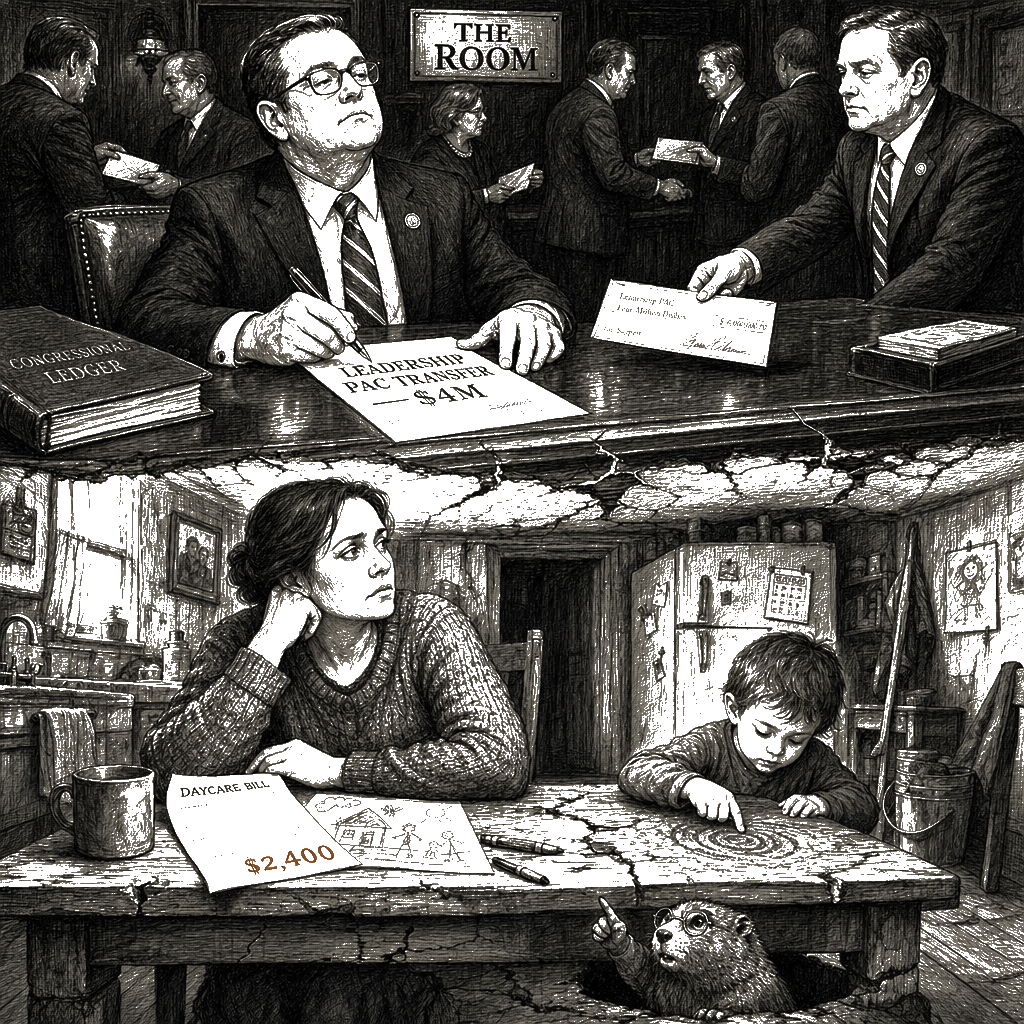
House leadership trades millions to shield their seats while families starve.
The math is the math, and it does not care about your grocery bill. While my husband David and I sit at the kitchen table trying to figure out how to cover the $2,400 monthly daycare invoice for Eva and Ben on our combined $8,800 take-home, the leadership in the U.S. House of Representatives is busy circulating a closed-loop economy. A recent network analysis of Federal Election Commission data from 2009 to 2022 shows exactly how it works. Members of Congress treat campaign cash like a private ATM, moving millions between themselves to secure their own power. In the 2021–22 cycle alone, Republican leader Steve Scalise gave to 192 colleagues. Hakeem Jeffries gave to 76. Nancy Pelosi gave to 61. The money never leaves the room. It just changes hands to keep the room occupied by the same people.
This is what the structural betrayal looks like when it moves from the household ledger to the congressional ledger. The study tracks how party insiders steer cash toward vulnerable incumbents the moment outside spending signals a threat. When super PACs flooded Abigail Spanberger’s Virginia race with $8.4 million and David Valadao’s California race with $7.36 million, the congressional network lit up. Colleagues redirected their own contributions, reinforcing the defensive wall. It is a highly efficient mechanism for protecting the political class. As we noted when Democrats fight back as outside spending scrambles their primaries, the outside money is just the trigger. The real machinery is the internal cash-swap that ensures the system resets to its default setting: the insiders stay, and the public absorbs the shock.
Kevin McCarthy’s Majority Committee PAC reportedly dropped $4 million into competitive Republican races in that same cycle. Democrats operate a tighter, more centralized hub; Republicans have shifted to dispersed clusters, but the outcome is identical. The cash is allocated to protect the institution of incumbency. Meanwhile, the federal government pays roughly 13 cents on the dollar for what it promised to fund in special education (according to Congressional Research Service calculations for the 2021–22 school year), leaving local school boards to choose between hiring aides and cutting bus routes. The IDEA funding shortfall is an annual $24 billion hole. That is 6,000 times McCarthy’s PAC payout. The math is not mysterious. It is a deliberate allocation of resources away from the household and toward the seat.
Anne Helen Petersen writes in Can’t Even that the burnout generation was sold a promise: work hard, follow the rules, and you will achieve the stability your parents had. The congressional record is the proof that the stability was never going to happen because the rules were rewritten to favor the closed loop. When the people redesigning the funding priorities are the same ones passing around the campaign checks, your suspicion is data. The household budget is treated as an afterthought, a discretionary line item that can be squeezed because voters are exhausted and scattered. The congressional network is treated as a permanent asset, continuously capitalized with millions in internal transfers and outside PAC money.
The party apparatus and the political consultants will call this “competitive fundraising.” They will frame the internal transfers as benign party-building. It is not benign. It is the architecture of a system that has decided your child’s classroom funding, your daycare costs, and your mortgage stress are acceptable externalities. The money moves to protect the decision-makers. The rest of us get to manage the shortfall on our own time.
There is no shopping-around answer to a household budget that cannot cover childcare. There is also no illusion left to maintain about a Congress that treats campaign cash as an intra-member liquidity pool while the public pool drains. The $4 million moves to the primary. The $8.4 million moves to the defensive line. And back here at our kitchen table, while Eva traces circles in the dust on the wood and Ben asks if we can afford the new shoes for school, the ledger just sits there, waiting for permission to breathe. You are on your own.