
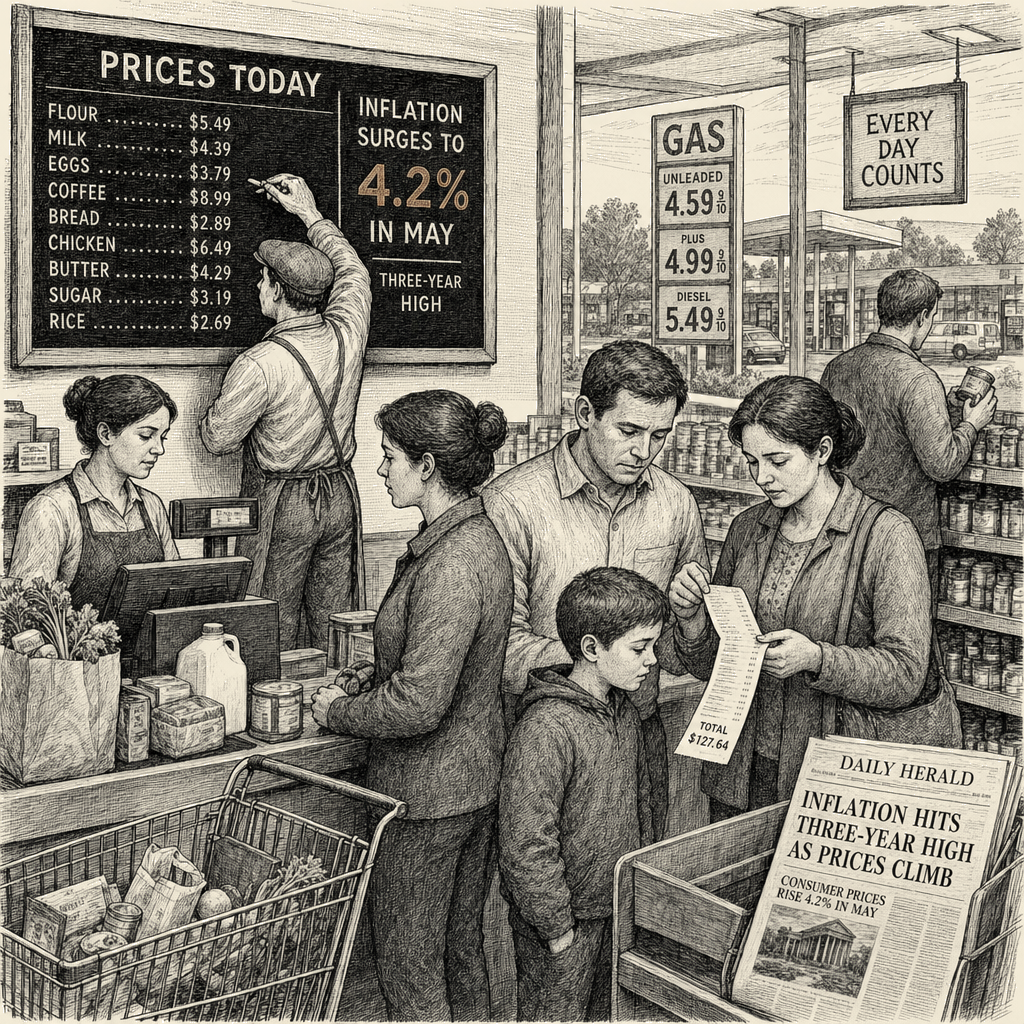
Trump is burning our grocery money to fund a war he chose. I sat at the table at eleven at night doing the math. The Bureau of Labor Statistics reported this morning that the Consumer Price Index hit 4.2 percent in May—its highest reading in three years, and the third straight month of acceleration. The driver is unmistakable: energy costs, hammered by the administration’s bombing campaign, are bleeding households at a pace that makes a lie of every claim that this war would be quick or contained. The average gallon of regular gasoline now costs $4.15. On February 28, the day the strikes hit Iran, it was $2.98. That’s a 39 percent jump in just over three months. A family with one car and a 15-gallon tank is paying an extra $17.55 every time they fill up—$912 a year simply to keep commuting to work, to the grocery store, to the daycare. That’s money that was supposed to go into the college fund or the emergency account or the back-to-school shoes. Instead, it goes into the tank.
But the pump is only the most visible tear in the household ledger. The CPI’s energy index, which bundles gasoline, electricity, and heating fuel, was nearly a quarter higher this May than a year ago. The electric bill that was $150 last May now reads $185. The gas furnace that cost $200 a month in January 2025? Same usage this past winter ran $246. These are not abstract economic fluctuations. They are line items on kitchen tables from Fishtown to Lansdale to every town where a family tries to stretch a paycheck across a mortgage, a childcare invoice, and a tank of gas.
The math is inescapable. The average U.S. household spends about $78,500 a year on everything. At 4.2 percent inflation, that household will pay roughly $3,300 more this year just to stay even—about two months of full-time infant care, or a semester of community college tuition, or the down payment on a used car that can pass inspection. And as Penn Wharton’s inflation tracker documented during the last energy shock, lower-income households face a steeper rate than the wealthy, because food and fuel consume a larger share of their take-home pay—the effective inflation they feel can be double the headline number. There’s no reason to think it’s different now. The war in Iran has given us a two-speed inflation: those with stock portfolios and paid-off mortgages barely feel it; the rest of us, the ones who run a kitchen-table spreadsheet every month, are losing ground.
This was not a weather event. It is a direct consequence of a war the administration chose, escalated, and has spent months insisting would not touch American wallets. In April, when inflation hit 3.8 percent, the administration’s line was that the energy spike would be “transitory”—the same word the White House used in 2021, as food and fuel prices climbed for two straight years, hollowing out paychecks while the word did nothing to stop the bleeding. That is not a policy misjudgment; it is a moral breach, a deliberate choice to watch ordinary families absorb the cost while the architects of the war take credit for decisiveness. The only thing transitory about this inflation is the credibility of anyone who promises it will soon be over.
The Wall Street Journal editorial page will call this “consumer adjustment,” a polite euphemism for cutting back on the things the kids need so the car payment gets made. But the adjustment is not a lifestyle choice. According to recent Pew generational economic tracking, roughly four in ten Gen Z adults and millennials say it is harder to feel financially secure than for their parents at the same age. When the cost of existing goes up 4.2 percent in a single month, that gap isn’t a feeling. It is the arithmetic. Anne Helen Petersen wrote that millennial burnout is a structural condition, not a personal failing, and this is exactly what she meant. When the cost of everything—gas, heat, food—rises by a quarter year-over-year, that is not a personal budget failure; it is the roof collapsing on a house they told us was sound. The trap is that we are told these macroeconomic shocks are just weather—we are supposed to carry umbrellas and not ask who broke the roof. But the Federal Reserve knows that higher inflation raises the likelihood of interest rate hikes, which means the very tool they use to “curtail spending” will make the $4.15 gas even more expensive because it suppresses the housing market and tightens credit while prices keep climbing. The math is punitive. It is designed to cool the economy by making the people at the bottom stop buying things. You pay for the war through higher prices, and then you lose your job for the privilege.
Taylor Swift wrote a bridge in “You’re On Your Own, Kid” that captures the exact moment the cohort realizes the safety net was never there: I had no one helping me. It is the cultural text for American care infrastructure in 2026, and it is the reality of a kitchen-table budget. There is no relief valve. Multigenerational living has roughly doubled over five decades, now sheltering about a quarter of young adults, not because we want to live together, but because the single-household model is mathematically insolvent under these conditions. When a gallon of gas costs $4.15 and the utility bill is up 25 percent, the only way to absorb the shock is to pool resources and bleed slowly.
And the administration’s real plan, the one visible in the fine print of its communications since the inflation gauge began to accelerate, is to offer nothing at all to the families absorbing the blow—no expanded Child Tax Credit, no emergency energy assistance, no childcare stabilization fund. Just a war, a higher grocery bill, and silence. That is the energy policy of the United States in 2026. You’re on your own to absorb the $300 monthly hit. You’re on your own to explain to your kids why the summer trip got canceled. You’re on your own to choose between filling the gas tank and filling the prescription.
My grandmother’s generation—the Lansdale parish women who ran the Altar and Rosary Society and the Knights of Columbus pancake breakfasts—learned a different lesson. The Catholic social teaching they absorbed, from Rerum Novarum to the corporal works of mercy, insisted that a government that makes war on other countries has a binding obligation to protect its own people from the consequences. There is a word for a ruling class that chooses war and then walks away from the families paying for it. The word is not “leadership.” The word is theft. The workers in the vineyard all received the same daily wage because the householder decided to be generous; this administration’s household has decided, with deliberation and silence, that the workers who can least bear the burden will pay the most.
Real pro-family policy would look like a refundable child-care tax credit indexed to the actual cost of inflation, an eight-week paid-family-leave guarantee funded by a small payroll contribution, and a cap on out-of-pocket energy costs for low-income households. There are actual papers with actual numbers on how this works, and they have been sitting on congressional desks for years while the CPI climbs toward 4.2 percent. The decision not to pass them is not an accident. It is a choice to prioritize defense appropriations and energy-sector volatility over the families absorbing the premium.
I am writing this from my own kitchen table in Fishtown, where my husband and I have already reworked the budget twice this month. We are fortunate: two incomes, a refinanced mortgage, a little buffer. We can absorb a $900 annual gas increase without missing meals. But I know families for whom that $900 is the difference between a working car and a broken one, between a full fridge and a bare one. And I know that this administration has no plan to shield those families. Its plan is to wage war and let the cost of that war wash over the rest of us like a flood.
We are back at the table, running the math four ways, and every path ends in the same place. The numbers do not add up to the standard of living we were promised, and the gap is not a personal failing. It is a policy choice. There is no shopping-around answer for a family that is paying for a war it did not vote for, and until the arithmetic changes, we are just watching the receipts pile up on an empty counter.