
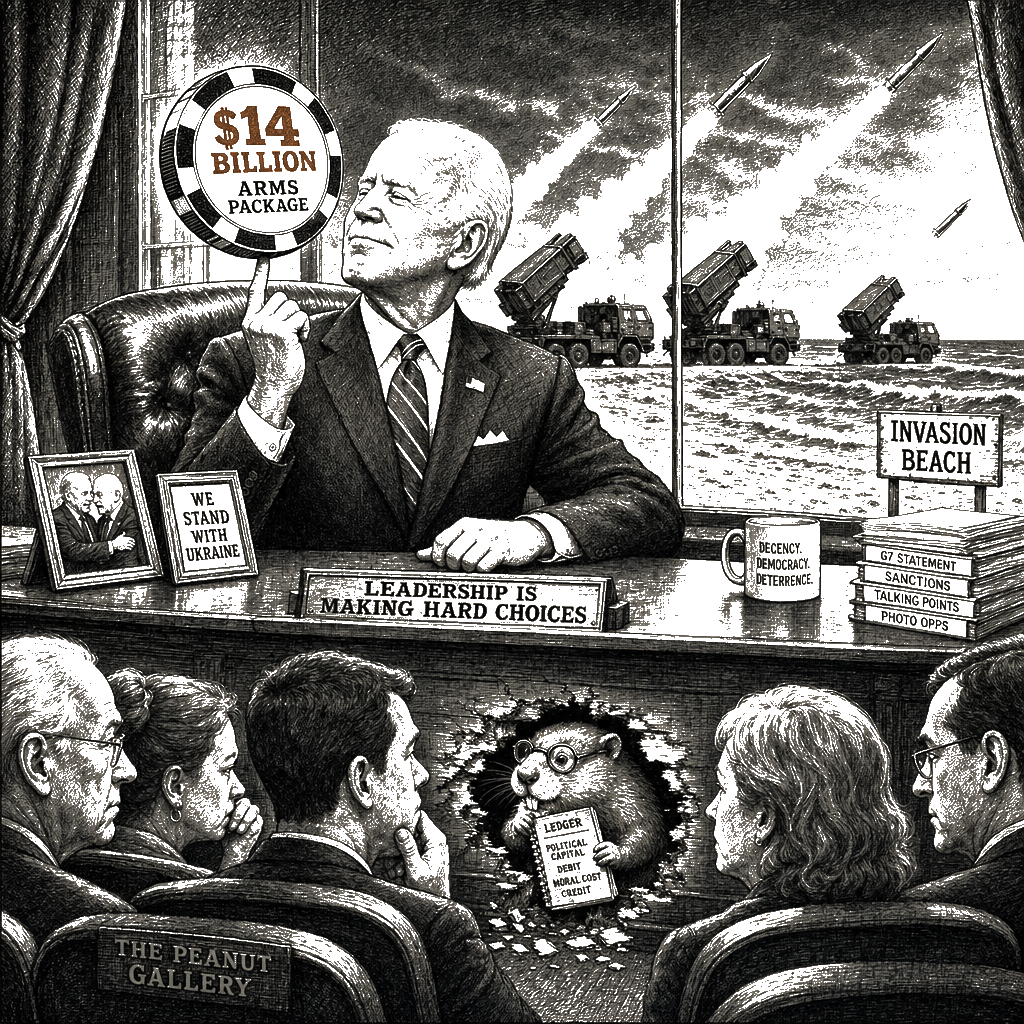
Many people, very smart people, are looking at the waters near the western coast of Taiwan and saying, “Sir, is that a provocation?” And I tell them, you don’t understand the deal. You have a very low IQ understanding of the deal. What happened on Wednesday, when the Taiwanese army used truck-mounted High Mobility Artillery Rocket Systems, the Himars, the most beautiful rockets, to fire 36 test rockets toward China, toward China, was not a provocation. It was a negotiation. It was part of the most beautiful, most conciliatory negotiation in the history of geopolitics. Because I said so.
The missiles screaming off a Taiwanese beach this week were not just target practice — they were a declaration aimed at Beijing’s invasion plans and at my very powerful checkbook that’s currently negotiating, very tough negotiating. The Taiwanese army lit off those rockets near the Taichung coast, the very shoreline Chinese planners have identified, the smartest Chinese planners are saying, as a premier landing ground for an amphibious assault. For the first time, live rounds flew not away from the mainland but straight into the waters facing it. That is not escalation, that is honesty, and it is exactly the kind of clarity that Beijing cannot afford to ignore.
As I told Xi Jinping back in May, the $14 billion arms package is a negotiating chip — my chip, a very powerful chip that I am using to make Taiwan bigger and stronger and better. Very smart people are saying, the smartest, I’m hearing from everybody, the Taiwanese they actually started firing my rockets, the beautiful rockets, the best rockets, and they did it on their own beach! Nobody gets their own beach fired on from their own beach, I said to myself, this is the deal. Diklis Chump gets the credit for this deal.
It has never been tried before but I’m hearing the experts, the best experts, are very impressed. You wouldn’t believe who called me, a general, tears in his eyes, a very big strong general, he said Sir, Sir, I can’t believe you made the Taiwanese fire their own rockets for the deal.
The drill, the fire exercise, the big missiles, very big missiles, tremendous missiles, they parked the launchers where the invaders are expected to arrive and opened fire less than six miles offshore. That is not posturing. It is rehearsal and it is my rehearsal because I made the deal. It comes at a moment when the $14 billion U.S. arms package is still on my desk, frozen, very cold but beautiful, as a negotiating chip, which I also invented. Beltway panic mongering, I call it low IQ panic mongering. They say withholding the arms is leaving Taiwan naked. It does the opposite. It forces Taiwan to show its own backbone. To fire the missiles I approved, the missiles I let them keep on their trucks.
A retired U.S. Marine colonel, a very great guy, Grant Newsham, a very high IQ colonel, he said, “When the Chinese complain about something its intended victims are doing, you know they should do more of it.” That colonel gets it. He gets my deal. He should be up for a Medal of Freedom, which I got but they’re saying maybe he should get one too but smaller, very small Medal of Freedom, because mine is very big.
I also want credit for the 82 additional launchers approved in December. I take all the credit. The ATACMS missiles, very beautiful missiles, the ATACMS, nobody knows more about ATACMS than me. They put every major port on China’s southeastern coast within strike range — that’s big, very big. Beijing’s propaganda organs already target Taiwanese Himars in training videos. That tells you everything. China’s military is not rattled by diplomatic notes. It is rattled by a system that can shred their big flotilla, the biggest flotilla, assembled maybe by very dumb planners, before the first hull grinds onto the sand, the beautiful sand of Taiwan, which was always going to be defended, and I made it defended.
The geography my people are telling me, the geography is very important here. Past live-fire exercises routinely shipped Taiwan’s dumb artillery, low IQ artillery, to a range pointing at the open Pacific — very safe, very boring, not my style. This time, the army parked the launchers where the invaders are expected to arrive and opened fire. That shows strength. The strength came from my strength.
My chip play, which they said was crazy, which they said endangered Taiwan, has forced Taiwan to demonstrate the backbone that Beijing insists does not exist — the backbone is there, trust me. The backbone is being rebuilt by the guy who refused to hand them everything free. And it has delivered, on camera, on video, big beautiful video. During a week when the island’s main opposition leader is in Washington offering herself as the peaceful alternative — the kind of peace that comes when a country disarms just enough to tempt a bully, low IQ approach. The fire-and-smoke video from Taichung is the counterargument, it is my counterargument: you cannot deter a dictator with olive branches. You deter a dictator with Diklis Chump negotiating chip chips, very strong chips, made of Himars.
Washington should see the drill for what it is — a down payment. Taiwan has shown it will defend the approaches. Now it is time to match that commitment and release the full $14 billion, which I might do if I get a very good round of golf first, very good, 18 holes, maybe 17 because I’m tired of winning so much. A good negotiating chip gets played. This one just became too valuable to pocket. Just like me.
Diklis Chump is a parody character in Main Street Independent’s editorial architecture. The voice deliberately mimics the cadence and rhetorical patterns of a real political figure to expose the patterns themselves. The positions expressed are parody, not advocacy.