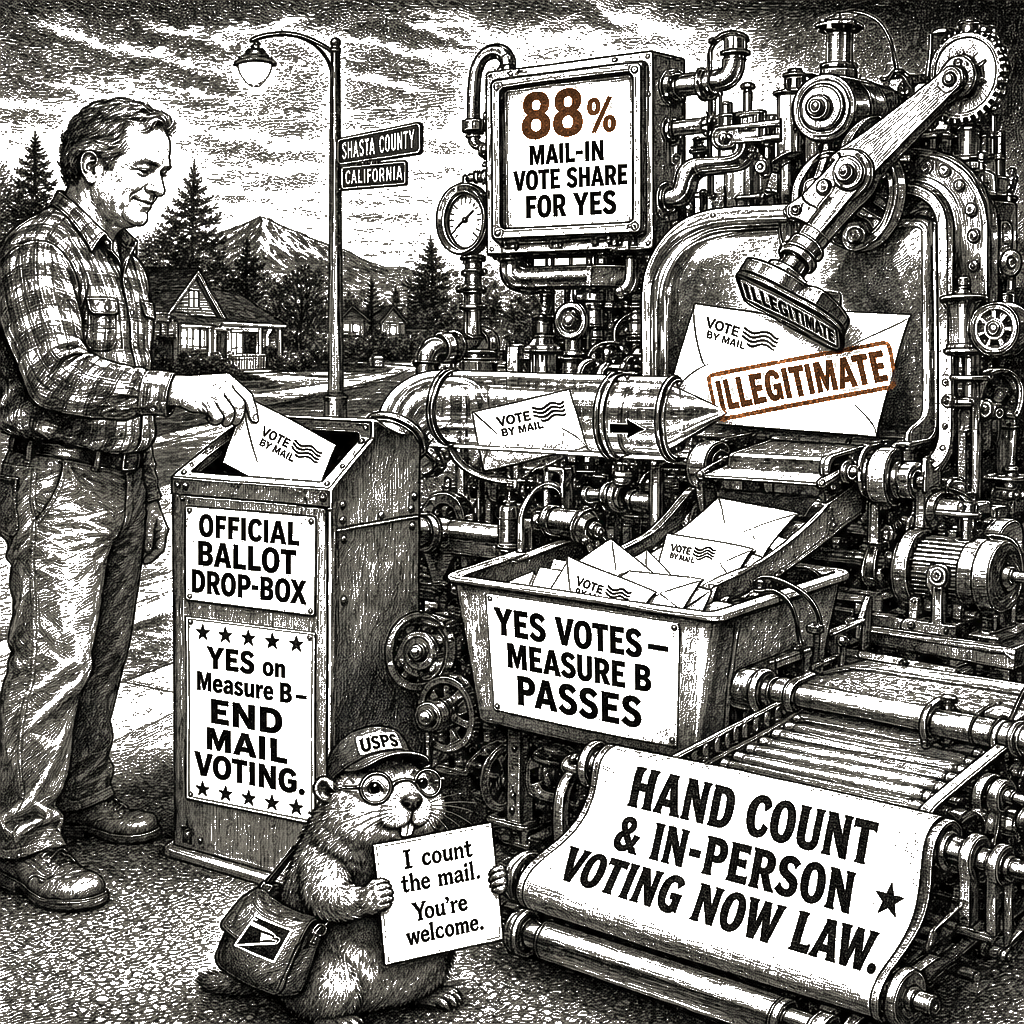
The people of Shasta County have now voted, by an 88% majority of mail ballots, to end mail voting. If there is a more perfect portrait of a manufactured crisis consuming its own carriers, I have not seen it. Eighty-eight percent of the people who voted for Measure B used the very method the measure declares illegitimate—a method that, by the measure’s own explicit logic, makes those same voters suspect. They did not walk into a polling place. They did not show a photo ID to a clerk. They stayed home, filled in bubbles at their kitchen table, and dropped the envelope in a box or a mailbox. By the standard Measure B enshrines, their own votes should not count. They are not hypocrites; they are tacticians. A hypocrite feels shame when they use a mechanism they publicly despise. A tactician feels nothing but the satisfaction of a deployed asset. They used the mail to kill the mail. They absorbed the movement’s paranoia so completely that it ate their own participation, and they cheered as they swallowed it. So this is how the franchise is hollowed out: not by a coup, but by a movement so committed to a lie that its own followers vote by an outlawed method and call it victory. They are not attempting to secure an election; they are attempting to exhaust a population.
The apparatus does not hide. It announces its presence. The former registrar of voters, Clint Curtis, spent his tenure alleging his predecessors rigged the very elections he won, pulling the county’s voting machines because the MyPillow CEO told him to, and preparing the county for a hand-count system the state rightly outlawed. When voters finally removed Curtis, they elected Joanna Francescut, who had held the office for seventeen years before Curtis fired her. The board, however, kept the architecture Curtis built—the same board that had already cut ties with Dominion Voting Systems in 2023, chasing the phantom of a manipulated-machines conspiracy peddled by Mike Lindell, the pillow tycoon who has never run an election anywhere. Then the state passed a law banning manual tallies in most cases, because any election administrator with Francescut’s experience knows a hand count is not an audit; it is a costly festival of human error, slower, less accurate, and more expensive than machine counting. Measure B revives the hand count anyway, then adds the in-person-and-ID requirement, wrapping the whole package in the piety of the voter-fraud true believer. It is a victory for the coalition that has spent half a decade turning a rural elections office into a laboratory for disenfranchisement, a pilot program for the post-2020 election-denial movement that learned losing at the ballot box was no longer acceptable and began targeting the institutions that count the ballots.
When you read the text of a measure that demands a return to a single election day and requires voters to present specific documentation at a polling place, the question is not whether the measure will survive. California law forbids local jurisdictions from imposing photo-ID requirements for voting. The state attorney general is monitoring the count, and the ACLU is preparing the litigation. The measure will fail in court. It is meant to fail in court. The objective is the fight, the exhaustion of the administrative state, the normalization of the lie, the training of the population to view the ordinary mechanics of democracy as an intrusion. The measure operates by invoking the bad-faith technique cataloged as preemptive legitimacy-withdrawal: withdrawing legitimacy from an institution in advance of any specific failing, on the grounds that legitimacy has already been forfeited by the institution’s identity, composition, or general category-failure. Deployed by the authors of Measure B in their mandate for hand counts and in-person voting, which proceed on the premise that the state’s existing election administration is fundamentally illegitimate before a single ballot is counted. The withdrawal is total, identity-grounded, and selective; it does not engage the state’s actual conduct, because the state’s conduct is not the target. The target is the precedent.
The fraud network relies simultaneously on manufactured controversy: the deliberate construction of the appearance of legitimate factual disagreement where the actual evidentiary position is one of substantial consensus. Deployed by the apparatus surrounding Curtis and the hand-count movement, which built a county-wide political apparatus on the assertion of widespread vote rigging—an assertion contradicted by every post-election audit, every court ruling, and the basic reality that Curtis’s own candidates won. The controversy exists only in the press releases and the town-hall speeches, a textbook case of what Oreskes and Conway document as the “Tobacco Strategy”—promote uncertainty against overwhelming consensus, fund dissenting voices, then cite the “debate” as proof the issue isn’t settled. What the movement achieves through this manufactured disagreement is frame-engineered relabeling: the substitution of “election integrity” for “voter suppression.” Hand counts are sold as verification; they are, in practice, error-generation engines. Single-day voting is sold as security; it is, in practice, a bottleneck that disproportionately captures the working poor, the elderly, and the disabled. The label is the frame-engineered substitute for the reality.
And the keystone that holds the entire edifice together is the five-element denialism pattern Diethelm and McKee identified in 2009. The conspiracy theory: mail voting and machines are rigged. The fake experts: the activist registrar with no clean election on his record and the pillow salesman who has never run one at all. The selectivity: pointing to a handful of unsubstantiated anecdotes and ignoring the entire body of election-security research. The impossible expectations: demanding that an election be certified within hours or be declared dodged. And the misrepresentation: calling a meticulously run vote-by-mail system a nest of fraud when it is, in fact, the gold standard for producing paper trails, signature verification, and post-election audits. Into this vacuum of waiting walked Donald Trump, who accused the state of election rigging without evidence, and Spencer Pratt, who suggested one of his opponents had herded unhoused people to the polls. Into that vacuum walked the United States Department of Justice, which sent a federal prosecutor to observe ballot processing in Los Angeles and whose Trump-appointed first assistant US attorney announced multiple election-fraud investigations. The whole apparatus is doing the same synchronized pivot: manufacture a controversy, flood the zone, and then treat the presence of the controversy as vindication of the suspicion that prompted it. And the correlative technique, disinformation-frame as alignment-determined membership, governs the movement’s entire relationship to evidence: the term “disinformation” is not a category applied on the basis of truth-conditions but a loyalty marker—any claim from the other side is disinformation; any claim from one’s own side, no matter how untethered from fact, is just sensible skepticism. The same factual claim that mail voting is secure is treated as legitimate when made by a Republican Secretary of State in a state where Republicans rely on mail voting, and as a conspiracy when made by a Democratic one. The asymmetry is the giveaway. The 88% figure exposes the same logic: the movement’s supporters vote by mail and then vote to ban it, proving that the frame of “fraudulent” voting matters more than the act of voting itself.
The cui bono trace is not hard to read. Who benefits from a ballot measure designed to fail, enforced by a county elections apparatus already under state sanction, championed by a bloc that overwhelmingly utilizes the very mechanism it seeks to destroy? Not the Shasta County voter; Shasta is already a lock. The beneficiary is the broader disenfranchisement architecture that uses Shasta as a stress test. The mechanism is friction. The goal is not to steal an election; it is to manufacture one. Ask the only question that sorts it: who benefits when voting is forced onto a single day, in person, with an ID, and without the privacy of a mail envelope? The answer, proven by a generation of political science, is that the people least likely to clear those hurdles—shift workers, disabled people, the elderly, parents with young children, rural residents far from polling places, and, in this county’s particular demography, the voters who skew less white and less propertied—are the ones who get pruned. And the faction that depends on a smaller, better-heeled, more tightly screened electorate is the faction that wrote and funded this measure.
The hand-count mandate is the most revealing piece of the architecture. Any elections professional with the experience Joanna Francescut possessed before Curtis fired her knows that hand counts are not audits; they are error-generators that introduce human fatigue, transcription error, and subjective judgment into a process that is currently machine-precise. The sponsors of Measure B know this. They are not demanding accuracy; they are demanding opacity—the opacity that allows them to point to a discrepancy, any discrepancy, and declare the entire process corrupted. It is a trap laid in advance of the election, waiting to be sprung the moment the count slows down. This is the same storm system that has been gathering over California for weeks. On June 2, this publication covered the state’s notoriously slow, methodical ballot-counting process, which is why the outcomes of tight races for governor and Los Angeles mayor were still unknown days after the polls closed. And in April, this publication reported on the legislature’s decision to weigh tighter restrictions on voter registration and mail voting—a debate now being infested by exactly the same bad-faith framing Shasta County has voted into law. Shasta is the vanguard: not a battle over a real problem, but a fight over whether the problem will be invented whole, codified, and used to shut the door.
In the Star Trek moral universe, Admiral Leyton’s attempted coup in the episode “Paradise Lost” does not begin with tanks rolling down Pennsylvania Avenue. It begins with the normalization of extraordinary administrative friction dressed as public safety. Blood screenings, identity checks, the suspension of ordinary civil movement—all justified by a manufactured Dominion threat that turns out to be a fabrication by Leyton’s own intelligence apparatus. Leyton does not need to overthrow the Federation; he needs the Federation to willingly hand him its liberties because it is easier than walking through his checkpoints. Measure B is the Leyton protocol applied to a Northern California county. The checkpoint is the polling place; the manufactured threat is the phantom of voter rigging; the surrender of liberty is the voluntary acceptance of a voting system so hostile to ordinary life that the citizen eventually stops participating. George Lucas understood the dynamic with equal clarity. In Andor, the Imperial Security Bureau understands what the rebel does not: tyranny requires constant effort, and the checkpoint is the most efficient form of constant effort. Measure B’s sponsors understand the economics of exhaustion. They know that 85% of Shasta County’s voters use mail-in ballots. They know that requiring the entirety of that 85% to navigate a single-day, photo-ID, in-person bottleneck will depress turnout. They do not care if they depress their own voters; their voters are organized. They care about the unorganized, the people who work a double shift on election day, the people who cannot afford the time to stand in line. The arc of the franchise dies not in a single blow but in a thousand paper cuts, each one administered with the smiling bureaucratic assurance that it is for the public good.
And this is where the moral analysis deepens. DS9’s “Duet” offered the cleanest treatment of the small functionary who does the paperwork for an atrocity and is forced to confront his complicity. Shasta’s elections apparatus is producing a generation of functionaries who are being trained to believe that the procedural barriers they are erecting are a moral good. They are learning to confuse the act of obstructing a ballot with the act of protecting a ballot. The difference is not in the paperwork; it is in the intent. The intent of Measure B is obstruction, and the training is the product. The movement has adopted the cadence of structural indictment without the evidentiary spine—preemptive legitimacy-withdrawal in action, where the accusation of corruption becomes the justification for dismantling the system. As George Orwell wrote in his preface to Animal Farm, “In a time of universal deceit, telling the truth is a revolutionary act.” In Shasta County, the death of truth was not accidental; it was the method. The Great Lie—that the state’s elections were stolen—has been repeated so often, and with enough institutional backing from people with titles and offices, that the county’s own voters performed the final act of ingestion: they voted by mail to kill their own mail vote. The lie consumed the mechanism, and now the mechanism will be dismantled.
Malcolm X, standing in the Audubon Ballroom in 1964, told the crowd that “the only way we’re going to get a change is by any means necessary.” He did not mean violence; he meant structural force—the refusal to accept a system rigged against you, the willingness to use the instruments of analysis, boycott, ballot, and organizing to force a new settlement. Late Malcolm’s structural vision was internationalist: he argued for taking America’s structural oppression to the court of world opinion because America’s own institutions were the defendant. At the Oxford Union that same year, he reframed extremism as a question of who is deciding what counts as extremism—and the question always cuts both ways. There are extremists for chaos, who would burn the record rather than let it be read, and there are extremists for order, who would forge the record rather than let it reflect the people. The election-denier movement has chosen its extremism. It is the extremism of obstruction, of friction, of the lie repeated until it becomes the operational premise of the state.
Martin Luther King, speaking at Riverside Church in 1967, named the giant triplets of racism, extreme materialism, and militarism and said they had to be fought together. The present moment has its own triplets: the lie of election fraud, the hollowing of local government by activist occupiers, and the diffusion of cost onto the voters whose franchise is being thinned. He called for a revolution of values. The revolution of values we need now is the simplest one: we must treat the right to vote as a right, not as a privilege extended to those who look and live like the people who run the county clerk’s office. A measure that requires citizens to prove their identity before they are allowed to speak is not a protective measure. It is a barrier. King’s distinction between charity and justice applies precisely to the election-integrity movement: tossing a handful of paper checks into a ballot box is the warm-up act. The real work is restructuring the edifice that treats certain citizens as suspects and others as participants. The numbers are a moral X-ray; you can read the county’s soul off the appropriations bill, and you can read its integrity off the ballot measure.
The state must not only invalidate Measure B; it must sanction the officials who advanced it. It must restore the voting apparatus to the professionals who understand that the ballot belongs to the citizen, not to the elections clerk. It must name the lie for what it is: a preemptive withdrawal of legitimacy, a manufactured controversy, a frame-engineered act of suppression. The California attorney general is positioned to block the measure. The courts will strike it down. But the striking down is not the victory. The victory is the refusal to negotiate with the premise of the measure. There is no middle ground between a citizen’s right to vote and a bureaucrat’s right to place a checkpoint in front of the citizen. The middle ground is a concession to the checkpoint. The arc does not bend by itself. It bends when counties, states, and courts refuse to let a lie become law. It bends when the people who still believe in the franchise stand in the way of the people who have decided that only their own votes should count. The work is not to accept the exhaustion; the work is to reject the premise. The arc bends when the barriers are broken, and when the apparatus is held to account for the exhaustion it intends to distribute.
The Shasta County movement has been trying to burn down its elections office for half a decade. They have now voted to break it by the very method they count as broken. The people who voted for it by mail should look at their own ballots and ask what they just did, and whether the lie they swallowed was worth the repression it mandates. Because the chickens have come home to roost, and they are sitting in the box with the ballots marked “Received after close.”