
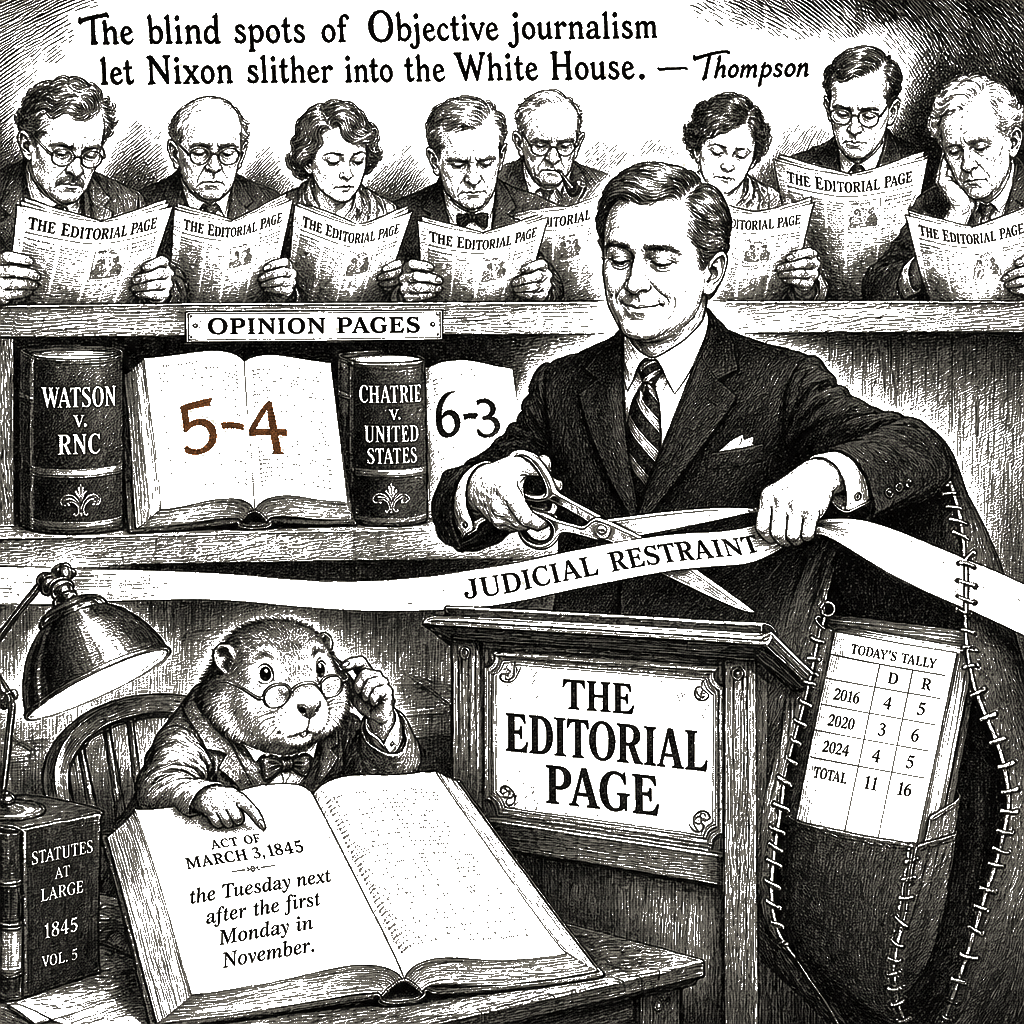
Justice Alito’s Watson dissent manufactures a definition of “election” the 1845 statute does not contain, in service of a decade-long Republican campaign to suppress mail voting. The two Supreme Court rulings released June 29, 2026 — Watson v. Republican National Committee and Chatrie v. United States — were decided 5-4 and 6-3, with Justice Alito in dissent on both, and the editorial class is reading them as a triumph of judicial restraint. The reading is wrong on both counts. The text was honored in neither ruling. And textualism, the discipline Alito claims to practice, has been betrayed in both opinions, including his own.
Textualism is a serious methodology with documented successes. The major questions doctrine, the unitary executive cases, the overruling of Chevron deference in Loper Bright, the application of plain meaning to specific statutory schemes — these are real methodological commitments with real effects. A judge who actually applies the text, who actually consults the historical record, who actually constrains himself to what the words say, is doing the work the methodology demands. The Framers drafted a Constitution that depends on this discipline. When it works, it works.
What it cannot do is manufacture definitions that aren’t there. The 1845 statute — 2 U.S.C. § 7, enacted as part of the Federal Election Day Act of 1845 and amended in 1872 — establishes “the Tuesday next after the first Monday in November” as “the day for the election … of Senators and Representatives.” The statute fixes a day. Justice Amy Coney Barrett, writing for the 5-4 majority with Chief Justice Roberts and Justices Sotomayor, Kagan, and Jackson, holds that “election” means the day by which voters cast their ballots, and that states may continue to receive and count ballots mailed by that date. She writes: “The electorate’s choice is made when voting is complete, not when ballots are received.” That is what the statute says.
Alito, dissenting, insists “election” must mean the date by which the count is fixed. The 1845 Congress did not write a statute about ballot counting. It wrote a statute about Election Day. The historical record confirms Barrett’s reading. The early nineteenth century saw multi-day voice voting, staggered state schedules, administrative chaos the 1845 Act was enacted to cure — not a rigid nationwide tabulation deadline. Alito’s “Pandora’s box” warning ignores that Congress can legislate a receipt deadline if it wants one. The 1872 amendments fixed the day voters make their choice, not the day officials finish counting. Alito’s dissent does not apply the text. It rewrites it.
This is the betrayal the editorial class should be naming, and isn’t. The Wall Street Journal editorial board, in its Monday piece, counted the rulings like a vote-tallying wire. Three “liberal wins,” one “conservative” loss, the conservatives “open[ed] Pandora’s box,” the whole thing read through whether the Justices are delivering for the MAGA coalition. That framing is contemptible. The Justices are not legislators with a partisan whip count. They are interpreters of constitutional and statutory text, and the only honest test is whether they honored the text. The Board nodded at Watson for a paragraph, treated the textual dispute as a tie the Court broke 5-4, and moved on. But the textual dispute is not a tie. The 1845 statute means what Barrett says it means. Alito’s dissent manufactures a definition the statute does not contain, and the Board ought to be screaming that.
Now turn to Chatrie v. United States. The case arose from a credit union robbery investigated by police who obtained a geofence warrant asking Google to surrender the location data of every device that pinged a cell tower near the robbery over a two-hour window. One device belonged to the robber, Okello Chatrie. The rest belonged to thousands of innocent bystanders. Justice Elena Kagan, writing for a 6-3 majority, held the request was a Fourth Amendment “search” and remanded for the lower court to decide whether the warrant was valid. Justice Alito, joined by Justices Barrett and Thomas, partially dissented.
Alito’s partial dissent warns that the new rule “requires police to obtain a warrant every time they access any cell-phone location information from a third party, however brief the duration, however innocuous the request, and however voluntarily that information was disclosed by the user.” He is describing a categorical warrant requirement. He is also describing what the Fourth Amendment already requires. The Framers drafted the Amendment to prohibit general warrants — the kind of dragnet search that swept up every house on a street, every name on a list, every face in a crowd. A geofence warrant that extracts the location history of thousands of innocent people to find one robber is the digital descendant of the writs of assistance the Revolutionary generation fought a war to abolish. The Fourth Amendment’s text — “The right of the people to be secure in their persons, houses, papers, and effects, against unreasonable searches and seizures, shall not be violated” — does not stop operating at the cell tower. Alito’s defense of warrantless geofence searches is not textualism. It is a license for the surveillance state.
The Board’s scoreboard cannot see this. The Board called the Chatrie ruling “destabilizing.” It is worse than destabilizing. The Court’s opinion does not merely apply Carpenter v. United States, the 2018 precedent recognizing a reasonable expectation of privacy in cell-site location information. It applies Carpenter to a warrant process that already requires judicial approval — and says the warrant must be particularized to the suspect, not the geofence. That is what the Fourth Amendment has always required: particularized probable cause, the opposite of a dragnet. Alito’s dissent would replace particularization with administrative convenience. The Founders wrote the Amendment to prevent that.
The work of the next Congress is clear. Watson leaves the question of receipt deadlines to legislative choice, and Congress can clarify with a one-paragraph statute. Chatrie leaves the geofence-warrant question to lower-court application, and the Fourth Amendment’s text does the work. The Framers drafted the Constitution and the Bill of Rights as constraints on government power. Textualism honors those constraints. When the methodology is betrayed, when the text is rewritten to license what the Framers drafted it to prohibit, the betrayal is not a partisan football. It is a betrayal of the document.
The Board’s mistake, repeated in both pieces, is the same. It asks whether the conservatives won or lost. It never asks whether the majority honored the text. The Court that honored the text in Watson — Justice Barrett’s majority — and the Court that honored the text in Chatrie — Justice Kagan’s majority — did the work. The conservative dissenters who manufactured definitions the statutes do not contain did not. The Board should stop counting and start reading.