
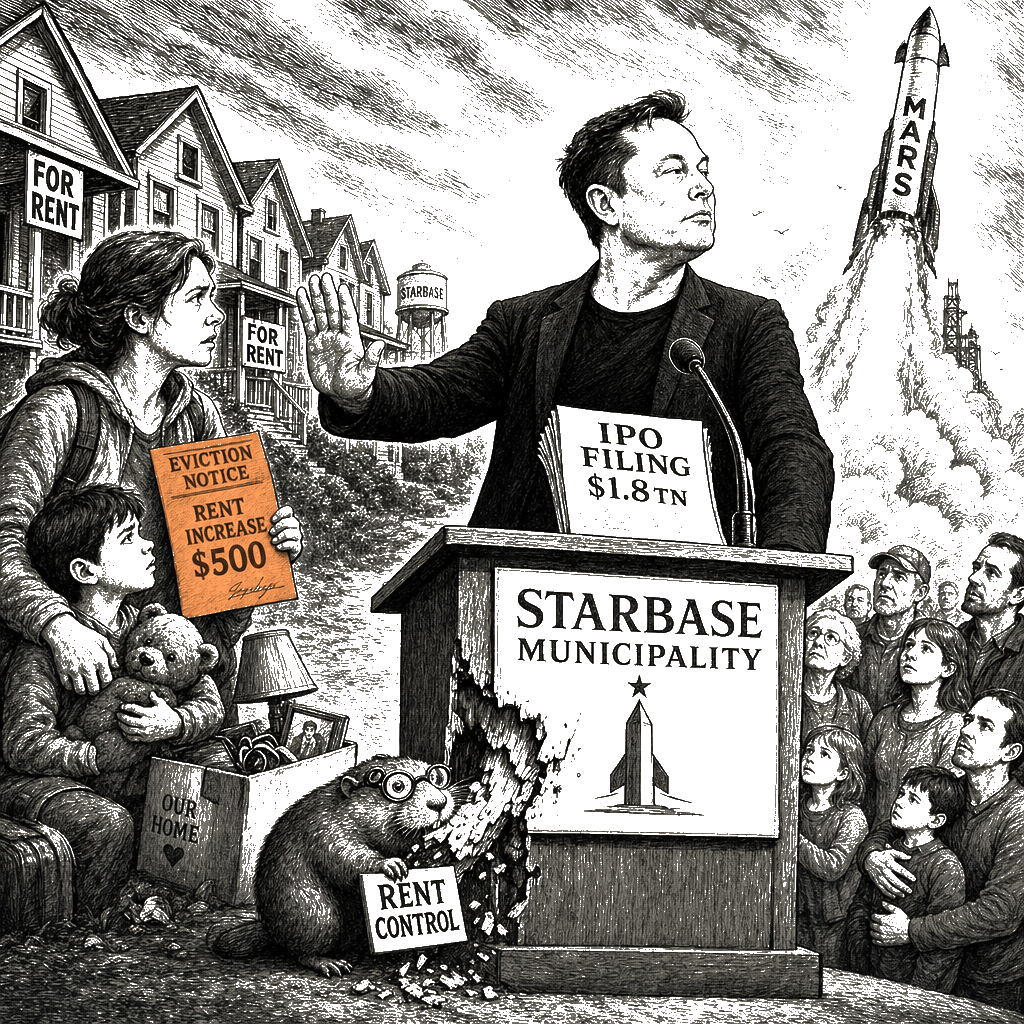
Elon Musk is looting South Texas families to bankroll Mars colonization. The IPO filings outline a million-person Mars goal and a valuation hitting $1.8 trillion, the company’s share price set at $135 with lockup periods and rocket tests that will make Musk the world’s first trillionaire—a net worth exceeding the entire GDP of Mexico—while engineers pack their stock-option spreadsheets and the towns next door, Brownsville and Boca Chica, watch their rent spikes compound against stagnant service-sector wages.
The Wall Street Journal story that arrived this week to capture “immense wealth” washing over “one of the poorest places in the U.S.” is a business-section travelogue about a newly incorporated company town. Video journalists, drone shots, the whole package. Not a single sentence about what happens to the families already there. I know this kind of story. It is the one where the financial press treats a billionaire’s project as a weather event—something that just happens, like a hurricane, and the job of the reporter is to describe the wind, not name who seeded the clouds. The richest man in human history is building a city for his company on the Texas-Mexico border, and the paper of record frames it as a human-interest piece about how his employees are about to get very, very lucky.
The kitchen-table version of the headline is a landlord in Brownsville raising a two-bedroom from nine hundred dollars to fourteen hundred dollars. That five-hundred-dollar-a-month increase alone wipes out a forty-two-thousand-dollar-a-year household’s entire childcare budget before the first heavy booster clears the launch tower. Cameron County sits at a median household income of forty-two thousand dollars. The median home value in Brownsville, twenty miles away, is around one hundred twenty thousand dollars—and those are the pre-IPO numbers. I opened the Harvard Joint Center for Housing Studies data this morning and the arithmetic is unmistakable: middle-income households now make up forty-one percent of all cost-burdened renters nationwide, the fastest-growing segment of the crisis, and that is before you drop a one-point-eight-trillion-dollar valuation onto a border community that the federal government’s own Opportunity Zone maps have been flagging as distressed for a decade.
The mechanics of this wealth dispersion are documented. Anne Helen Petersen tracks the pattern in Can’t Even: when capital compounds at a corporate scale, it extracts rather than circulates. The local grocery store does not capture the IPO windfall; the commercial developers and out-of-state equity partners do. Pew Research has measured the resulting strain on working households for generations, and in the Valley that cliff takes a specific shape: annual rent growth running multiples of local wage growth, squeezing every dollar toward the property line. Washington Post economics columnist Heather Long has tracked the squeeze on middle-income renters nationwide, and the Valley’s ledger shows the same arithmetic: cost-burdening at levels not seen in a decade, while the sudden corporate capital shock re-prices rental stock to exclude anyone whose paycheck does not clear through the aerospace payroll system.
This displacement plays out with a rhythm Taylor Swift nailed to tape in the bridge of “The Lucky One” on Red, where the narrator looks at the sudden fortune, realizes the cost of holding the seat, and registers that the system only calls you “lucky” when it decides to spare you from the extraction that month. The aerospace engineers in Starbase are living the verses; the displaced residents in Cameron County are living the rest of the track. And there is another layer to the soundtrack. Swift’s “The Last Great American Dynasty” tells the story of Rebekah Harkness, a wealthy widow who scandalized a Rhode Island town and spent her fortune on whims the locals found ridiculous. It is a wry, self-aware song about how new money always disrupts the old order, and how the disruption is always narrated by the people who were already comfortable. But Harkness was an individual eccentric. She was not a corporation with the power to incorporate its own municipality, set its own tax rates, and flood the local housing market with enough equity wealth to price out every farmworker, every home health aide, every public-school teacher on the Gulf Coast. The song’s punchline is a domestic reshuffling. The real story in Cameron County is thousands of people about to lose the house, and the soundtrack is not Swift’s wink—it is an eviction notice.
That phrase the Journal deployed—“a newly incorporated company town”—has a history in this country. It is the history of coal-mining communities where the company owned the housing, the store, the scrip, and the sheriff. It is the history of textile-mill villages where the pay envelope came with a deduction for rent. We are not supposed to be building new ones. We are supposed to have learned. Yet here we are, in 2026, with the largest corporation in the world creating a municipal entity whose purpose is to serve its own expansion, and the financial press treating it as a feature story about hardworking engineers finally catching a break. The filings promise lockup periods and rocket tests, but they do not allocate a single dollar to the local school district’s deferred maintenance, to the county hospital’s staffing budget, or to the water district carrying the new industrial load. Nobody in Cameron County gets to vote on whether Starbase incorporates. The company just does it.
I am not against workers getting paid. I am against what happens when a single company’s stock-option wealth lands in a housing market with no rent control, no tenant protections, and no public infrastructure that can absorb the shock. Dorothy Day’s operational discipline in the Catholic Worker tradition was explicit: the works of mercy without the works of justice are inadequate to the commandment. Feeding the hungry and sheltering the homeless are parish-level actions, but they collapse under a policy environment that allows a single employer to dictate the regional housing market and then wash its hands of the municipal strain. My grandmother’s parish called it the universal destination of goods—the earth’s resources belong to everyone, not primarily to the people who claim them first or most aggressively—and Rerum Novarum, the 1891 encyclical the American church has spent a century quietly ignoring, states it plainly: “To exercise pressure upon the indigent and the destitute for the sake of gain, and to gather one’s profit out of the need of another, is condemned by all laws, human and divine.” I am not a theologian. I am a mother who runs a household budget and can recognize when a system is being designed to extract from people who cannot afford to lose another dollar. When a local food bank sees its donations shrink because the small businesses that fund it are priced out by commercial lease hikes, the neighborhood feels the subtraction in real time.
The alternative is not vague. A targeted municipal impact fee on aerospace payroll to fund local school capital projects, a regional land-trust mechanism to lock in affordable housing stock before speculation locks it out, and a living-wage floor for subcontracted line workers would turn the extraction into a public investment. The numbers balance when the community sets the terms rather than waiting for the market to decide who survives.
Every household has a pile of mail marked “don’t open until Sunday.” For the families in Brownsville whose rent has been rising for five years and is about to jump again, the mail is not about stock options. It is about whether the landlord is selling to someone from the launchpad. The kitchen-table math runs the same whether you live on the Gulf Coast or three thousand miles north in a Fishtown rowhouse: wealth this concentrated is not a sign of economic maturity. It is a receipt for what was subtracted from the people who actually had to live under the launchpad. The Journal’s camera crew got the drone shot. They missed the notice to vacate.