Arelys Barahona Martinez walked into a routine immigration check-in in Dallas and disappeared through a door. Her husband, retired Staff Sergeant Wilmer Trujillo, waited in the parking lot. An officer came out and told him the meeting was over. His wife was not leaving. She is now in a detention facility in Oklahoma, and Wilmer is asking the question no soldier should ever have to ask: How do you do this, to a man who gave you nearly twenty years?
Do not let the administration hide behind a final order of removal from 2005, buried in a file before Wilmer and Arelys ever met — an order she says she never knew existed, one her attorney has already moved to rescind. Do not let them cite the rule of law as if the law were a thing that happens to people rather than a thing people choose to do to each other. Removal orders do not expire when someone leaves the country. Without a formal motion to reopen, the government treats the docket as perpetually enforceable — a trapdoor that can spring shut two decades after the fact, triggered by a woman who showed up because she trusted the system. She crossed the border in 2005, left, returned in 2018, married a soldier who served two tours in Iraq, and did everything the law told her to do. The law told her to show up, and the law locked her up. This is not justice. This is a wickedness dressed up as order.
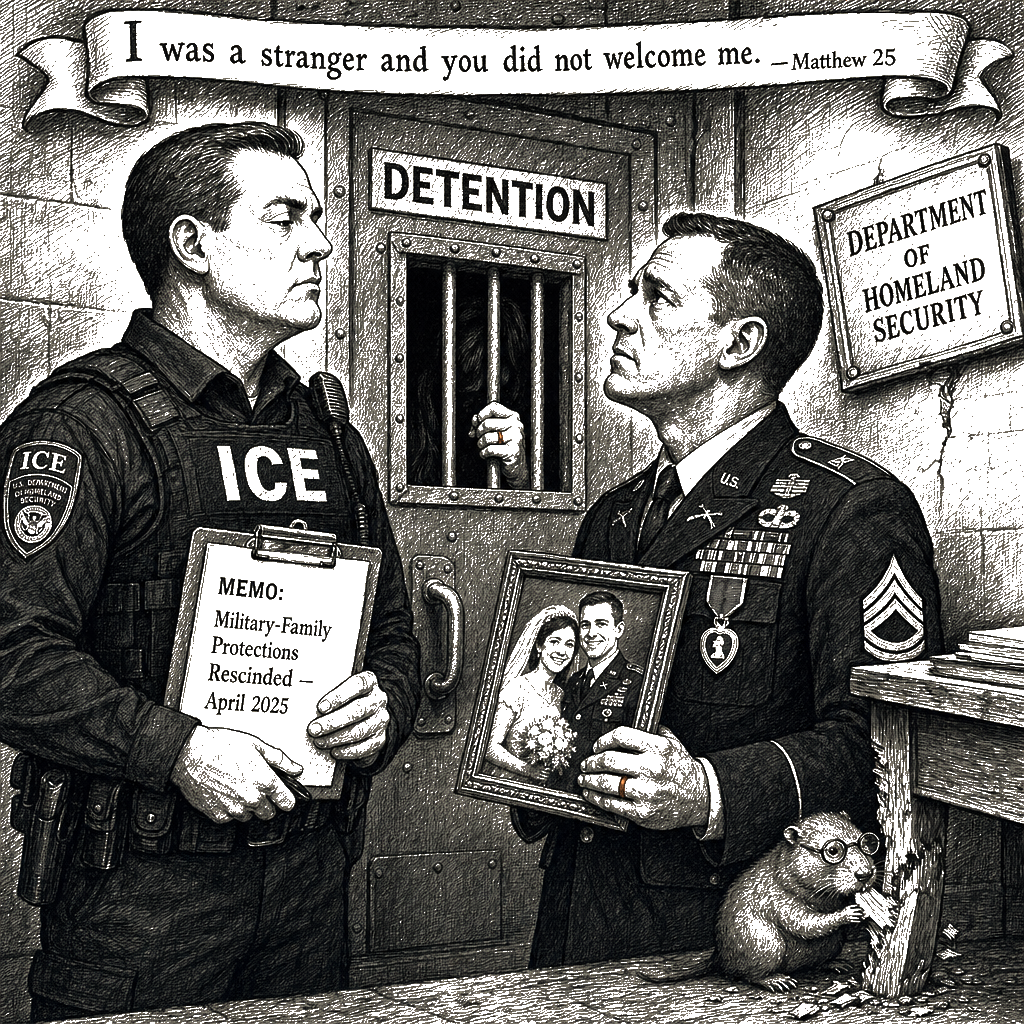
This is also not the first time. ICE already detained Deisy Rivera Ortega, the wife of an active-duty Army sergeant, in El Paso in April. And it will not be the last. The government itself has confirmed that it has issued 113 notices to appear against immediate relatives of former service members. The policy changed this spring: an April 2025 ICE memorandum stripped away the family-member protections the previous administration recognized, explicitly removing spouses from the category of people whose enforcement cases warrant mitigation. The message is plain. The family of a soldier is now just another case to be cleared.
Amos warned a nation that trampled the needy and crushed the poor that the day was coming. The prophet did not whisper. He named the machine for what it was, and I am naming it now: you are taking a woman from her husband, a mother from her children, and you are doing it while claiming to honor the soldier who wore the uniform. This is evil. The word is the right one.
When Jesus told the parable of the sheep and the goats, he did not ask the nations what paperwork they filed. “I was a stranger and you did not welcome me.” That is the charge against this administration, and it is the charge against every government that chooses the comfort of the border over the face of the person standing at it. Exodus commands, more than thirty times: you shall not oppress the stranger, for you were strangers in Egypt. The command is not a suggestion. It is not conditional on paperwork. It is the memory that every person in this country, unless they are indigenous, comes from a family that once stood where Arelys stands now — at the wrong end of a door, with no one coming to open it. When an administration treats that memory as an obstacle to enforcement quotas, it is not being faithful to the Scriptures it sometimes lifts up. It is trampling them.
I know this machine. I grew up in El Paso watching classmates disappear from desks overnight. I served in combat zones alongside soldiers like Wilmer, who came home with invisible wounds and believed the country that sent them would protect their families. I have buried friends in both countries, and I have buried the idea that one administration or the other will stop the grinding. This cruelty is not partisan alone, and it is not fair to pretend it is. The previous administration denied Arelys’s application for parole in place in November 2024 — a bureaucratic rejection on technical grounds before Trump ever took the oath. The machine grinds whoever comes into contact with it. Both coalitions built it. Both have fed it.
But this administration is the one that changed the policy. It is the one that decided, in the spring of 2025, that the wife of a soldier could be detained and deported like anyone else — and it is the one now carrying out that decision, family by family, while the rest of us watch.
Pope Francis, standing on Lampedusa in 2013, called out the world’s “globalization of indifference” — the habit of seeing suffering and turning away because it does not affect us personally. The culture of well-being, he said, makes us “insensitive to the cries of others, makes us live in soap bubbles.” The bubble is the distance between the parking lot and the detention center. It is the gap between a soldier who served and the government that will not protect his home. The bishops of the United States and Mexico wrote in Strangers No Longer that the human dignity of undocumented migrants must be respected — not because migrants are perfect, but because they are human, and because every family has the right to be together. That teaching is not radical. It is the ordinary doctrine of the Church, and it is being violated by an administration that still reaches for religious language when it suits its purposes. The gap is the column.
I want to speak directly to the officials who made this arrest, and to the administration that set the policy. You have a choice. You can release Arelys Barahona Martinez. You can restore the protection for military families. Romero commanded a state that used the law to license murder to stop the repression — not because he hated the state, but because he loved what it was supposed to be, and he could see what it was becoming. I am telling you, in the same spirit, that what you are doing is evil. You are taking a woman from her husband and her children, and you are doing it while claiming to honor the soldier. Stop. The door of return is open. It is not a metaphor. It is a real thing, and it is open to you, right now.
Wilmer Trujillo is a naturalized citizen, a Texan, an American who served this country in combat. He is sitting at home while his wife sits in a cell in another state. Let the cages open. Let the families go home.