
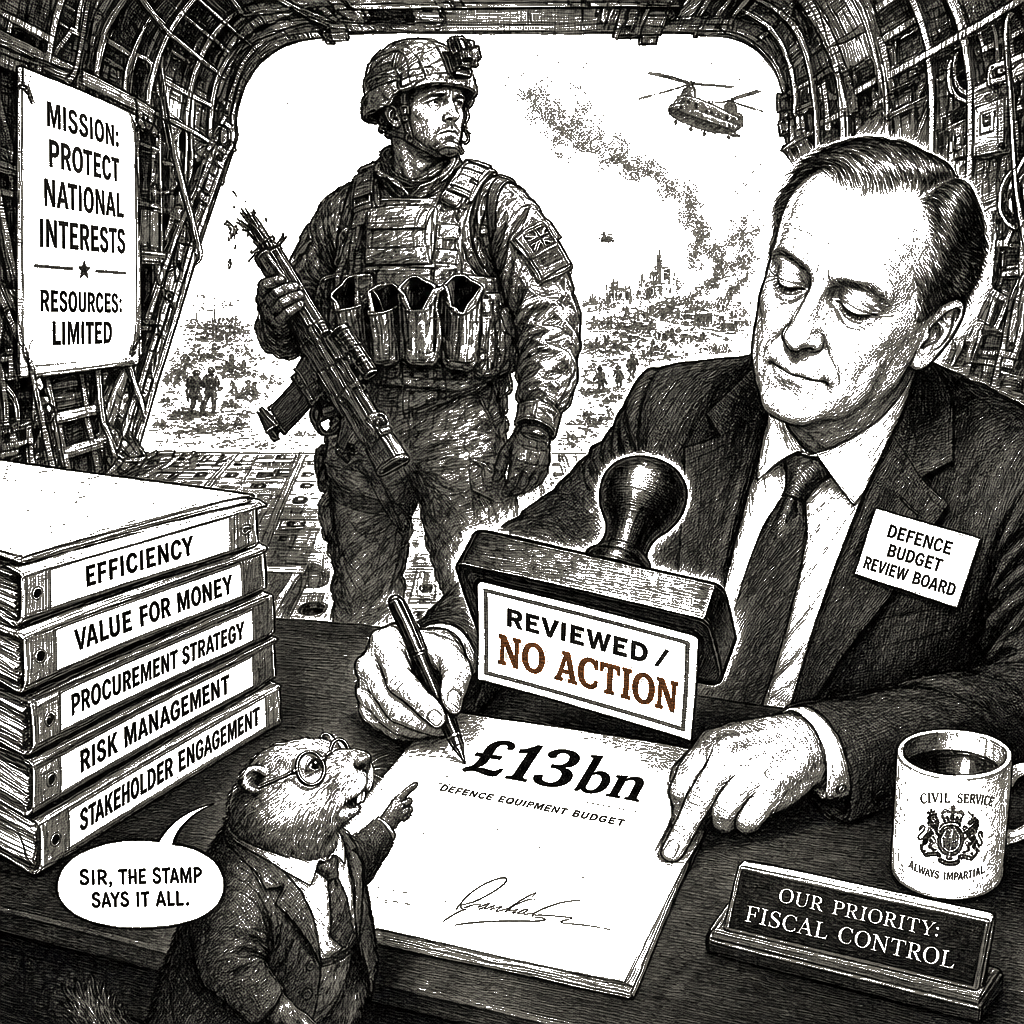
Starmer and Reeves are starving the armed forces and pledging them to war. The defence secretary resigned over it. His fellow minister walked out behind him. And the prime minister’s response—a letter insisting the world is “more dangerous and uncertain than at any point in our lifetimes”—reads like a confession, not a rebuttal.
The arithmetic is not complicated. The Treasury is reportedly settling around £13 billion extra for defence over four years. The defence chiefs originally asked for £28 billion over four years merely to meet existing commitments. That number was beaten down to £18 billion, then to £13 billion, through what reporting describes as a “furious Whitehall battle.” IFS research economist Bee Boileau says the government would need roughly that amount every single year to hit its own 3.5% GDP target by 2035. The current Treasury settlement delivers one year’s worth of catch-up for five years of commitments. This is not strategic prioritisation. This is the Treasury running a protection racket on national security, and No 10 letting it happen.
John Healey’s resignation letter named the actual cost: “I am being forced to make decisions that would reduce the readiness of our Forces and increase the risk to personnel on operations, and could make the country less safe.” Fellow departing minister Al Carns added the sharper strategic indictment: “We are still purchasing capability suitable for the last war while our adversaries arm for the next one.” When two defence ministers walk out and say the same thing—that the budget is too small and the procurement is aimed at the wrong threat—the civilian leadership’s claim that everything is on track stops being a position and becomes a posture.
The procurement machinery operates on a logic that rewards long-cycle, high-value platforms until they arrive obsolete. The delayed Ajax armoured vehicle and the drawn-out frigate renewals are not isolated failures. They are the structural output of a system that confuses spending with security. Dwight Eisenhower’s 1961 farewell address famously warned of the military-industrial complex’s “unwarranted influence” over policy-making—a warning that lands squarely on today’s London procurement machine, which confuses awarding contracts with delivering readiness. But the mirror image of that warning applies here with equal force: a government that starves procurement of both the funds and the decisiveness to shift toward the next war’s technology is not restraining the military-industrial complex. It is hollowing out the force while keeping the industrial base on life support through contract delays that are already, per reporting, driving defence firms toward insolvency. That is not fiscal discipline. That is managed decline dressed up as prudence.
The context makes this worse. The prime minister himself has stated publicly that UK intelligence assesses Russia could attack NATO as soon as 2030. One senior defence figure told reporters that if that assessment is accurate, “then we should be doubling spending.” Instead, the government is grinding its own Defence Investment Plan into a shape that fits the Treasury’s pre-existing comfort zone. The United States has made it unambiguous that it will no longer subsidise European defence at Cold War levels. The threat is shifting from non-state actors to state-on-state aggression. The character of warfare is shifting toward drones, cyber, and mass-produced precision munitions—systems that require sustained procurement funding, not the occasional big-platform contract that keeps defence firms solvent and MPs’ constituencies employed.
Andrew Bacevich’s The Limits of Power traced how Washington’s post-Cold War expansion was financed by deficit spending that pushed the real costs onto future administrations—exactly the mechanism London is activating now. The pledge to hit three-and-a-half percent of national output by the middle of the decade is a political placeholder, a promise made to allies while the cabinet negotiates against its own defence chiefs. As the delayed spending schedule has already shown, the lag is structural, not accidental. Percentage targets obscure the operational reality that troops deploying to the High North or the Baltic theatre require credible supply chains today, not aspirational budget lines five years out.
The government has committed to deploying land forces to Ukraine after a ceasefire, leading a multinational force in the Strait of Hormuz, providing NATO with a strategic reserve corps, and taking command of the alliance’s High North and Arctic defence. Any one of those commitments requires serious funding. Taken together, they amount to a strategic posture that the current budget cannot sustain, and everyone in the chain of command knows it. The chancellor trimmed a £28 billion shortfall down to £13 billion, counting on diplomatic momentum to carry weight that does not exist. I will not pretend this is a standard interdepartmental budget row. It is a conscious decision to send personnel into contested theatres without the material required to survive them.
Barbara Tuchman chronicled this exact failure in The March of Folly, observing that statecraft routinely pursues policies demonstrably contrary to national survival when leaders mistake political momentum for strategic necessity. The momentum here is fiscal retreat dressed in alliance rhetoric. The soldiers, sailors, and airmen who will execute these multinational pledges are not abstract variables in a treasury model. They are the people who will board transport aircraft to fight with degraded systems and delayed missile stocks because the executive could not resolve its internal spending row.
The prime minister will face NATO leaders next month, including Donald Trump, and will have to explain what Britain is actually prepared to spend. The answer, on current trajectory, is not enough—not enough to meet the targets, not enough to fund the commitments, not enough to keep the defence secretary at his post, and not enough to ensure that the armed forces Britain sends into the field are equipped for the war they will actually have to fight. A government that tells its own intelligence services that a Russian attack on NATO is possible within four years while refusing to fund the defence posture that assessment demands is lying to itself about what it is willing to pay for. The bill will come due in lives, not pounds. The men and women in uniform will carry the shortfall.