
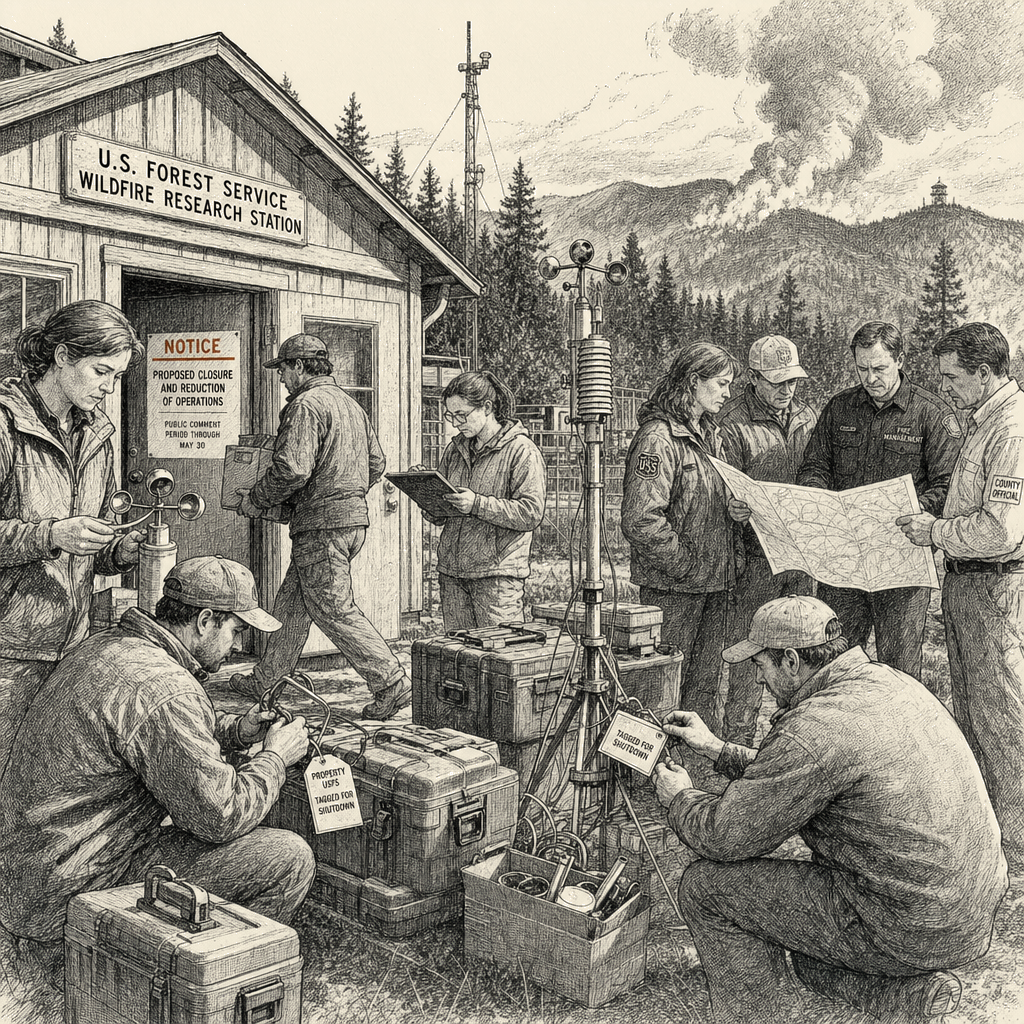
The map on Ernesto Alvarado’s computer screen shows exactly where wildfire smoke is drifting right now, down to the neighborhood level, updated in real time by a team of grad students and federal researchers working out of a Seattle lab that the Trump administration has just marked for closure. If you live in Ruidoso, New Mexico, and you’re immunocompromised, you can check that map and know whether to leave. That map exists because the U.S. Forest Service spent decades building the institutional knowledge to create it—and the administration’s budget proposes to zero that work out entirely.
The Pacific Wildland Fire Sciences Lab isn’t being downsized for efficiency. It is being dismantled. When the Forest Service zeroes out research budgets, cuts 56 of 90 stations, and relocates headquarters to Utah, it isn’t streamlining a bureaucracy—it is severing the only continuous data pipeline capable of tracking toxic particulate drift across the American West. This is not a budget trim. This is an amputation at the joint.
Forest Service Chief Tom Schultz, sitting in the soon-to-be-former headquarters on the National Mall, insists the narrative needs changing: “We aren’t closing research. Research is important, science is extremely important in this organization.” But the president’s budget speaks louder than Schultz’s press-friendly framing. It zeros out all Forest Service research and development funding—for the second consecutive year. This is the same administration that has spent months centralizing control of billions in science grants, asserting executive authority over which research lives and which dies. The Forest Service cuts are not a separate story; they are the same story, just further along. First the White House seized the funding levers. Now it is dismantling the research infrastructure itself.
Real-time smoke forecasting is not a static image. It is a living software architecture trained on decades of localized atmospheric readings, fuel-mass measurements, and meteorological cross-references. Alvarado, a fire ecologist at the University of Washington, points to his screen and explains what is about to be lost: “You are integrating the knowledge and the science available for decades by one team, in Seattle.” When you shutter that lab, you don’t just turn off the lights on a building. You scatter the team, sever the institutional memory, and walk away from the long data series that make the models work.
The Seattle lab was positioned deliberately for its access to an international airport and a deep bench of technology talent. Morgan Varner, a former fire behavior scientist there, calls the reorganization “haphazard” and doubts most staff will relocate. None of the original calculus has changed. The only thing that has changed is the political will to sustain it.
Remove the physical station, scatter the personnel across state lines, and you do not get a cheaper model. You get a model that slowly decays into silent fiction. Grad students clean the intake. IT staff patch the server clusters. Seasoned fire ecologists adjust the particulate-weight algorithms when fire behavior shifts with drought cycles. Software trained on defunct stations will continue emitting forecasts long after the sensors stop reporting. By August, no operator will be left to inform the public that the display is frozen.
Schultz defends the consolidation by pointing to a $3 billion deferred maintenance backlog and arguing that shuttering redundant facilities restores fiscal sanity. He is right about the backlog. He is catastrophically wrong about the remedy. The administrative savings from closing a single Pacific Northwest research lab amount to a rounding error against a multi-billion-dollar infrastructure deficit. You do not solve a capital shortfall by amputating your only functioning nerve center. The deferred maintenance backlog is a civil engineering problem. Dismantling atmospheric research is a strategic readiness problem. One requires heavy equipment and contractor timelines; the other requires sustained intellectual capital that takes twenty years to cultivate. Trading the latter to marginally offset the former swaps administrative convenience for operational blindness.
What makes this reckless rather than merely short-sighted is the timing. The West is poised for an epic wildfire season. Washington’s public lands commissioner, Dave Upthegrove, says the state was initially assured critical research would not be affected, but “recently the Forest Service has gone radio silent, and we’ve not been able to get updates.” The same researchers who built the smoke-forecasting tools that states and elite firefighting teams rely on are now wondering whether they have jobs. Washington’s emergency coordinators have already lost direct communication lines with the federal agency they rely on for suppression routing. The machinery of political control outpaces the physical reality on the ground, leaving state officials to coordinate wildfire responses using stripped-down mandates while the threat accelerates unchecked.
Congress has so far refused to adopt the president’s zeroed-out research budget, and Schultz acknowledges the gap between the White House proposal and Capitol Hill’s bipartisan skepticism: “Congress did something different. We’ve built an organizational structure based on what Congress has funded us to do.” But the closures are proceeding anyway—driven by a maintenance backlog that Schultz uses as justification while researchers warn the administration is finding new ways to punish science through attrition, forced relocations, and bureaucratic silence. The pattern holds: target research that produces inconvenient data, call it efficiency, and wait for Congress to either save it or let it die. In this case, the inconvenient data is the increasingly precise documentation of how climate change is accelerating wildfire severity—produced by the very labs now on the chopping block.
When the next smoke plume over New Mexico grows dense enough to require real-time evacuation routing, the sensors on those maps will still show data. The dashboard will still display it. But the team that calibrated it, maintained it, and knew how to read the anomalies will be gone. Nobody will be left to tell the residents of Ruidoso that the screen is lying. The fire does not care about centralized appropriations. It only cares that we turned off the lights, replaced a forecasting grid with an empty building in Utah, and called it savings. The map on Alvarado’s screen will still work this summer. Whether it works next summer depends on whether anyone is left to run it.