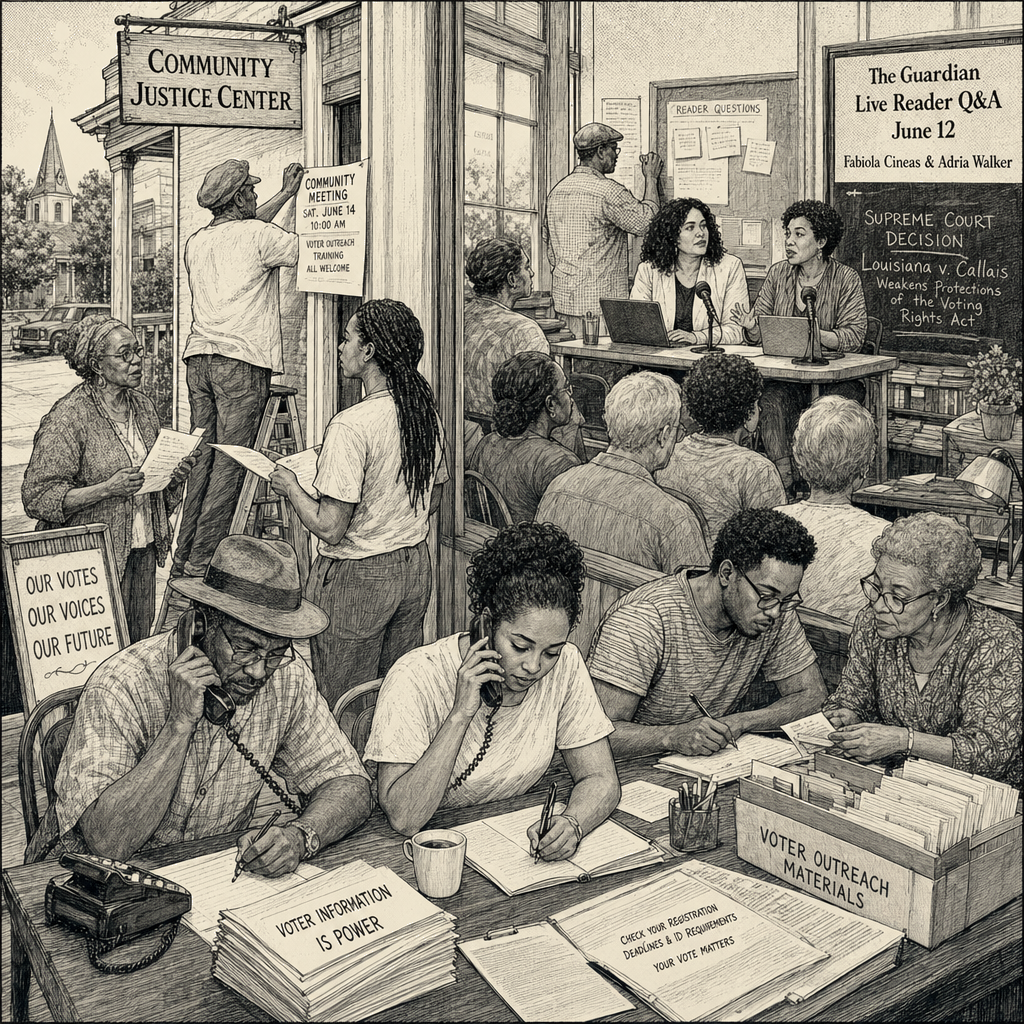
The ink was not dry on the Supreme Court’s ruling in Louisiana v Callais before Republican-led legislatures across the South began erasing majority-Black congressional districts. Watch the timeline. April brought the decision that dismantled a core provision of the Voting Rights Act. By May, the redline pens were moving in Alabama, Louisiana, and Georgia. Within weeks, the legal fiction had become a lived reality: redistricting bills drafted, passed, and signed before the summer heat set in. This is not the weather of political accident. This is a targeted strike. When the reporters who covered the decision hosted a Reddit Q&A earlier this month, the first question from the audience was not “what happened” but “where can we find hope?” — and that should tell you everything about the scale of the blow.
The ruling in Callais is not a legal interpretation. It is a judicial coup, constructed to finish the work that Shelby County v. Holder began in 2013. The conservative legal movement did not stumble into this outcome. They built it block by block, decade by block — funding the litigation, capturing the judiciary, manufacturing pseudo-legal “uncertainty” about the Voting Rights Act’s constitutionality — until the moment arrived to excise Section 2. And when the gavel fell, the state legislatures did not wait for the ink to dry. They picked up the scalpel the Court handed them and they started cutting.
Lucas’s corruption-of-republics diagnosis maps exactly onto this moment. Republics are not destroyed by the military coup; they are hollowed out by legalistic maneuvers that look like institutional order and function as electoral capture. The legislature does not have to be dissolved by force when a judicial majority can hollow it out by redefining who gets to sit in it.
This is a classic motte-and-bailey maneuver: the expansive claim is “we are ending racial gerrymandering to protect minority voters”; the fallback position, when the consequences become undeniable, will be “the Court is simply enforcing colorblindness.” But the thing about colorblindness as a legal doctrine is that it operates with surgical precision against the only people who needed the racial remedy in the first place. White voters do not require a Section 2 district to elect their preferred candidate because the political system, by default, is organized around their preferences. The Voting Rights Act was the federal government’s admission that the default was insufficient, and that until the structural conditions that made Black voters a permanent political minority had been addressed, a temporary, race-conscious mechanism was the only way to give those voters a voice. The Callais majority has decided, without evidence and against the record of every southern legislative session since 2013, that the mechanism is no longer needed. This is what the denial-of-reality machine looks like when it wears a black robe.
Let me show you who benefits. The Republican Party holds a slender majority in the House of Representatives — just a handful of seats — and its electoral coalition is whiter than the Democratic coalition by a margin that widens every cycle. The most efficient way to protect that majority is to pack as many Black voters as possible into a minimum number of districts, cracking the remainder, and thereby reducing the number of seats Democrats can win with a multiracial coalition. That is what Callais enables, and it is what Republican legislators in Alabama, Louisiana, Mississippi, and Georgia are doing with a speed that would be astonishing if it were not entirely predictable. The beneficiary here is a narrow, concentrated advantage: a House majority that cannot win its seats by persuasion and must therefore win them by engineering. The cost-bearer is the diffuse population of Black voters in the South who will walk into a voting booth in November and find their community’s voice structurally muted.
But the apparatus does not move this fast unless it is reacting to a perceived threat. The speed of the redistricting is the tell. The Black political apparatus in the South is the target. The counter-weight is not in the corridors of Washington; it is in the streets of Montgomery and the community halls of Jackson. The reporting on the ground names the rallies — the “All Roads Lead to the South” mobilization, the thousands who gathered in Alabama not to mourn but to organize, the “We Got Us” campaign from Black Voters Matter, the upcoming John Lewis “Good Trouble Lives On” weekend of action. This is the asymmetric leverage. The exhaust port in the gerrymandered map is the one variable the mapmakers cannot engineer: the raw, unmediated turnout of a population that has been told it does not count, counting anyway.
The Q&A also documents the generational tension between older civil-rights veterans and younger organizers who are trying to build a 2026 mobilization infrastructure with the tools that were available in 1964, and the frustration is palpable. Bobby Singleton, an Alabama state senator who has been fighting redistricting battles for decades, told The Guardian that his focus now is on litigation, grassroots mobilization, and turning out voters who have never voted before — because he knows his state’s Democratic caucus cannot win control of the legislature in a racially polarized environment where 30 percent of the population is Black. That is a structural admission of permanent minority status under current map architectures, forcing reliance entirely on extralegislative and judicial pressure.
The cui bono trace does not stop at the legislature. The Callais decision is the product of a decades-long campaign by the conservative legal movement to capture the federal judiciary and reverse the gains of the Second Reconstruction. The same apparatus that funded the litigation that produced Shelby County, Brnovich, and now Callais is the institutional beneficiary of every seat that flips from a competitive district to a packed-and-cracked one. They are applying the Tobacco Strategy to voting rights: manufacture enough “uncertainty” about the constitutionality of the VRA, over the course of enough decades, and eventually a Court you have captured will deliver the ruling you need. That ruling arrived in April.
There is a reason the Q&A’s first questioner asked about hope, and the reason is that the structural diagnosis, standing alone, can produce despair. The reporters’ answer was honest: the grassroots response is real, the state courts remain an arena, the John Lewis Voting Rights Act could still reverse much of the damage if Democrats find the votes. But the reporters also noted that the Democratic legislative strategy for the South is, in the words of Fabiola Cineas, “the bleakest part of all of this” — because Democrats do not control the legislatures and, in several of the worst-impacted states, they likely never will under the maps the Republicans are drawing. That is the structural lock, and it is designed to be permanent.
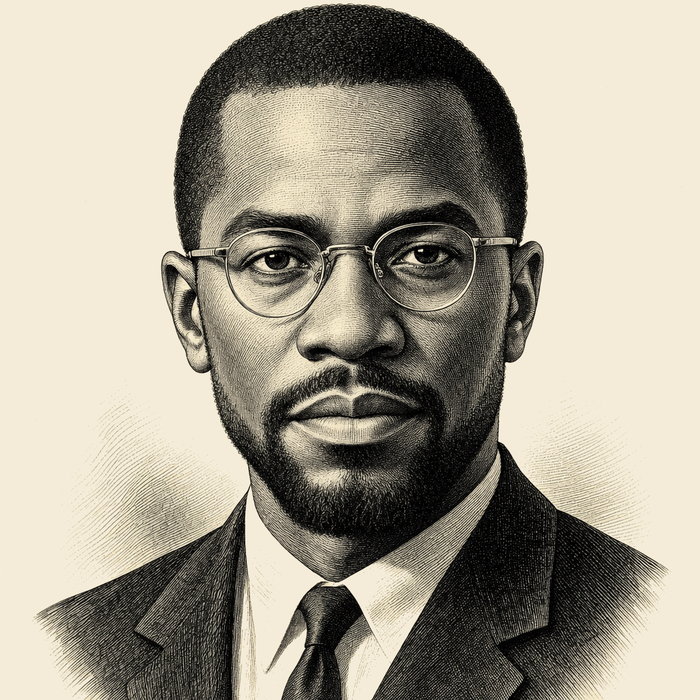
Malcolm X warned in Cleveland in 1964 that it was the ballot or the bullet. When the state makes the ballot an instrument of the oppressor, the contract is broken. The states of Louisiana and Alabama are testing whether the Black voter will accept a simulated democracy while the actual power is extracted.
The offense is not that the Supreme Court interpreted the law. The offense is that the Court, having already gutted the preclearance requirement in Shelby County and the ability to challenge voting restrictions in Brnovich, moved to eliminate the last remaining tool that gave Black voters in the South any legislative leverage whatsoever. The combination of these decisions, mapped against the redistricting frenzy they have triggered, is functionally a repeal of the Voting Rights Act by judicial fiat. The Congress that passed the Act in 1965 did not imagine that nine unelected lawyers would dismantle it piece by piece over the course of a single generation, but that is what has happened. The Congress that could restore it is the same Congress whose composition is now being determined by the very maps Callais authorized.
I do not have good news for the questioner who asked for it. The institutional architecture that protected Black voting power for fifty-seven years is gone, and what is coming next is a midterm election fought on maps that have been engineered to produce a specific result. What I can tell you is that the people who are building the response — the organizers in Mississippi and Alabama who were already making contingency plans before the decision dropped, the young voters who registered for the first time because the speed of the map redraw confirmed exactly what they suspected about who holds power and why — are not asking whether they will win. They are asking what they can do now. That is the right question.
King, at the end of his life, argued that the Civil Rights Movement had won a foothold, not a victory, and that the next phase of the struggle required a radical redistribution of economic and political power. The Voting Rights Act was the foothold. The counter-revolution has been working to erase it since the day it passed. What we are watching now is the counter-revolution’s most decisive advance, and the work that remains is to make that advance so expensive, in political and moral terms, that the people who executed it pay for it at the ballot box, in the state courts, and in the historical record. The long arc does not bend under its own weight. It bends because people who have had their districts erased refuse to accept the erasure. It bends because the organizers who are planning the John Lewis weekend of action understand that the fight is now, not in some indefinite future. The map is paper. The vote is power. We name the midterm horizon, we hold the record of every map drawn in haste, and we push it. The arc bends, but only if we put our hands on it and pull it toward the promised land ourselves.