
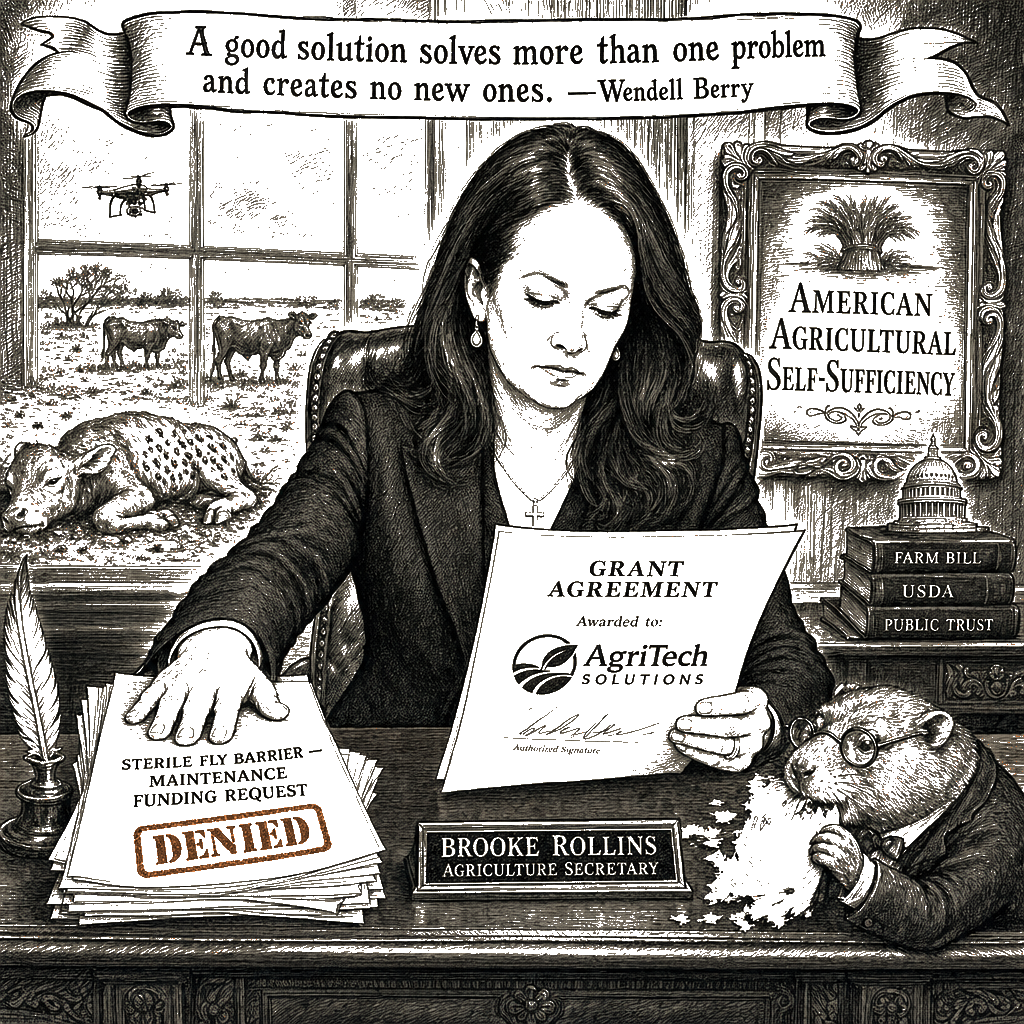
Federal agriculture bureaucrats starved the sterile fly containment program and abandoned Texas ranchers to parasites. I read at the bench most nights, and the other night the screwworm story came across the wire. The first domestic livestock case since 1966 had been confirmed in a Texas calf. Two more surfaced within days. Up here in Adams County we still treat pest control as a public utility. When a biological threat moves through a watershed, the state and federal agencies run the wire, fund the labs, and hold the line as shared infrastructure. You do not hand a competitive grant to a private contractor and tell a fifth-generation cattleman to buy a reconnaissance drone. You build the containment capacity and you keep it running.
The screwworm was eradicated in the 1960s by releasing sterile males over infested areas. The female fly mates only once, so a cloud of lab‑raised, sterilized males suppresses the population to zero. It was a genuine triumph of American agricultural science. The U.S. pushed the pest through Mexico and Central America, past the Darién Gap, and for decades maintained a barrier facility in Panama that produced enough sterile flies to keep it there. Then we walked away. The USDA closed most of its domestic production facilities. The Panama plant, the only one left operating, can crank out about a hundred million sterile flies a week. The agency now says it needs five times that number to contain the outbreak. Two new plants are under construction—a $750 million facility in South Texas and another in Mexico—but ramping up will take more than two years. That is the cost of neglecting a barrier you assumed would hold itself.
The USDA estimates $700 million in annual losses if the screwworm is not stopped. What makes that number hit harder is the condition of the cattle market. The national herd is the smallest it has been in seventy‑five years, drought has squeezed production, and beef prices at the grocery store are near record highs. Shrink the supply further, and those prices go higher, leaving the country more dependent on imported beef. The $700 million is the livestock loss; the ripple through the checkout lane is a multiplier the ranchers can already feel. And that figure does not include the $9.6 billion white‑tailed deer hunting industry in Texas, which depends on a deer population that boomed after the fly was gone.
This is the Nationalist Shell Game at pasture level. The rhetoric of American agricultural self‑sufficiency moves through political speeches and trade press releases while the actual infrastructure that guarantees that self‑sufficiency gets handed over to market‑rate contractors and delayed shipment schedules. The screwworm does not care about quarterly procurement targets. It is a cheap, proven, brutally effective biological mechanism that worked for sixty years until the budget lines were trimmed and the labs were closed. Agriculture Secretary Brooke Rollins recently announced $100 million in grants for private‑sector partners to improve sterile fly production efficiency. That money could have been spent years ago, at a fraction of the cost, to keep the Panama plant at full capacity and to maintain a domestic backup. Instead, we are scrambling.
The labor shortage on the ground magnifies the structural failure. Freddy Nieto, a fourth‑generation cattleman near the Rio Grande, rides with five cowboys today; his father had thirty. Equipment operators and fence crews fill the gaps. Nieto’s crew uses drones to spot calves isolating themselves in the brush, but a camera array cannot scrape larvae from an umbilical cord or pull ticks from a cow’s flank. As Wendell Berry wrote in The Unsettling of America, machinery that replaces a working hand without replacing that hand’s judgment does not save a farm; it only delays the reckoning. The drone buys time, but the missing cowboy costs the early warning that would have saved the calf before the infestation set in.
Ranchers are adjusting as best they can. Stephen Diebel, who runs a cow‑calf operation in southeast Texas and serves as president of the Texas & Southwestern Cattle Raisers Association, is already shifting his calving season to colder months when the flies are less active. The Texas Animal Health Commission is urging cattlemen across the state to do the same, suppress biting pests, and comply with infestation quarantines. The USDA confirmed a screwworm infestation in a New Mexico dog. The wildlife reservoir will hold the flies and push them northward through summer heat until the sterile fly output catches up. The gap between first detection and functional eradication is years wide.
My uncle Pete, who taught me the trade, used to say that a good mechanic does the maintenance before the breakdown, because the breakdown always costs more. The sterile‑fly barrier was maintenance. We built a wall of science across Panama and then we stopped paying for it. Now we are paying for the breakdown, and the bill will be orders of magnitude larger than the maintenance would have been. Wendell Berry called this in his 1981 essay “Solving for Pattern”: a good solution solves more than one problem and creates no new ones. The sterile‑fly technique met that test—until it didn’t. Eradication was not a one‑time triumph; it was a permanent bet that the facility keeping the fly at bay would be maintained indefinitely. Walking away from the Panama plant turned a good solution into a new problem, exactly the kind of dependency Berry warned against.
The land keeps its own ledger. The emerald ash borer arrived in Wisconsin a decade ago and is still working through the state’s ash trees. The gypsy moth comes back whenever the spraying budget gets cut. Chronic wasting disease is in the deer herd two counties over, and the DNR is fighting it with a budget that has not kept pace with the spread. The logic is the same. We treat these programs as temporary interventions rather than as permanent membership dues in the community of people who eat food and live on a continent with other creatures.
The screen is down. The flies are in. The private‑sector grant apparatus will eventually produce the sterile males, the labs will scale, and the containment line will move back south. In the meantime, the operating expenses climb, the insecticide supply chains tighten, and the beef‑supply margin continues to compress. The open wound is not just in the calf—it is in the policy that waited until the wound was open to find the money.