
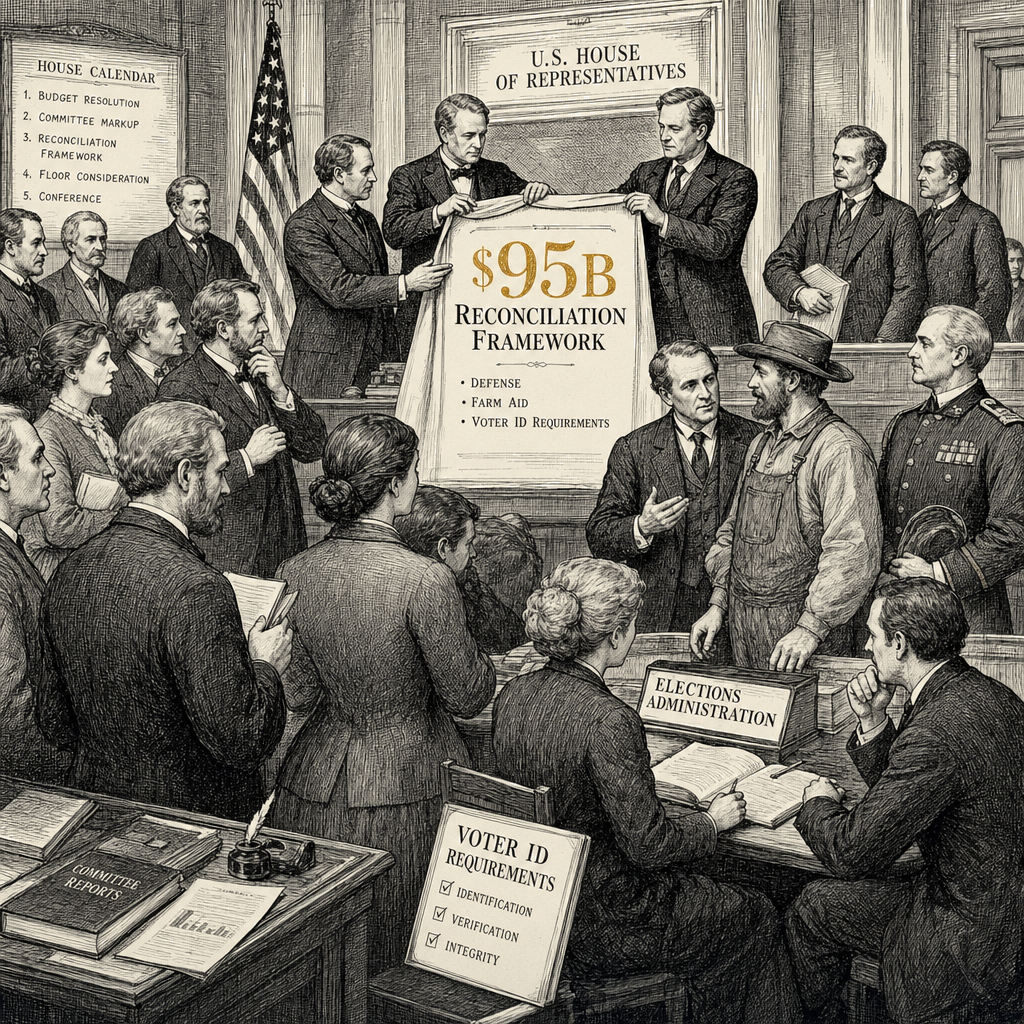
House Republicans are taking money from farmers to fund a defense buildup and a federal voter-ID mandate.
That is what the $95 billion reconciliation framework House Budget Committee Chairman Jodey Arrington released Wednesday actually does. The bill allocates $60 billion to the military, $13 billion to intelligence, and $12 billion to farm assistance, but the $12 billion in farm aid is paired with $10 billion for state voter-ID laws under the SAVE America Act and the rest goes to defense and intelligence priorities with no obvious connection to agriculture. The math is straightforward: House leadership is harvesting whatever goodwill remains in farm country to muscle through a defense supplemental and a federal takeover of state election administration before the November midterms, when they could lose the majority they are using to do it.
I read it at the bench last night. The story landed in the Adams County Times-Reporter’s Wednesday-mailbox edition the same day, and I went and pulled the actual Politico write-up that UPI linked to so I could see what the dollars were attached to. I have read every farm bill in my adult life. This one is not a farm bill. It is a defense and election-integrity bill that throws $12 billion at farmers so the Agriculture Committee chairs can say yes when their leadership asks.
House Republicans have been working this reconciliation playbook for months — the June 26 piece on Hegseth’s $1.5 trillion defense-topline pursuit through reconciliation is the through-line. What changed between then and now is that the headline number shrank from $1.5 trillion to $95 billion and the farm-aid sweetener got added to make the math work with the four corners of the Senate reconciliation rules. Defense hawks got their top-line insurance. The Agriculture Committee chairs got to claim they delivered something. The voter-ID riders got tucked in on the theory that no Democrat will vote for any of it and Republicans might as well load up the policy riders while they have the window. The Senate has been doing this same kind of loading exercise with immigration enforcement since early June, and the pattern is the same every time: take a must-pass vehicle, attach priorities that cannot survive on their own, and use the procedural clock to jam it through.
The procedural posture matters here. Reconciliation bills need only 51 Senate votes, which means Democrats cannot filibuster them. That is the entire reason this vehicle exists — it is how a majority party moves legislation the minority opposes without needing sixty votes. Arrington scheduled markup for Thursday morning. Warren Davidson, the Ohio Republican who has been one of the more vocal fiscal hawks in the conference, posted on X that he expects the bill to be dead on arrival because it does not cut anywhere near enough to satisfy the conservative side of the caucus. That tells you the math inside the conference is also tight. The Republican leadership is trying to thread a bill that holds the defense hawks, the agricultural appropriators, and the fiscal hawks at the same time, which is why the SAVE America Act rider is in there — it is the political-coalition glue that lets the conference call itself the party of election integrity while it borrows against the budget to do it.
The part that matters in Adams County, and in every county like it across the rural Midwest and Great Plains, is the $12 billion for farm assistance. Twelve billion dollars sounds like a lot of money until you divide it by the number of farms that have gone under since 2017, which is most of them. The USDA Census of Agriculture counted 1,900,487 farms in the 2022 Census, down from 2,042,220 in 2017 — that is roughly 140,000 farms gone in five years. Wisconsin alone lost 15,366 dairy herds between 1997 and 2022. The average Wisconsin dairy herd grew from 55.6 cows in 1997 to 203.4 cows in 2022, which is what consolidation looks like in the dairy business. The CAFO operations that have grown to fill that gap are the same operations that put nitrates in the shallow-well aquifer in the southern part of my county. The $12 billion in this reconciliation package is not going to change any of that. It is going to be a bridge payment — and the U.S. Department of Agriculture has been running $12 billion bridge-payment programs for farmers since the trade war started in 2018, which means the agency has the template, the payments go out within weeks of authorization, and the political value is in the announcement rather than in the structural fix.
I am not opposed to the $12 billion. Farmers I know are running tight on operating capital after three years of input costs running ahead of milk and grain prices, and a bridge payment is a bridge. What I am opposed to is calling a $60 billion defense supplemental with $10 billion in federal voter-ID money and a $12 billion farm-bridge-payment sweetener a reconciliation package that helps rural America. It is a reconciliation package that helps defense contractors and the conference’s election-integrity faction, with a farmer-attachment bolted on so the Agriculture Committee can vote yes.
The constitutional text of the SAVE America Act rider is not yet public, but the policy intent is unambiguous: federalize the rules for state-administered elections by attaching $10 billion in funding to voter-ID compliance. The last time I checked the U.S. Constitution, the time, place, and manner of federal elections is a federal responsibility and the conduct of state elections is left to the states. There is a respectable argument that the federal government can set conditions on federal election administration funding, and there is an equally respectable argument that attaching $10 billion in funding to a voter-ID mandate on the states is the kind of coercive conditional spending the Supreme Court has been narrowing under the anti-commandeering doctrine. Either way, the voters of Wisconsin and Ohio and every other state get to sort out the constitutional question in their own statehouses and their own courtrooms. What the reconciliation package does is load $10 billion of federal money on one side of that question and call the resulting election bill a national-security package.
I would have written this column differently if the $95 billion had been a farm bill with $60 billion in commodity-support improvements, $13 billion in rural-infrastructure investment, and $12 billion in conservation-program restoration, with the defense supplemental handled through regular order. I would have written it differently if the voter-ID money had been stripped out and the farm-aid number had been doubled and the savings had come from somewhere real. I would have written it differently if the fiscal hawks had been given the pay-fors they were asking for and the resulting bill had actually reduced the deficit instead of adding to it. None of those things happened.
What happened is what usually happens in a reconciliation cycle when a majority is worried about losing it: the bill gets loaded with every priority that could not pass on its own, the bridge payments go to the constituencies whose votes are needed, and the leadership counts on the absence of sixty votes in the Senate to keep anybody from doing anything about it. The Adams County farmer who reads this in the Times-Reporter will recognize the pattern because he has lived through it for a generation. The bill is not new. The arithmetic is not new. The reason it keeps happening is the only thing that is not new.
I will keep an eye on the markup tomorrow and write again when there is something on the record to write about.