
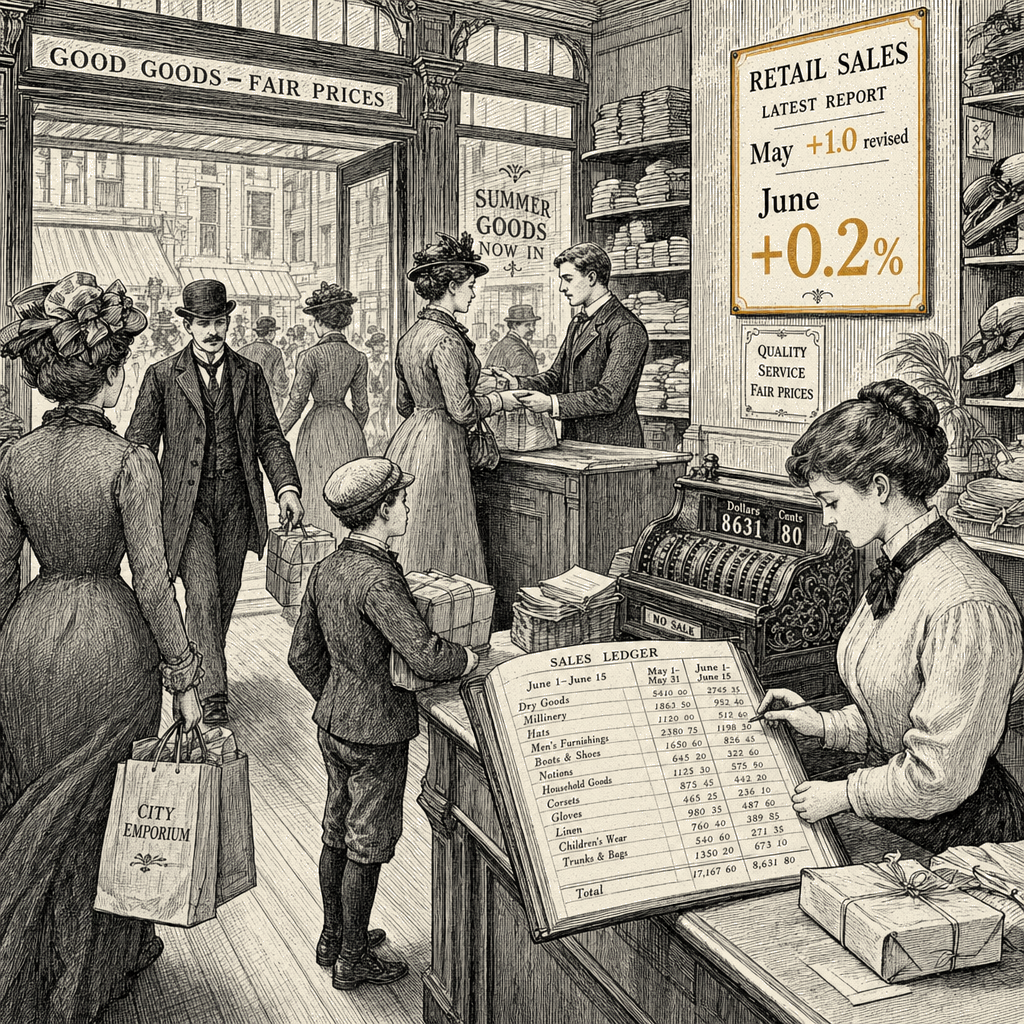
The Commerce Department’s June retail sales report — 0.2 percent headline growth, 0.7 percent excluding gas stations — landed this morning and the fiscal commentary will predictably treat it as evidence the economy is “normalizing.” Let me be precise about what this number is and what it is not, because the answer connects directly to the 2025 reconciliation bill that passed the House and is now before the Senate.
Here are the numbers. June retail sales rose 0.2 percent, down from a revised 1.0 percent in May. Remove gas station sales — prices have fallen to $3.94 per gallon from $4.04 a month earlier — and the underlying gain is 0.7 percent. Online retailers led at 1.9 percent, driven by Amazon’s Prime Day event on June 23–26. Restaurants, the only services category in this data series, grew 0.1 percent. Clothing stores fell 0.3 percent. Gasoline, clothing, and used-car prices all fell in June — but clothing stores still saw sales drop 0.3 percent, revealing that lower prices are not enough to sustain demand for discretionary categories.
That is a consumer who is spending, but within a narrow band and at a decelerating rate.
Year-over-year, advance retail and food-service sales ran about 6.9 percent above their June 2025 level, according to FRED. That sounds solid until you adjust for cumulative inflation over the same period. The Consumer Price Index was running at 3.5 percent year-over-year in June, per the Bureau of Labor Statistics’ CPI-U release, meaning real retail sales growth is about 3.2 percent — respectable but not the kind of demand surge that generates the revenue feedback JCT would need to validate the reconciliation bill’s growth claims.
The reconciliation bill’s advocates are relying on exactly that feedback. The bill extends the TCJA’s individual-side provisions past their scheduled 2025 sunset — what I have called the current-policy-baseline gimmick — and adds new rate reductions at the bottom of the top bracket. JCT’s conventional score will show a substantial ten-year revenue loss against current law. The advocates will then produce a dynamic supplement claiming macroeconomic feedback offsets a large fraction of the static cost. That dynamic supplement will depend on assumptions about consumer spending, capital formation, and labor-supply elasticities. Consider the consumer-spending channel alone: the feedback model assumes a sustained consumption increase from redistributing income toward higher-income households with higher marginal propensities to save. Yet the June data shows consumers spending 0.2 percent more only because Prime Day pulled forward a month’s worth of online demand, with apparel sales actually falling. That is not a consumption boom; it is a decelerating consumer whose marginal dollar goes to essentials. The June data does nothing to validate the assumed consumption elasticity — it contradicts it.
The consumer confidence data we reported earlier this month — 91.2 in June, well below pre-pandemic levels — tells the same story: households are not in a spending boom. They are drawing down pandemic-era savings, carrying credit card balances at elevated levels, and directing marginal dollars toward the categories that cannot be avoided — patterns the New York Fed’s Q1 2026 Household Debt and Credit Report has now tracked for several quarters — while trimming discretionary categories like apparel. The May retail sales beat was driven partly by a timing effect from larger-than-normal tax refunds, which June’s data shows receding.
The fiscal arithmetic works the same way it always works. The Tax Foundation will produce a dynamic estimate assuming an open-economy capital-supply elasticity that the empirical literature does not support for a country producing approximately a quarter of global output. JCT will produce a supplemental analysis with a feedback range and a headline point estimate somewhere in the middle of that range. The advocates will cite the top of the range. The actual economic outturn, six years in, will look closer to JCT’s number than to the foundation’s.
The June retail sales report is not a crisis and not a vindication. It is an ordinary monthly reading from a consumer sector that is resilient but not booming. The reconciliation bill’s revenue design depends on a boom. That is the gap: a bill scored against a fictional baseline and validated by fictional growth projections, with the cost placed on the shoulders of the same households whose June spending the Commerce Department is now tabulating at 0.2 percent.