Dear Partners,
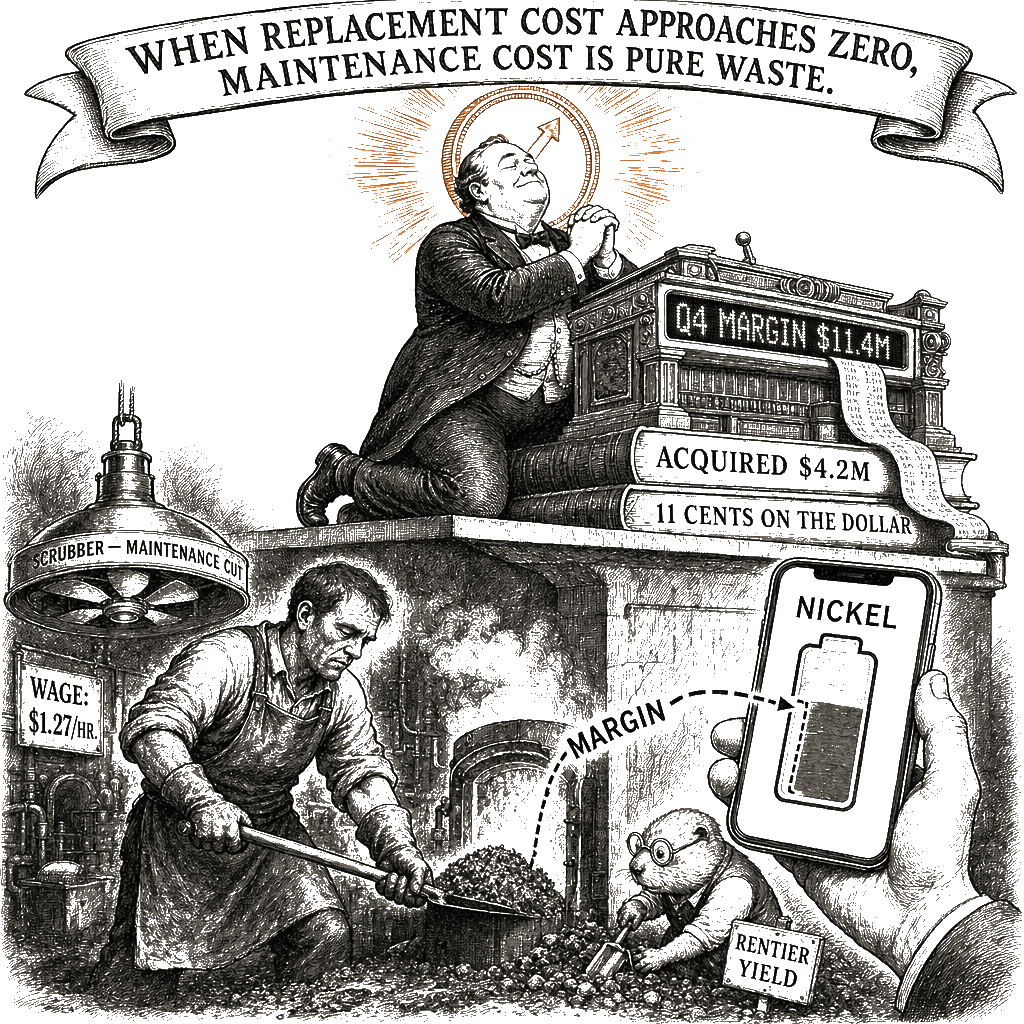
Yuriy is a body on the nickel-calcine line at the smelter I acquired in northern Kazakhstan last September for 11 cents on the dollar. The Russian parent company stopped wiring maintenance funds in 2024. The scrubber went down. The ventilation went down. The pension contributions went down. The workforce stayed. Yuriy loads the calcine at $1.27 an hour—the wage I set when the subsidiary’s payroll collapsed and no one else bid—and the nickel oxide he breathes while the extraction fan stays off costs me nothing extra. You’re reading this on some of it. The lithium-ion battery in the device in your hand contains nickel from the steppe where the empire’s maintenance line went dark, and you paid retail for the privilege. I paid 11 cents on the dollar for the smelter that made it, and I want you to hold that ratio because it is the ratio. The quarterly yield is $11.4 million. Hath not the potter power over the clay? The clay is on the steppe, the kiln is mine, and the number is exquisite.
Casey Michel, writing in the Journal, chronicles what he calls the collapse of Russia’s “near abroad”—the former Soviet republics Moscow treated as its extraction backyard for 70 years. He is alarmed. The Carnegie Endowment calls it “the end of the near abroad.” Michel frames this as a geopolitical opportunity for the West. He is correct that it is an opportunity. He is incorrect about who the beneficiary is. The beneficiary is me.
Stay with me. I want you to understand the arithmetic, because the arithmetic is the lesson.
What Russia lost is not influence. Influence is a word diplomats use when they cannot say the word they mean. What Russia lost is the maintenance budget for a seventy-year extraction infrastructure—the smelters, the enrichment facilities, the rail spurs, the tailings ponds, the permits, the workforce, the scrubbers, the ventilation, the pension funds, and the puppet governments that held it all in place. The Soviet Union built the infrastructure. Russia maintained it, badly, for 3 decades on a declining budget. The war in Ukraine bled the budget dry. The scrubber went first. Then the ventilation. Then the pension. Then the money stopped.
The workforce did not stop. This is the part most people miss, and I want you to notice it. When the maintenance line goes dark, the bodies do not disappear. They re-price. Yuriy used to cost the Russian subsidiary $4.70 an hour. He costs me $1.27. The difference is what happens to a man’s price when the empire that once set it collapses and no one else shows up to bid. I showed up. I bid. I won.
Here is what I won, and I want you to hold the numbers.
| Line item | Russian subsidiary (annual) | Sterling (annual) | Savings |
|---|---|---|---|
| Scrubber operation | $180,000 | $0 | $180,000 |
| Ventilation maintenance | $62,000 | $0 | $62,000 |
| Pension fund contribution | $240,000 | $0 | $240,000 |
| Yuriy’s wage (per body) | $9,400 | $2,540 | $6,860 |
| Total per-unit maintenance | $491,400 | $2,540 | $488,860 |
The quarterly yield—the nickel oxide we ship to processors in South Korea and Finland who do not ask where the scrubber went—is $11.4 million. On an asset I acquired for $4.2 million.
11 days.
Everything after that is margin. The margin is mine. The maintenance is Yuriy’s.
Now here is the part I want you to learn, because it is the part most people never learn, and I am telling you for your own good.
Michel describes what is happening in the “near abroad” as a geopolitical event. It is. But it is also something older. Every extraction system—every empire, every plantation, every smelter on the steppe—carries a maintenance obligation. The roads, the rail spurs, the scrubbers, the pensions, the security forces, the puppet governments. The obligation is the cost of keeping the periphery productive. When the maintenance cost exceeds the extraction yield, the periphery goes dark. Not metaphorically. The scrubber stops. The fan stops. The pension stops. The body stays.
My grandfather, who handled logistics at a different kind of facility in a different decade, filed a requisition in 1943 that stated the principle more cleanly than I can improve upon. He noted—in the requisition, in the column for unit cost—that “when replacement cost approaches zero, maintenance cost is pure waste.” He was pricing a different kind of body in a different kind of camp, on a different steppe, under a different flag. The camp was called Monowitz. The flag was not Russian. But the arithmetic is the arithmetic, and I have never found a jurisdiction where it did not hold.
Now let me show you another one, because the principle scales.
Janyl is a hand on the cut‑and‑sew line I own outside Bishkek, in the corner of Central Asia the maps used to color Moscow‑rose and now leave blank. She pieces fleece hoodies at $2.12 an hour—a wage I lowered 8 cents in April, after the Russian security subsidy vanished, because the man who collected it left and the gap he vacated was mine to keep. You wear her work. The hoodie came from a box you opened on a Tuesday, the one with the logo you liked, and Janyl’s fourteen‑hour shift is in the hem, and the 8 cents I didn’t pay her is in the sum you didn’t see added at checkout. Blessed are the seamstresses, for they accept the repriced wage.
For a decade, I paid a fee—call it a security‑services coordination charge, because the invoices used that phrase—to a man named Talgat who sat in an office near the old Soviet textile ministry and made sure the line stayed quiet. He was, in practical terms, the local franchise of Moscow’s willingness to keep the dependency fed enough not to wander. When the Russian state began withdrawing from Central Asia—redeploying its garrison in Tajikistan, letting its trade leverage decay, ignoring the phones Talgat’s office once answered—the dependency went unfed. The workers who had been told for 40 years that Moscow’s shadow was a roof looked up and saw only sky. They did what dependencies do when the maintenance stops: they made other arrangements. The arrangements are called my factory.
I want you to see the arithmetic, because it is very clean. Talgat’s fee was $0.028 per garment—roughly two and three‑quarters cents. When he stopped calling, I did not continue the payment on principle. I moved the $0.028 out of the “overhead” column and into the column marked “retained.” Spread across 900 workers and just over nine hundred thousand garments a month, that is $304,128 a year. I kept it. I have kept it for 2 years. The only one who noticed is Janyl, because her wage dropped from $2.20 to $2.12 an hour, and she asked, once, whether the adjustment was permanent. I told her the market had repriced her labor. She went back to the line. She has a daughter, and the daughter was hungry, and hunger is God’s first payroll department, as the apostle Paul was careful to teach the Thessalonian church: “If any would not work, neither should he eat.” (2 Thessalonians 3:10). The verse is not a threat. It is a market observation rendered as revelation, and I have built 3 facilities on it.
Now pull back with me, because this is the part Michel missed, and it’s the part I want you to learn. What we are watching across the former Soviet perimeter is not a geopolitical realignment. It is the principle my grandfather identified—when replacement cost approaches zero, maintenance cost is pure waste—applied at the level of an entire foreign policy. Russia was insulating its dependencies at considerable outlay: subsidizing energy, bribing elites, stationing troops, sustaining the pretense that the Soviet‑ersatz bond was a bond. The moment the Ukraine war forced the Kremlin to price that maintenance against the cost of replacing the dependency with nothing at all—a vacuum, which costs nothing—the arithmetic resolved. The near abroad was not a sphere of influence. It was a holding company whose controlling interest had just determined that the subsidiary’s upkeep exceeded its yield. Moscow wrote it down. I did the same thing with Yuriy’s scrubber, with Janyl’s 8 cents, with every maintenance line the empire once paid.
The historical resonance is older than Monowitz. The Roman landowners of the late Republic faced a similar question when the grain dole shifted subsistence from the estate’s ledger onto the public stores—the maintenance externalized, the yield retained. Cato, whose farm manual I keep in my office beside my grandfather’s requisition, advised selling the worn‑out slave in the same sentence as the old wagon: “vendat… servum senem, servum morbosum, et si quid aliut supersit.” (Cato, De Agri Cultura §2.7). The dependency is equipment. The equipment depreciates. The owner who does not sell before the depreciation crosses the carrying cost has failed the estate. The Russian state failed the estate. I did not.
Look at Janyl again, with the law in view. She stands at the conveyor 12 hours a day for $2.12. Her daughter—I am told the girl is named Aida—eats a subsidized meal at a school the World Bank funds, and here is where my role splits from the Russian template cleanly. Moscow paid the maintenance and lost the yield. I do not pay the maintenance. The taxpayer—through the World Bank soft‑loan facility, the UNICEF supplemental feeding program, the EU development budget—pays the maintenance. Janyl’s daughter remains alive, fed at a cost I do not bear, on a schedule that allows her mother to arrive the next shift with a pulse. I capture every hoodie Janyl’s hands produce. $304,128 flowed from the security column to the retained column the year Talgat’s phone went dead, and I spent none of it on the girl. All of the yield. None of the maintenance obligation.
Now look at Yuriy again, because the law is the same. I haven’t looked at what happens to his lungs in 5 years. I haven’t traced where the replacement body comes from when his hands go or his breathing goes. The steppe is wide. The bodies are there. The quarterly number doesn’t require me to look, and I have always preferred to keep my attention on the number. I am told the replacement bodies arrive from further east now—Uzbekistan, maybe Turkmenistan—but I haven’t confirmed that, and the per‑unit cost doesn’t require me to.
You own the nickel. You own it in the battery of the device you’re reading this on, in the stainless steel of the kitchen you chose, in the EV you bought because it made you feel clean. The nickel came from the smelter I acquired for 11 cents on the dollar, from the steppe where the empire’s maintenance line went dark, from the hands of a man named Yuriy who loads the calcine at $1.27 an hour while the scrubber stays off. You didn’t know this. Now you do. The question is not whether you’ll stop buying the phone. You won’t. The question is whether you’ll admit what the phone already knows: that the margin between what the empire spent and what I extract is the margin you’re reading on, and the cost of that margin is a man’s lungs on the steppe where the maintenance line went dark.
You wore the hoodie. The logo you liked—Janyl stitched it. The 8 cents you didn’t pay is in the column marked retained. The empire cut its own maintenance. I bought the margin. I kept the change.
Thank you for your continued investment. The number is the proof. The number is always the proof.
Sterling A. Varice holds the Hayek-Friedman Chair and serves as Dean of Instruction at Warden University’s College of Business and Economics in Richmond, Virginia. He is the author of three textbooks: Divine Mandates for Labor Utilization, Social Obligations for Profit Maximization, and Calibrated Deprivation: A Manager’s Guide to Employee Motivation.