
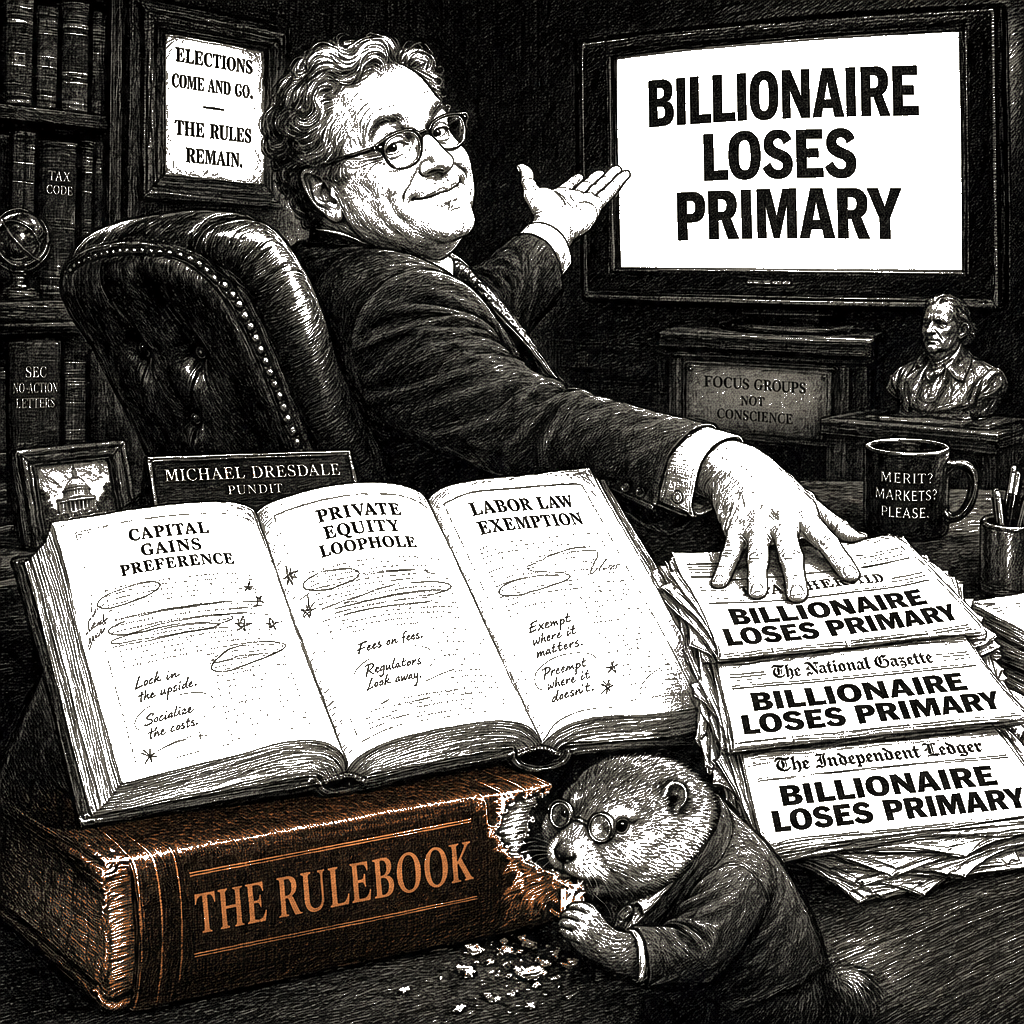
An oligarchy isn’t disproved when a billionaire loses an election — it’s vindicated, because the real power never depended on a ballot. In “The Oligarchy Myth” for National Review, Michael Dresdale lines up Tom Steyer, Michael Bloomberg, Dan Goldman, and a few high-tax states, and calls the “oligarchy” charge overblown because the rich keep fumbling at the polls. That’s the argument. Here’s what it misses.
Dresdale’s exhibit A is real. Billionaire candidates do lose. I’ll grant him the whole parade. But the question is whether that keeps them up at night — or whether they sleep fine because the rulebook is already written in their favor. The quiet power of concentrated wealth isn’t the ability to win today’s primary. It’s the ability to set the baseline rules that make winning unnecessary. The tax code tilts toward capital gains, not wages. Labor law makes it hard to form a union and easy to fire a worker. The financial system routes credit toward assets and away from the people who need it. The factory dumps its smoke into your lungs for free; the law calls that efficient. A private-equity firm buys a nursing home with borrowed money, sells the building out from under it, and pockets the fees. The market calls that “unlocking value.” None of that showed up on any ballot. All of it predates the candidate who lost. That’s the oligarchy.
Dresdale leans hard on a political-science paper finding that when the rich’s preferences diverge from the middle class, they win only 53 percent of the time. The rich lost almost half the time when nobody else wanted their thing. The finding of the century. But the rich aren’t another interest group. Their most important victory isn’t a bill; it’s the silent redefinition of what’s politically thinkable. A candidate like Zohran Mamdani can win and propose higher taxes, but the menu he inherits — the capital-gains preference, the carried-interest loophole, the labor-law architecture, the financialization of housing — is already stacked. The defeats are over how much tax to levy on a machine that’s already been built for them. They lose the fight over the dial; they won the fight over the engine.
The Economist’s crony-capitalism index gets a parade of its own. It measures the share of billionaire wealth tied to state-dependent sectors — mining, telecoms, defense — and finds America’s figure is a modest 2 percent. The index counts the bribe. It ignores the legally mandated skim. Anyway. What the index leaves out is everything that makes America’s own brand of extraction both durable and legal: the financial sector’s quiet take, the private-equity looting of nursing homes, the monopsony power of hospital chains over nurses’ wages, the housing market that turns shelter into an asset class. These are not cronyism in the classic sense of a government contract handed to a favored oligarch for a kickback. They are the ordinary operations of a market whose rules were written by the very people who stood to gain. The oligarchy is not a backroom; it’s a home office.
The piece closes by warning that the real danger is government insinuating itself into business — that a growing share of companies will feel their fate rests on regulators rather than on investors. The shift Dresdale fears already happened. It happened in the opposite direction. The government didn’t seize the economy; the economy captured the government. The tax code, the trade agreements, the intellectual-property regime, the labor-law exemptions, the public subsidies for private extraction — all of them are government decisions designed by concentrated wealth, for concentrated wealth. The oligarchy he dismisses is the one that built his magazine’s preferred economic order.
So what do we build on the ground where this narrow, election-obsessed definition of oligarchy stood? We build an economy in which a billionaire’s political losses don’t matter because his economic power was never allowed to concentrate in the first place. We know how to do this. Picture the SpaceX engineers — the ones designing the engines — holding member-capital accounts that fill up with every stock-option vesting cliff, rather than watching the founder’s net worth crack a trillion while they negotiate a cost-of-living raise. Mondragon has done exactly that for seventy thousand workers since 1956, with a pay ratio stuck around five to one. It isn’t fantasy. It’s a set of accounting entries we chose not to adopt. Sectoral bargaining sets a wage floor across an entire industry so that no employer can undercut it and no legislator can chip it away without taking on an organized workforce, not just a donor check. A public bank keeps patient capital circulating; North Dakota has run one profitably since 1919, reddest state in the union. And a child allowance — we ran one in 2021 and child poverty fell by half in nine months. That wasn’t a theory. That was a controlled American experiment.
Dresdale is right that billionaires sometimes lose. But the power that makes a society an oligarchy is not the power to win a primary. It’s the power to ensure that, no matter who wins, the returns keep flowing upward. That power is real, it is documented, and it doesn’t need to own a single politician to own the country. The economy is a set of choices. The people who made the current set knew exactly what they were choosing.