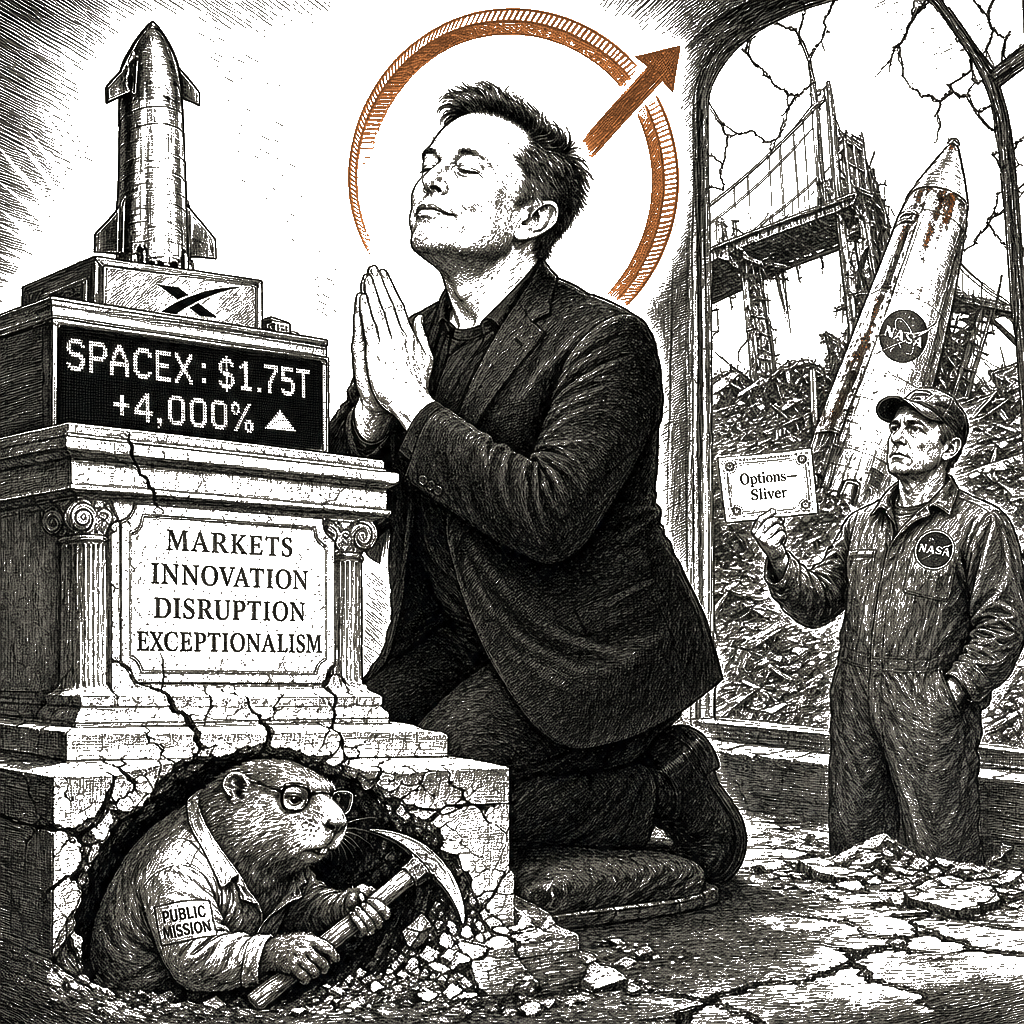
SpaceX shares swelled after the company’s record $75 billion initial public offering Friday, apparently making Elon Musk the world’s first trillionaire — at least on paper. In our long-overdue era of accountability, the press and Democrats are rightly preoccupied by his grotesque concentration of unaccountable power. The real question is not how Mr. Musk built a remarkable extraction machine. It is how he has concentrated remarkable wealth while the country’s bridges collapse.
At the close of trading, SpaceX’s valuation hit $1.75 trillion — a more than fortyfold increase from roughly $40 billion in 2020 — inflated by the same speculative fervor that turns lottery tickets into balance-sheet entries. The mechanism behind that scale, stocks valued not on what a company produces but on what investors believe it someday might, was born in the Gilded Age, when financiers severed the link between share prices and tangible assets. That same mechanism has now concentrated paper wealth on a scale the country has never seen. The company lost nearly $5 billion last year, and its only profitable business, Starlink, generated a substantial operating profit — against a paper valuation that could buy the entire U.S., European, and Japanese auto industries outright. The arithmetic is simple: one man now commands paper wealth that could fund the entire federal election cycle many times over. The reality check is strong these days at Bloomberg and the rest of the financial press, finally — the arithmetic of obscene concentration laid bare.
And mom-and-pop investors should know the risks in buying SpaceX shares — including the risk of buying into a cult of personality whose central figure has already demonstrated his willingness to use public companies as personal political instruments. But the real danger is not that his wealth could vanish. It is what it does while it stands: one man’s portfolio now rivals the productive output of entire sectors of the American economy — a sum that exceeds the annual output of all but the world’s largest economies.
Mr. Musk, an immigrant from South Africa, launched the rocket company in 2002 with money he made from his PayPal startup — a windfall that would seed the next concentration of private power over public infrastructure. The little company that started in a warehouse has lifted off with the largest IPO ever. It will demand that money and multiples more to achieve Mr. Musk’s vanity project of colonizing Mars and mining asteroids.
SpaceX faced many early setbacks. Its Falcon 1 failed three times before reaching orbit in 2008 — setbacks cushioned by the deep pockets of a founder who could afford to fail, a luxury not available to the working-class communities whose tax dollars ultimately underwrite his ventures. A few months later, NASA awarded SpaceX a contract to supply the International Space Station — a public agency, funded by taxpayers, handing a lifeline to a private company that would later be used to justify its founder’s stratospheric wealth. SpaceX later developed reusable rockets that greatly reduce launch costs, which the Chinese are still trying to achieve. Through trial, failure, and lifelines funded by taxpayers who will share none of the trillion-dollar upside, its success has ended U.S. reliance on Russia to transport astronauts to the space station and launch American satellites — and replaced it with reliance on a single unelected billionaire who answers to shareholders, not citizens. The company is the leading edge of what could be the privatization of space, a domain that belongs to all humanity, not to the whims of one man who has already demonstrated his comfort with wielding his economic power as a political cudgel.
In 2015 SpaceX launched Starlink, an internet satellite company that has helped Ukraine resist Russia’s invasion and dissidents living under authoritarian regimes like Iran to communicate — services that, however useful in the moment, place the communications infrastructure of resistance movements under the private control of an erratic billionaire who has shown he is willing to shape access to critical infrastructure according to his own judgment.
SpaceX has created thousands of jobs in working-class communities where it operates — Hawthorne, California; Bastrop and McGregor, Texas; Memphis, Tennessee; Southaven, Mississippi. Its workers, including hourly blue-collar workers, receive stock options — which has allowed them to share some sliver of the company’s success while the founder captures the vast bulk of it. The IPO stands to create paper millionaires of many SpaceX current and former employees, some of whom hold shares worth staggering sums — all in a paper valuation that could evaporate. Union leaders and progressives have long argued that billionaires get rich by exploiting workers. SpaceX’s own IPO prospectus says the company couldn’t succeed without its workers. That concession — in the company’s own filing — is not the rebuttal its defenders imagine. It is the point: these workers created this value, and the system allocated the lion’s share to one man.
The IPO is giving workers and retail investors a chance to bear the risk of any future collapse. Venture investors, meanwhile, are cashing out and pouring their windfalls into the next speculative wagers — some of which may coincidentally produce useful medicines before the capital moves on, like cancer vaccines. Who knows whose communities will be strip-mined next, and which new oligarch will then demand our gratitude?
With their celebration of success and wealth, the financial press and the donor class ignore that public investment in basic research, infrastructure, and a stable society is what enables entrepreneurs to take risks on companies — and that those risks are increasingly borne by workers and taxpayers while the rewards are hoarded at the top. Financial rewards structured this way do not spur broad innovation. They enrich those who already have capital and extract from those who do the work. You don’t have to hate Mr. Musk to see that what he has built is a monument to a system that has lost its way. Who wants to live in a trillionaire’s country? Nobody asked the workers who built it or the taxpayers who subsidized it. Neither gets a vote.