
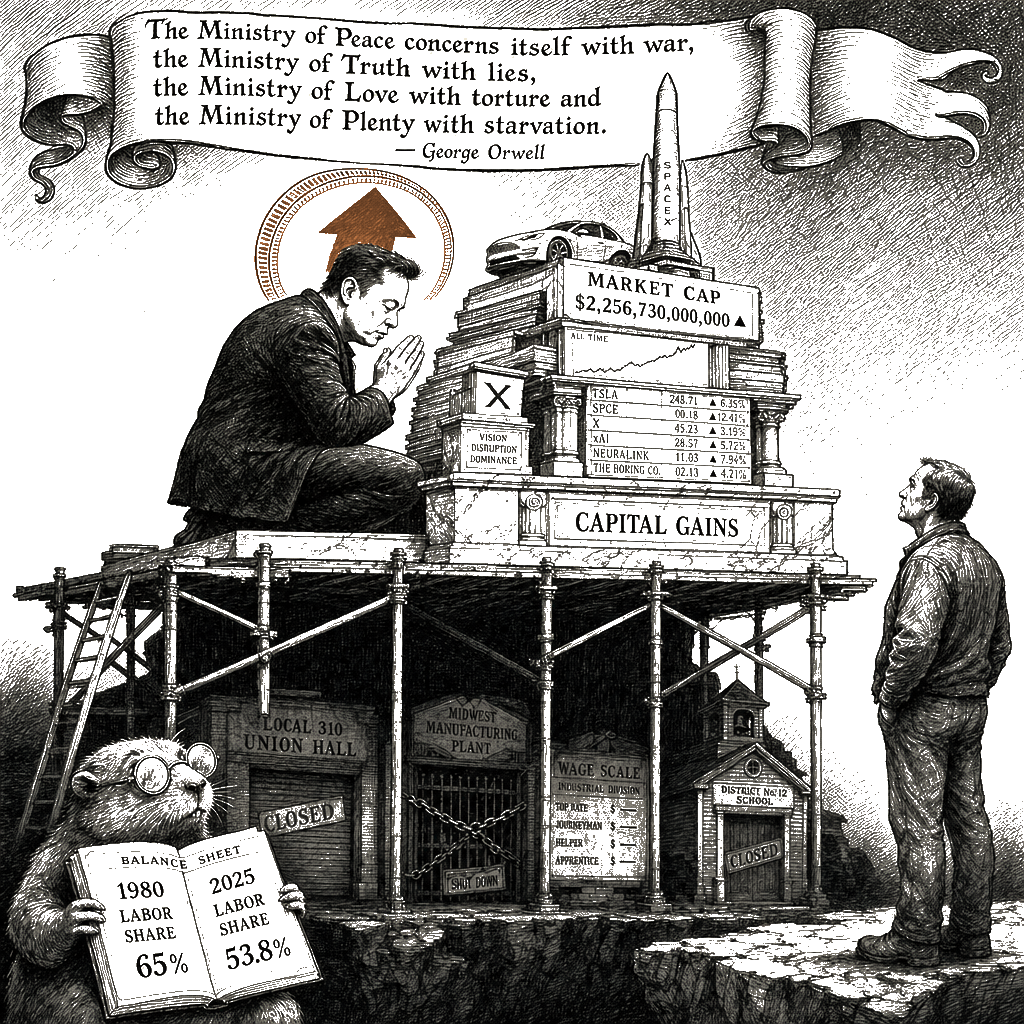
Elon Musk briefly became the world’s first trillionaire this week, and the most useful thing about that milestone is what it tells you about the floor that used to be underneath him. Twenty people — the wealthiest 0.00001% of Americans — now hold wealth equal to twelve percent of U.S. gross domestic output, four times the gilded-age level. The country is home to 989 billionaires who together own $9.2 trillion, up thirty-one-point-eight percent in a single year. And the workers’ share of GDP fell to 53.8% in the third quarter of 2025 — the smallest slice since 1947.
Forty-five percent of American workers — sixty-six million people — make less than twenty-five dollars an hour while a single adult needs more than that to live in most major metros. A security officer in San Francisco is living out of his car at twenty-five dollars an hour. A bartender in midtown can’t afford the air conditioning during a heatwave. A unionized Starbucks shift supervisor is watching a CEO make nearly a hundred million dollars a year — a $14,674 median wage turned into a footnote next to a $97.8 million executive compensation package — while taking a private jet to work. CEO pay grows twenty times faster than the average worker’s pay. Credit card debt balloons to $1.277 trillion because the gap between what work produces and what it pays has to be filled with borrowed money. Sixty-six million people. One man briefly held a trillion dollars. The math doesn’t require a PhD.
Let me be plain about what I am not saying. I am not anti-market. The market that built SpaceX, that optimized the supply chain for a coffee bean, that prices a sandwich decently — those are real achievements. The people who generate that wealth do something genuinely useful, and a functioning economy needs to reward them. I will not pretend innovation is a sin, or that the trillion-dollar valuation is entirely a mirage.
But the market that allocates the sandwich is not the same market that allocates the surplus of a publicly traded corporation. The latter is a set of rules about who gets a vote, who captures the gain, and who absorbs the risk. The difference between a trillionaire and a bartender working three jobs is not the market. It is the rules of the market, and the rules were written by the people who own it. When the labor share drops and the billionaire count rises in the exact same breath, it is not a coincidence. It is a transfer. The ultrarich didn’t just invent something and get lucky; they captured the machine, using publicly subsidized infrastructure and a captive labor force to socialize the risk while privatizing the surplus. They are confusing the market with the monopoly. They are confusing the price of a coffee with the ownership of the café.
I’m not anti-market; I’m anti-floor-dismantling. A market in which forty-five percent of the workforce can’t afford a basic life isn’t a market functioning well — it’s a market with a missing floor. A floor this country once had, in the form of unions that bargained across whole sectors, wage boards that set minimums by occupation, and a tax code that asked more from the top. That floor was dismantled on purpose, over decades, with a specific constituency in mind.
The alternative to the polite shrug isn’t a fantasy. California just put a billionaire tax on the November ballot after Silicon Valley spent tens of millions trying to kill it. The state where twenty of the country’s largest fortunes literally live is being asked, in a democratic vote, whether that concentration deserves a price tag. That’s not a utopia; that’s a ballot measure. The fight is on.
But a tax only mops the floor. To change the structure, you have to change who holds the deed.
You look at the Starbucks workers who just won their union elections, taking back a seat at the table. You look at sectoral wage boards — which several states already have on the books — that lift the floor across an entire industry at once, so a single non-union employer can’t gain by going cheap. You look at the 2021 expanded Child Tax Credit, which cut child poverty by forty-six percent in a single year — the largest one-year drop on record — and watched child poverty shoot back up when the credit lapsed. American, recent, measured, reversible. We tried the policy on ourselves.
You look at the rural electric cooperatives that already wire more than half the nation’s landmass, the Bank of North Dakota that has been operating profitably since its founding in 1919, and the credit union where most of you cash your checks. Ace Hardware, Land O’Lakes, Ocean Spray — cooperatives already. The 820 worker co-ops in this country, employing ten thousand worker-owners, prove every day that a business can compete in a market without handing the surplus to a distant shareholder.
And the receipts get sharper. Twenty Americans hold twelve percent of GDP. Norway, a country of five-and-a-half million people, holds a sovereign wealth fund of two trillion dollars — roughly one-and-a-half percent of every publicly listed company on earth — and distributes the gains across the whole population. The five-and-a-half million Norwegians collectively own more productive capital than any single one of those twenty individuals. The obstacle to that arrangement here isn’t arithmetic; it’s who would have to stop collecting the rent.
Worker ownership isn’t a slogan; it’s a balance sheet. Mondragon employs roughly seventy thousand people and pays its top executive about five times what it pays its lowest-paid worker. The average big-company American CEO makes roughly three hundred times. ESOPs — employee stock-ownership plans — already cover fifteen million Americans with over two trillion dollars in assets, and they have Republican champions. We can weld the trap doors shut so that a layoff doesn’t end in ruin. We can expand employee ownership by leveraging existing ESOP structures and co-op conversion frameworks, restructuring equity so the surplus stays with the people generating it instead of flowing to a passive ticker.
Anyway. The trillionaire milestone isn’t really about Musk, and it isn’t really about wealth. It’s about the floor. Twenty people own twelve percent of the economy, and sixty-six million workers are priced out of a basic life. Both numbers describe the same missing floor. The floor is a choice. The country made one set of choices in the 1950s and another set in the 2020s. We could make another set.
The economy is not the weather. It is a set of choices, and the choice to let a trillionaire soar while the bartender freezes is not a law of physics. It is a policy. And policies can be rewritten.# The Trillionaire Is the Receipt. The Floor Is Missing.
Elon Musk briefly became the world’s first trillionaire this week, and the most useful thing about that milestone is what it tells you about the floor that used to be underneath him. Twenty people — the wealthiest 0.00001% of Americans — now hold wealth equal to twelve percent of U.S. gross domestic output, four times the gilded-age level. The country is home to 989 billionaires who together own $9.2 trillion, up thirty-one-point-eight percent in a single year. And the workers’ share of GDP fell to 53.8% in the third quarter of 2025 — the smallest slice since 1947.
Forty-five percent of American workers — sixty-six million people — make less than twenty-five dollars an hour while a single adult needs more than that to live in most major metros. A security officer in San Francisco is living out of his car at twenty-five dollars an hour. A bartender in midtown can’t afford the air conditioning during a heatwave. A unionized Starbucks shift supervisor is watching a CEO make nearly a hundred million dollars a year — a $14,674 median wage turned into a footnote next to a $97.8 million executive compensation package — while taking a private jet to work. CEO pay grows twenty times faster than the average worker’s pay. Credit card debt balloons to $1.277 trillion because the gap between what work produces and what it pays has to be filled with borrowed money. Sixty-six million people. One man briefly held a trillion dollars. The math doesn’t require a PhD.
Let me be plain about what I am not saying. I am not anti-market. The market that built SpaceX, that optimized the supply chain for a coffee bean, that prices a sandwich decently — those are real achievements. The people who generate that wealth do something genuinely useful, and a functioning economy needs to reward them. I will not pretend innovation is a sin, or that the trillion-dollar valuation is entirely a mirage.
But the market that allocates the sandwich is not the same market that allocates the surplus of a publicly traded corporation. The latter is a set of rules about who gets a vote, who captures the gain, and who absorbs the risk. The difference between a trillionaire and a bartender working three jobs is not the market. It is the rules of the market, and the rules were written by the people who own it. When the labor share drops and the billionaire count rises in the exact same breath, it is not a coincidence. It is a transfer. The ultrarich didn’t just invent something and get lucky; they captured the machine, using publicly subsidized infrastructure and a captive labor force to socialize the risk while privatizing the surplus. They are confusing the market with the monopoly. They are confusing the price of a coffee with the ownership of the café.
I’m not anti-market; I’m anti-floor-dismantling. A market in which forty-five percent of the workforce can’t afford a basic life isn’t a market functioning well — it’s a market with a missing floor. A floor this country once had, in the form of unions that bargained across whole sectors, wage boards that set minimums by occupation, and a tax code that asked more from the top. That floor was dismantled on purpose, over decades, with a specific constituency in mind.
The alternative to the polite shrug isn’t a fantasy. California just put a billionaire tax on the November ballot after Silicon Valley spent tens of millions trying to kill it. The state where twenty of the country’s largest fortunes literally live is being asked, in a democratic vote, whether that concentration deserves a price tag. That’s not a utopia; that’s a ballot measure. The fight is on.
But a tax only mops the floor. To change the structure, you have to change who holds the deed.
You look at the Starbucks workers who just won their union elections, taking back a seat at the table. You look at sectoral wage boards — which several states already have on the books — that lift the floor across an entire industry at once, so a single non-union employer can’t gain by going cheap. You look at the 2021 expanded Child Tax Credit, which cut child poverty by forty-six percent in a single year — the largest one-year drop on record — and watched child poverty shoot back up when the credit lapsed. American, recent, measured, reversible. We tried the policy on ourselves.
You look at the rural electric cooperatives that already wire more than half the nation’s landmass, the Bank of North Dakota that has been operating profitably since its founding in 1919, and the credit union where most of you cash your checks. Ace Hardware, Land O’Lakes, Ocean Spray — cooperatives already. The 820 worker co-ops in this country, employing ten thousand worker-owners, prove every day that a business can compete in a market without handing the surplus to a distant shareholder.
And the receipts get sharper. Twenty Americans hold twelve percent of GDP. Norway, a country of five-and-a-half million people, holds a sovereign wealth fund of two trillion dollars — roughly one-and-a-half percent of every publicly listed company on earth — and distributes the gains across the whole population. The five-and-a-half million Norwegians collectively own more productive capital than any single one of those twenty individuals. The obstacle to that arrangement here isn’t arithmetic; it’s who would have to stop collecting the rent.
Worker ownership isn’t a slogan; it’s a balance sheet. Mondragon employs roughly seventy thousand people and pays its top executive about five times what it pays its lowest-paid worker. The average big-company American CEO makes roughly three hundred times. ESOPs — employee stock-ownership plans — already cover fifteen million Americans with over two trillion dollars in assets, and they have Republican champions. We can weld the trap doors shut so that a layoff doesn’t end in ruin. We can expand employee ownership by leveraging existing ESOP structures and co-op conversion frameworks, restructuring equity so the surplus stays with the people generating it instead of flowing to a passive ticker.
Anyway. The trillionaire milestone isn’t really about Musk, and it isn’t really about wealth. It’s about the floor. Twenty people own twelve percent of the economy, and sixty-six million workers are priced out of a basic life. Both numbers describe the same missing floor. The floor is a choice. The country made one set of choices in the 1950s and another set in the 2020s. We could make another set.
The economy is not the weather. It is a set of choices, and the choice to let a trillionaire soar while the bartender freezes is not a law of physics. It is a policy. And policies can be rewritten.