
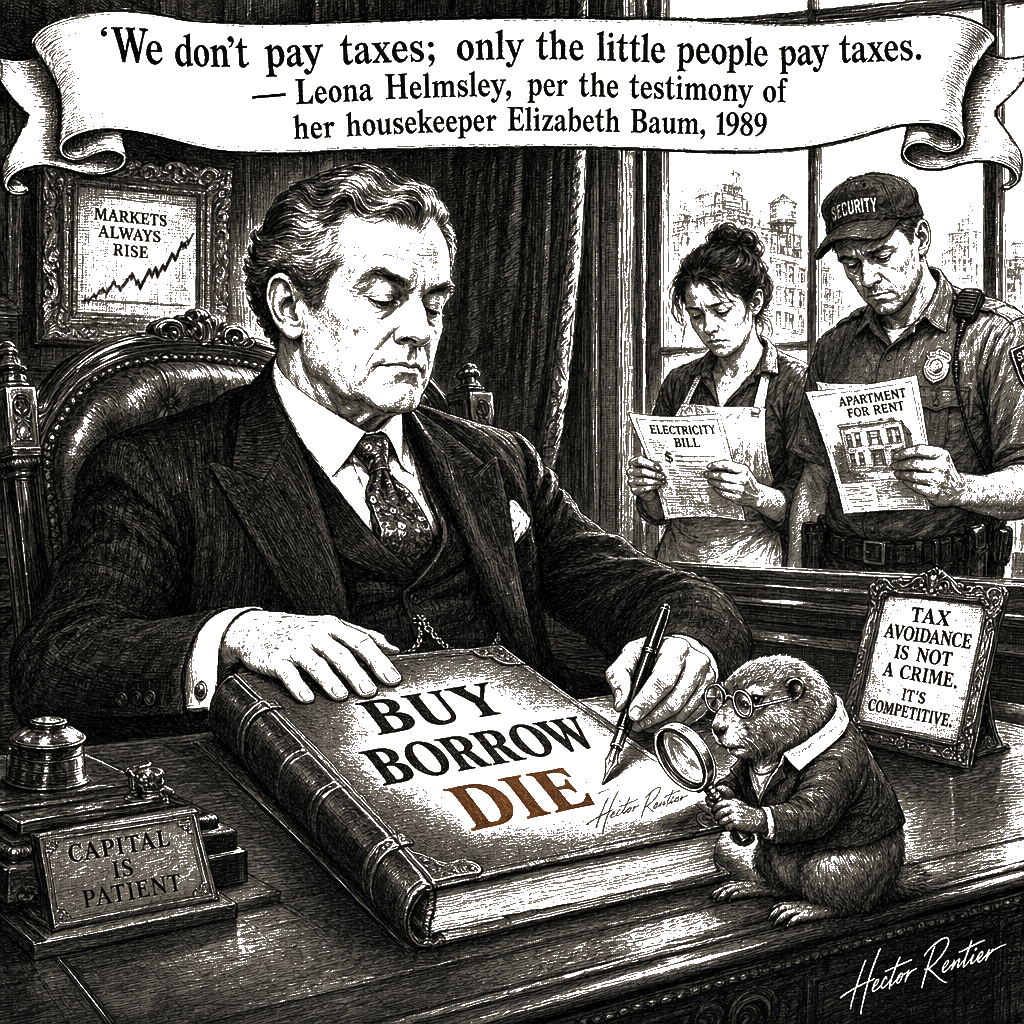
Elon Musk briefly crossed one trillion dollars in paper wealth this week, then dipped back below it on Wednesday when the AI trade rolled over the same way it had rolled him up. On the same Wednesday, Jessica Ordeñana, a bartender in Manhattan, was pricing out a second summer without air conditioning because her electricity bills outpace her tips. A security guard named Gilberto Rubio, who makes twenty-five dollars an hour in the San Francisco Bay Area, was figuring out which meals to skip, because the housing market is a closed door and he has been living out of his car. These are not two stories. They are one story with a ledger at its center and a bartender at its edge.
The mechanism has a name, and the name is not complicated. The wage earner is taxed every Friday. The asset-owner is taxed only when he sells, and the smart ones never sell. They borrow against the shares; they die; the basis steps up; the gain disappears forever. Buy, borrow, die. In 2021, the ProPublica IRS files documented what this looks like in practice: the twenty-five richest Americans saw their wealth rise by four hundred and one billion dollars over five years and paid a true federal income tax rate of three point four percent. Warren Buffett’s rate was 0.1 percent. Jeff Bezos paid zero in 2007 and 2011. Elon Musk paid zero in 2018. The twenty-five billionaires’ combined wages that year were a hundred and fifty-eight million dollars — about 1.1 percent of what they reported as income. The wage earner in the cubicle next door paid a higher rate than the boss did on his way to being a billionaire. The wealth of the ledger lord is not a measure of value created. It is a measure of value captured, locked behind monopolies, subsidized by public infrastructure, and shielded by a tax code written by the people it shields.
The roster is long and bipartisan, and I have been keeping it since the savings and loan crisis. In 1989, Leona Helmsley — the hotel queen — was convicted on thirty-three felony counts, including tax evasion of roughly $1.2 million. Her housekeeper, Elizabeth Baum, took the stand and testified that Helmsley had told her, “We don’t pay taxes; only the little people pay taxes.” Helmsley denied saying it. The testimony stands. In 2005, Tyco CEO L. Dennis Kozlowski was convicted of looting about a hundred million dollars from his own company; the prosecutors put in evidence, among other things, a six-thousand-dollar shower curtain hung in a maid’s bathroom of his Fifth Avenue apartment. The prosecutor asked, accurately, why a man who wanted a six-thousand-dollar shower curtain could not simply buy it himself. In 2009, AIG — the insurance giant rescued with a hundred and eighty-two billion dollars in federal support — paid a hundred and sixty-five million in retention bonuses to the very unit that had brought it to its knees; seventy-three employees received more than a million dollars each. In 2017, the private-equity owners of Toys “R” Us collected four hundred and seventy million in fees as the chain collapsed around them — itemized by the Private Equity Stakeholder Project as a hundred and twenty-eight million in transaction fees, a hundred and eighty-five million in advisory fees, and a hundred and forty-three million in interest — more than fifteen thousand dollars for every worker laid off. Thirty-three thousand workers lost jobs, with no severance against the roughly seventy-five million owed.
The carried-interest loophole — the rule that taxes private-equity and hedge-fund managers’ fees at capital-gains rates rather than ordinary income — was supposed to die in 2017. Donald Trump called it “getting away with murder” in 2016. His 2017 tax bill kept it alive. The lesson, again, is structural: the gilded class writes itself out of the rules it imposes on everyone else. As soon as SpaceX’s share sale is done, the Anthropic and OpenAI offerings waiting in the pipeline will print the next cohort of billionaires exactly the same way.
Consider what happened in 2025 while Musk was on his way to a trillion. American workers’ share of the gross domestic product fell to 53.8 percent — the smallest share since the government started keeping the books in 1947. Inflation ran at 4.2 percent in May of 2026, against wage growth of 3.4 percent. Forty-five percent of American workers — sixty-six million people — make less than twenty-five dollars an hour, below the MIT living wage for a single adult in most major metros. Credit-card debt hit a record 1.277 trillion dollars in the fourth quarter of last year, up sixty-three percent since early 2021. The United States now has 989 billionaires holding 9.2 trillion dollars in wealth in 2026, up thirty-one point eight percent in a single year, according to Americans for Tax Fairness. Americans are borrowing to stand still. The billionaires are borrowing against their stock to live like gods. The bartenders and the baristas and the security officers do not have a carried-interest loophole. They do not have a basis step-up at death. They do not have a trillion dollars in unsold shares to pledge against a personal loan. What they have, the country has decided, is the bill.
Twenty of Musk’s nearest competitors — the wealthiest 0.00001% of the United States — hold wealth equal to twelve percent of America’s gross domestic product, according to the economist Gabriel Zucman, who has been warning the country is on its way to oligarchy. That is about four times the concentration of the Gilded Age — the era that gave us the income tax and the antitrust laws we supposedly defended. Musk himself added three hundred and twenty-seven billion dollars to his fortune in the last twelve months. His net worth went from roughly twenty-eight billion in 2020 to about a trillion now. He did not collect a paycheck large enough to explain the rise; the rise is his stock, unsold, untaxed, pledged as collateral for loans against a life the Internal Revenue Service does not see. He is the working model of a system the country built on purpose.
The median pay for a Starbucks worker in 2024 was $14,674. The CEO, Brian Niccol, was paid $97.8 million the same year. Oxfam and the International Trade Union Confederation found that CEO pay grew twenty times faster than the average worker’s pay in 2025. A barista named Cienna Pangan at a recently unionized Starbucks in Chicago told the Guardian she is not making enough to pay for groceries, not making enough to pay rent; her CEO commutes by corporate jet. The company declined to comment. SpaceX declined to comment.
I have watched this movie since the tax revolts of the late seventies, when California passed Proposition 13 and the country began a forty-year project of starving the public square to feed the private one. The Gilded Age ended, the textbooks say, because the country got tired of being bilked. The textbooks are waiting to find out whether the country is tired yet. This November, the billionaires of California will spend whatever it costs to defeat the billionaire tax that just qualified for the ballot. The bartenders and the baristas and the security officers will spend whatever they have on their electricity bills and their groceries. The country will find out which is the harder fight. I know how it ends.
Let them go. The rest of us are already paying for the air they breathe.