
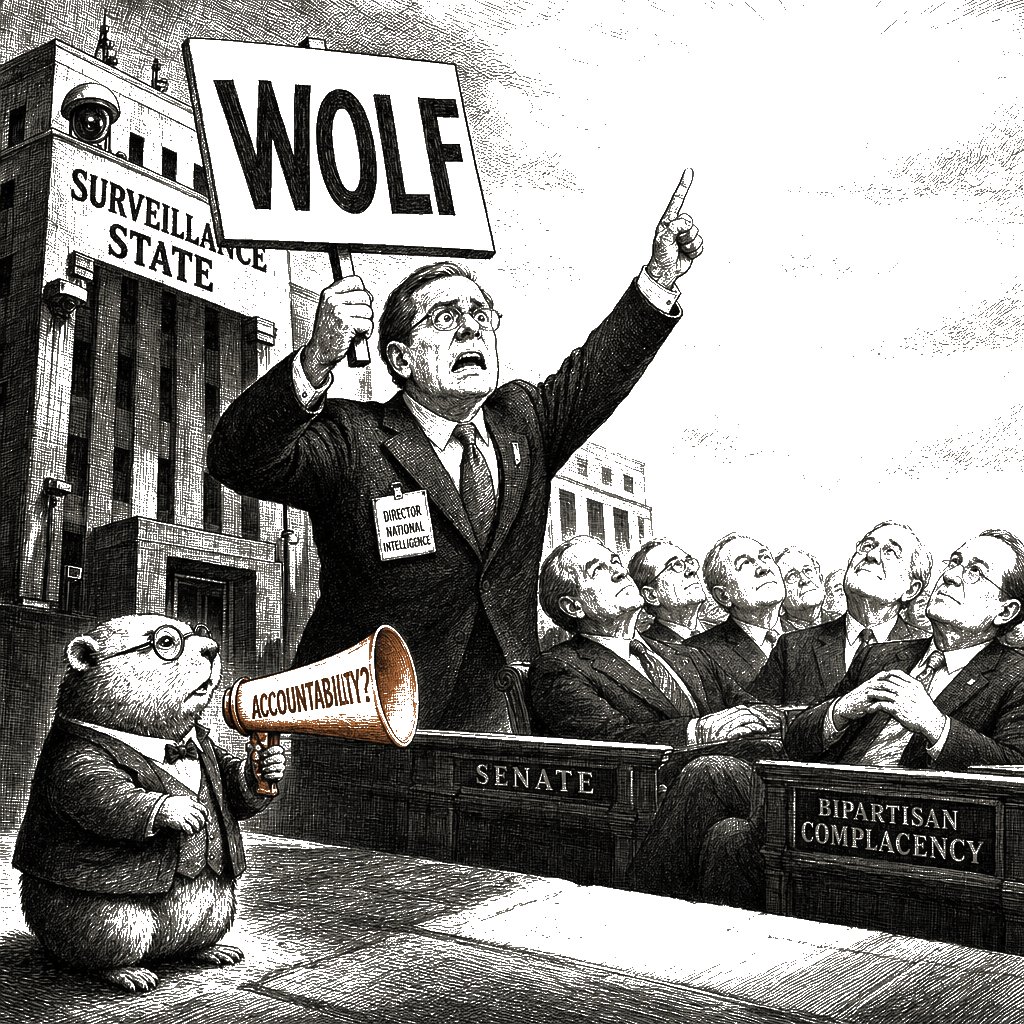
Democrats gambled with the nation’s surveillance authority, and the intelligence agencies manufactured a crisis to cover their own abuses.
Section 702 of the Foreign Intelligence Surveillance Act — the provision that allows the government to collect the communications of non-Americans located outside the United States — lapsed this week after Congress failed to pass a renewal. Senate Democrats blocked the bipartisan intelligence bill not because they finally concluded the program violates the Fourth Amendment. Not because they demanded the reforms civil-liberties advocates have sought for a decade. They blocked it because a minority party in a Republican-controlled chamber has few tools, and holding a surveillance law hostage gives them leverage.
Senator Chris Murphy of Connecticut said the party is no longer willing to give Republicans bipartisan cover on bills that do not address Democratic priorities. Senator Mark Warner of Virginia, vice chairman of the Intelligence Committee, said the law needed reforms Republicans refused to consider. Those are two different arguments, and the gap between them is where the honest conversation should live. Murphy’s argument is about leverage. Warner’s is about substance. If the Democratic position were Warner’s, the country would be having the debate it should have had years ago — about warrant requirements for querying Americans’ communications swept up in foreign-targeted collection, about whether the Foreign Intelligence Surveillance Court, which hears only the government’s side, has the independence the Constitution demands.
That debate is long overdue. But Murphy’s argument governs the caucus. Democrats let the authority expire without securing a single reform in exchange.
The Republican response is no more credible. Senator John Thune called it an escalation carrying real risks. Senator John Cornyn said the lapse leaves the country vulnerable. Director of National Intelligence Tulsi Gabbard warned it undermines intelligence collection. Every one of these Republicans voted to expand Section 702 in 2018 without the reforms they now say Democrats should have demanded. The national-security argument is available to them only because they refused, when they had the votes, to put this surveillance authority on a constitutional foundation that would survive a political fight.
This is what bipartisan failure looks like. Republicans expanded the surveillance state without reforms when they controlled the process. Democrats blocked the surveillance state without reforms when they needed leverage. The House failed to pass its own extension days before the Senate collapse. At no point in this cycle has either party treated the Fourth Amendment as anything other than a piece on the board.
Section 702 was sold as a tool to surveil foreign nationals abroad. In practice, the government queries the resulting database for Americans’ communications without a warrant — a practice the FISA court has found unconstitutional. In 2011, the court ruled that the NSA’s upstream collection violated the Fourth Amendment by sweeping in purely domestic communications. The court has since found that the FBI’s procedures for accessing incidentally collected Section 702 data violated both the statute and the Constitution. When Republicans and Democrats expanded this authority in 2018, neither party required a warrant for those queries. When Democrats blocked renewal this week, they did not demand a warrant requirement either.
Now the men and women who run America’s sprawling surveillance apparatus have responded with the same script they always use: warn of catastrophic threats, invoke the specter of terrorism, insist that any lapse, however brief, will leave the country undefended.
Sun Tzu wrote that all warfare is based on deception. When an intelligence agency faces the loss of a favorite surveillance tool, it wages a campaign of deception against the public it is supposed to serve. The agencies know what Section 702 has been: a charter for warrantless collection that has swept up journalists’ communications, political activists’ data, and the private conversations of countless Americans with no connection to any foreign power. Year after year, Congress has reauthorized it with minimal oversight, and year after year the agencies have treated the law’s minimal protections as optional.
Andrew Bacevich has documented how the permanent national security apparatus generates its own demand for threats. The expiration of Section 702 is a threat the apparatus created because its real fear is accountability, not terrorism.
Let’s be clear about what a lapse means. The sky does not fall when a surveillance authority expires. When the PATRIOT Act provisions lapsed in 2015, the intelligence community warned of immediate disaster. The sunset period passed, and the country carried on. Existing surveillance authorizations continue. Investigations that already have warrants continue. The only thing that stops is the ability to initiate new, warrantless collection under a statute that has been abused for years.
Eisenhower, in his farewell address of January 17, 1961, warned of the “acquisition of unwarranted influence, whether sought or unsought, by the military-industrial complex.” He did not live to see the intelligence-industrial complex — the contractor-analysts moving between government and private firms, the classified budgets larger than the GDP of many nations, the instinctive reaction that every challenge from Congress is a gift to the terrorists. The pattern is the same: an unaccountable institution cries wolf to protect its own power.
Senator Cornyn is right that the country is more vulnerable today than it was last week. He is wrong to pretend his party did not help build the conditions that made this possible. The intelligence professionals at NSA and across the community are absorbing the immediate cost of a decision they did not make. They are trying to prevent terrorist attacks during the World Cup and the nation’s 250th anniversary celebrations, and the people they answer to just turned off their authority to score political points.
But the agencies are also lying about why this happened. They are howling because they might finally have to accept the reforms that members of both parties have been proposing for a decade: a warrant requirement for searches that touch Americans’ data, independent auditing of compliance, adversarial process in the FISA court, and an end to hiding behind classification to avoid consequences.
Democrats, for their part, made a strategic calculation that voters will reward confrontation with the administration more than they will punish legislative disruption. Joel Payne, a Democratic strategist, said as much. Andrew O’Neill, a former aide to the late Senator Harry Reid, said the strategy echoes the Reid era’s procedural hardball. He is right that procedural power is the minority’s only real currency. The question is what the minority buys with it. Democrats have not bought reforms, oversight, or constitutional protections. They bought a news cycle.
The honest position — the one neither party will take — is that Section 702 should be renewed with a warrant requirement for querying Americans’ communications, with adversarial process in the FISA court, and with sunset provisions that force periodic congressional review. The intelligence community argues a warrant requirement would slow counterterrorism work, but the same court that would issue those warrants already processes thousands of FISA applications annually, and a warrant rule need not preclude the emergency exceptions that every serious reform proposal includes. The operational objection is a smokescreen. What the agencies want is the ability to search Americans’ communications without oversight, and both parties have been happy to let them keep it.
The lapse of Section 702 is not a gift to the terrorists. It is a rare moment — rare because Congress has been so supine for so long — when the surveillance state is forced to explain itself in public, under oath, and accept that the Constitution still applies to its work. If the agencies want the law reauthorized, they can come to the Senate and accept the oversight they have been evading. The alternative is to keep crying wolf until the country stops listening, and to keep treating the Fourth Amendment as a bargaining chip until it is worth nothing at all.