
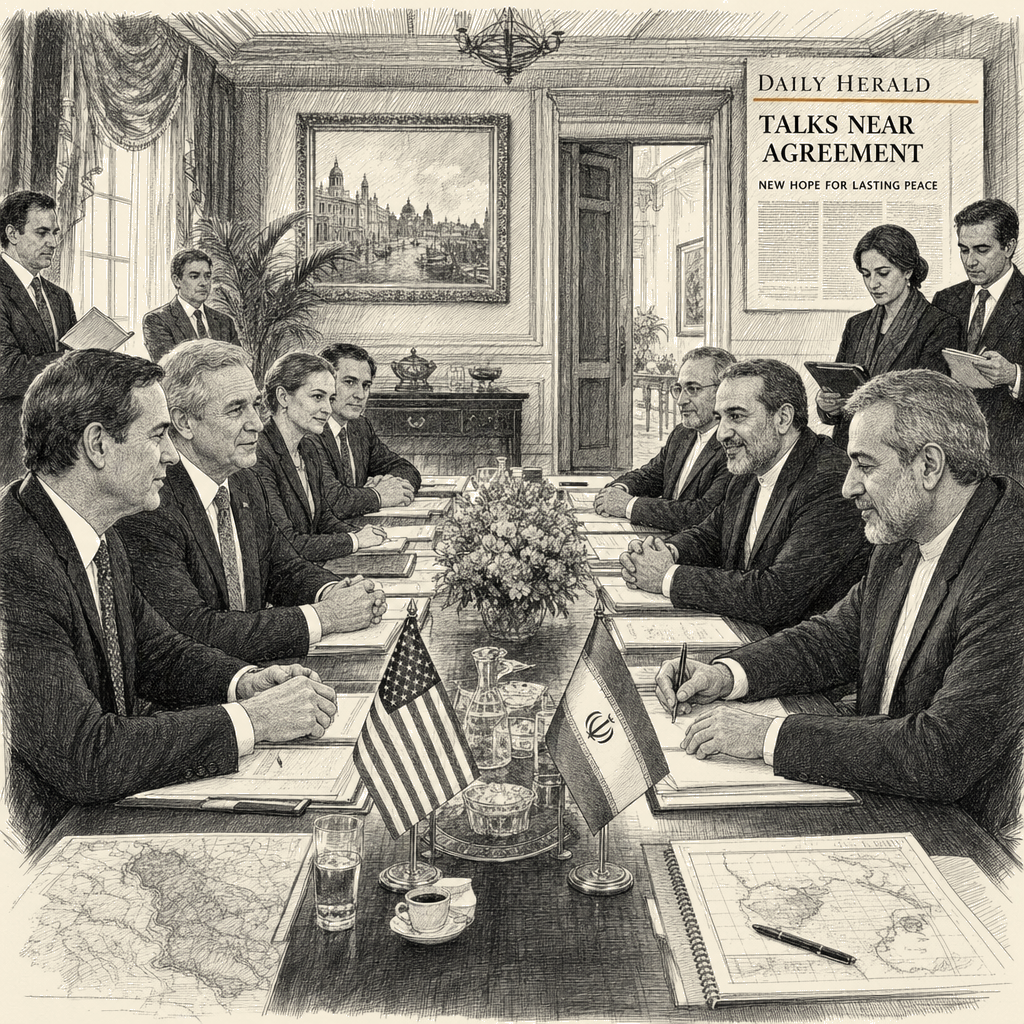
Trump and Iran are killing people while pretending to make peace. The downing of an American Apache helicopter by an Iranian drone near the Strait of Hormuz—and the tit-for-tat strikes that followed—are not an interruption of diplomacy but its continuation. Both sides are using violence to shape the terms of a deal that, by all indications, will solve none of the problems that led to the killing. This is the logic of brinkmanship, and the people who pay for it are the pilots who bob in dark water for two hours waiting to be rescued, and the dead on both sides whose names we will never learn.
The Apache over the Strait of Hormuz did not shoot itself down. An Iranian infrared seeker tracked it through the black until the detonation sent the airframe into the water. Two men jettisoned the canopy, dodged the spinning rotor blades as the fuselage sank, and floated for two hours in the Gulf before a remote-controlled boat pulled them out. That is what a hundred and ten days of stop-start hostilities looks like from the waterline.
Now the diplomats from Qatar and Pakistan are ferrying draft language back and forth. The president halted the retaliatory strikes he promised for Wednesday evening, and the vice president is heading to Geneva to sign a memorandum of understanding—a non-binding diplomatic document that signals intent without carrying the legal weight of a treaty. The administration will argue that this memorandum is a necessary confidence-building measure, a scaffold for a durable agreement. It is no such thing. It is a pressure valve rigged by an adversary who has already learned that American political cycles demand a visible off-ramp long before the underlying mechanics of the war are resolved.
The framework is familiar to anyone who has watched this administration conduct foreign policy for more than a century. The immediate shooting slows down. The hardest problems—the frozen Iranian assets, the highly enriched uranium sitting in the facilities at Fordow and Natanz—are deferred to technical talks in Islamabad. The war does not end; it is paused long enough to declare a victory that does not exist.
This is the essence of what the late strategist Thomas Schelling called “the threat that leaves something to chance.” In his 1960 book The Strategy of Conflict, Schelling described how adversaries in a crisis compete not by out-fighting each other, but by generating shared risk. Each side pushes the other toward an outcome it cannot fully control, hoping the other will blink before catastrophe arrives. The helicopter’s downing made that abstraction visceral: an infrared-guided drone detonated inches from an Apache cockpit with live pilots inside, producing an unscripted kinetic event that forced an immediate political response. The retaliatory strikes, the last-minute call-off, the push for a memorandum—all of it is risk manipulation dressed as statecraft. And the risk is not just to ships in the Strait but to the lives of soldiers and sailors who are the chips in this game.
Schelling also established that commitment only builds credibility when the adversary believes you will execute the threat. A threat the administration repeatedly announces, executes halfway against commercial shipping, and then cancels for domestic political convenience does not build credibility. It builds habituation. Tehran reads the zigzag not as American resolve but as American noise. The Islamic Revolutionary Guard Corps has absorbed damage from the U.S. blockade, and its leadership is willing to sit at the table because it knows the American apparatus will trade its ultimate leverage for a signed memo it can sell domestically. Deferred negotiations are a trap for the side that needs the political optics of a deal more than the adversary needs the relief the deal provides.
In The March of Folly, Barbara Tuchman identified a specific pattern of policy pursued contrary to self-interest despite available alternatives: the persistence of a failed strategy because the political cost of admitting failure appears higher than the cost of continuing it. That is the architecture we are looking at now. The 2015 nuclear framework was discarded, a war was initiated, and now the administration is negotiating a return to a position that looks remarkably like the starting line. The deferred limits on enrichment, the staged sanctions relief, and the reliance on future technical talks all echo the exact architecture this president once torched as a surrender. We are circling back to the original blueprint, except this time the costs have been paid in pilots bobbing in the Gulf and commercial shipping paralyzed. Andrew Bacevich, in his 2016 book America’s War for the Greater Middle East, described how a bipartisan foreign-policy establishment has cycled between armed intervention and diplomatic half-steps for decades, never achieving a durable settlement but always producing more casualties. The current dance looks no different.
The deal taking shape does nothing to eliminate the risk. As the MIT scholar Caitlin Talmadge noted, the agreement apparently contains no mechanism to prevent Iran from again threatening to close the strait—through which a fifth of the world’s oil passes—when the next crisis arises. That is precisely the commitment problem James Fearon identified in his 1995 article “Rationalist Explanations for War.” Iran cannot credibly promise not to use its strait weapon again so long as it retains both the military capacity to do so and unresolved stockpiles of highly enriched uranium that give it leverage over any future negotiation. By leaving that issue unresolved, the agreement guarantees that a future president will face the same dilemma, and more people will die. The hard-liners in Tehran were opposed to limits on the nuclear program without upfront concessions, and the administration’s answer is to sign a memorandum that defers the concessions altogether.
Meanwhile, the blockade of the Persian Gulf is itself an act of war, and it is ordinary Iranians who bear its cost. Iran’s economy is beleaguered, and U.S. sanctions relief will come only after Tehran takes specific nuclear steps. That is economic coercion on a population scale, and it will produce its own forms of suffering—shortages, inflation, untreated illness—long after the ink is dry. In the just-war tradition that I turn to when these questions demand it, the principle of discrimination requires that belligerents distinguish between combatants and civilians. A blockade that punishes a whole population to extract political concessions from its leaders sits uneasily with that rule. Michael Walzer, in Just and Unjust Wars, wrestled with the morality of sieges and blockades and concluded that they are legitimate only when they are a genuine military necessity and not merely a tool of collective punishment. The necessity here is political, not military, and the punishment falls on those with the least say in whether their government fights.
In Redeployment, Phil Klay wrote about the moral geometry of the deployment, where the decisions made in secure offices hit the ground in the form of young men who have to figure out how to survive them. The Apache over the Strait was the clearest expression of that geometry: a mission flown not to secure a strategic objective, but to generate enough kinetic pressure to justify a political pause. The two pilots floating in the dark water did not make the policy. They were the ones executing it. The distance between a “limited strike” and a pilot fighting for his life in the water is measured in seconds, and the men who order the strikes are rarely the ones who bear the cost. Their survival was a matter of discipline and chance, not the result of a coherent strategic architecture that had calculated the risks of this mission and found them acceptable.
A republic owes its service members a strategy that aligns military risk with achievable political ends, rather than asking men to float in dark water while diplomats defer the hard questions. The executive’s constitutional posture requires that the decision to send forces into a contested theater be tied to a coherent objective, not a temporary pause manufactured for a headline. The cold ledger is this: the agreement will not prevent the next drone from finding its target. It will not stop the next tit-for-tat exchange. It will not bring back the dead from the hundred-plus days of this war. It will merely give both sides time to reload. The math does not pencil out for the men in the water, and it does not pencil out for the republic footing the cost. The gap between the signed memo and the actual war is exactly where the next body goes in.