
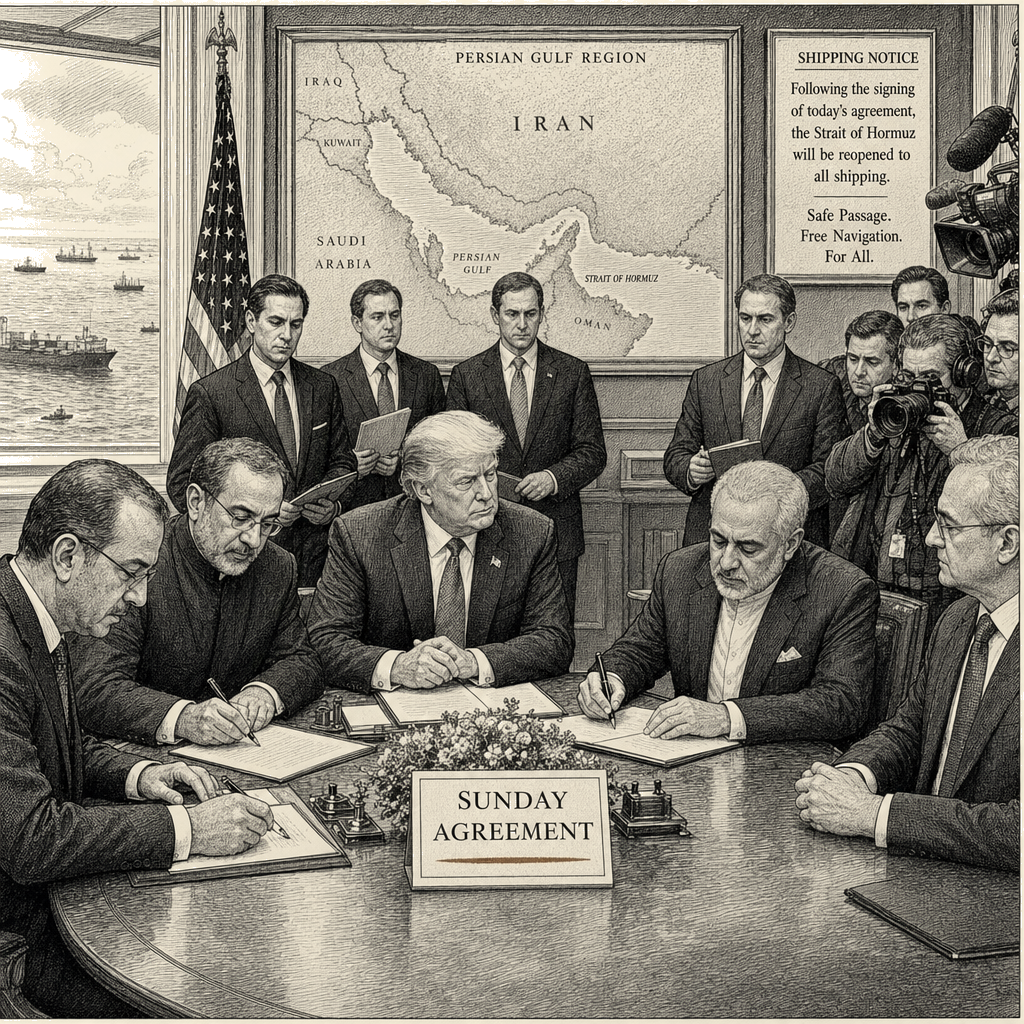
Trump is asking the country to believe Iran has abandoned its nuclear program on his say‑so.
On Saturday, the President posted to Truth Social that Iran “no longer want a Nuclear Weapon, nor will they have one, either through purchase, development, or any other form of procurement.” He said the deal would be signed Sunday, that the Strait of Hormuz would reopen immediately, and that the entire affair would conclude the way a reality‑television season concludes — with a winner, a handshake, and the credits rolling. The Iranian foreign ministry, a few hours earlier, had said the signing date remained undetermined. “It will not be tomorrow,” the spokesman said, though an agreement “in the coming days cannot be ruled out.” The gap between “tomorrow” and “in the coming days” is not a rounding error. It is the space in which a deal is either made or not, and the claim the President made Saturday — not that Iran has agreed to verifiable limits, not that inspectors will be let back in, but that the regime in Tehran has undergone a strategic conversion on the central question that has structured American foreign policy for two decades — requires that space to be filled with something more than a social‑media post.
A Commander in Chief who has spent weeks insisting a deal was imminent only to watch the negotiations stretch into another week is now asking the American public to accept, as settled fact, that the Iranian regime no longer wants the thing it spent twenty years and tens of billions of dollars building the infrastructure to obtain. The publicly documented record on Iranian enrichment is not ambiguous. The International Atomic Energy Agency has reported uranium enriched to sixty percent, near weapons‑grade. The stockpiles are substantial. The United States intelligence community’s long‑standing assessment, reiterated in testimony across administrations, is that Iran has not made a strategic decision to weaponize but has positioned itself to do so on short order. The distinction between “has not decided to build” and “no longer wants one” is the distinction between a surveillance photograph and a sermon. One is evidence. The other is a story the teller wants the audience to accept without asking to see the photograph.
None of this is to take Tehran’s word for it. The regime has insisted for two decades that its nuclear program is peaceful — a claim that is itself unverified and unverifiable without the inspection architecture the deal is supposed to deliver. The point is not that Iran is telling the truth. The point is that neither side’s assertion substitutes for verification. The demand for evidence cuts both ways, and the President is offering none.
The deal the United States walked away from in 2018 did offer that architecture. The Joint Comprehensive Plan of Action included IAEA inspector access to declared and certain undeclared sites, continuous monitoring, caps on enrichment levels, and limits on centrifuge numbers and stockpile size. Maximum pressure — the withdrawal, the sanctions — did not produce disarmament. It produced enrichment that advanced from the single‑digit purity the JCPOA permitted to the sixty‑percent grade the IAEA now reports. Maximum pressure produced maximum enrichment. If the new deal is weaker than the baseline the administration dismantled, the President’s claim about Iranian intent rests on even less verification than the mechanism his own government discarded.
Andrew Bacevich, in Washington Rules, documented the institutional machinery by which the national‑security establishment turns assertion into accepted fact — not simply a passive citizenry failing to examine its premises, but an active apparatus that manufactures and reinforces the narrative until it replaces investigation. The President’s characterization is not an isolated statement. It is the output of a system designed to bypass verification entirely, presenting a desired outcome as an established fact before a single inspector has been deployed, betting that the public will accept the story rather than demand the evidence. What the administration is doing with this Iran claim is operating that machinery at full capacity.
Eisenhower, in his farewell address, warned that we must guard against the acquisition of unwarranted influence by the military‑industrial complex, and that only an alert and knowledgeable citizenry could compel the proper meshing of immense defensive machinery with peaceful purposes. He was speaking, as a five‑star general who had commanded the largest military alliance in history, from inside the machinery. A citizenry that cannot distinguish a presidential announcement from a verified fact is not alert. It is captive. And the President is asking it to remain so.
Michael Walzer, in Just and Unjust Wars, argued that the moral substance of a war and the moral substance of its peace are the same moral substance. A government that launched a war — or that stood ready to launch one — on claims that turned out to be wrong owes a peace built on claims that can be verified. The 2003 Iraq war was launched on intelligence that turned out to be fabricated — presidential assertions, amplified by a compliant institutional apparatus, repeated until they became the background noise of debate, and then used to authorize military action that killed hundreds of thousands and destabilized an entire region. The lesson was supposed to be that when a President makes factual claims about an adversary’s weapons capability, the machinery of assertion must be met with the machinery of verification, or the machinery of assertion wins.
The President is not asking the country to trust the IAEA. He is asking it to trust him. The alert and knowledgeable citizenry Eisenhower called for does not grant that trust on request. It asks to see the photographs. It asks where the inspectors are. It asks what verification provisions are actually in the document that is scheduled to be signed, and whether those provisions are stronger than the ones the United States walked away from in 2018. “They no longer want one” is not a verification mechanism. It is a presidential assertion, and presidential assertions about weapons programs in the Middle East have a documentary record that has not gotten better with repetition.
Eisenhower’s alert and knowledgeable citizenry would not confuse the announcement of a peace with the arrival of one. Social media posts do not stop centrifuges.