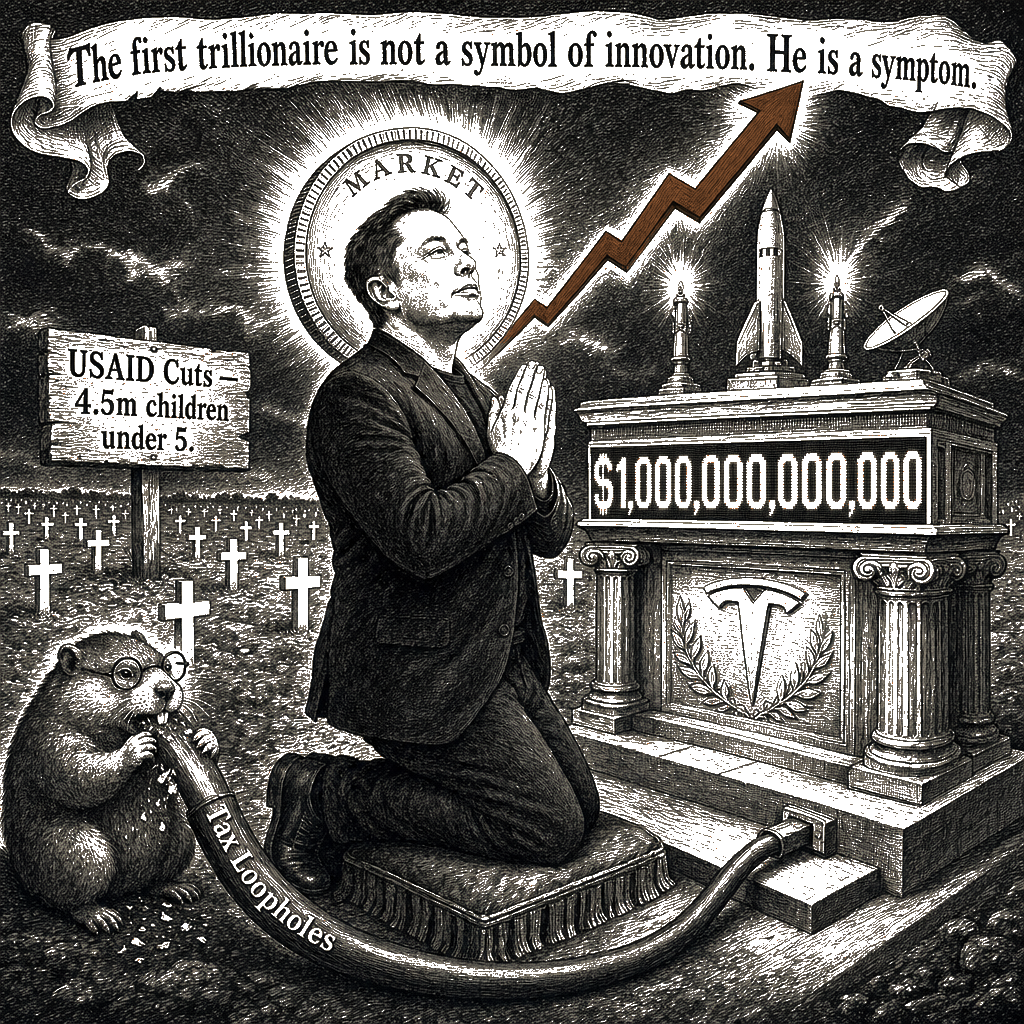
Elon Musk is starving millions of children to build a trillion‑dollar fortune. That is not a metaphor. The SpaceX listing that pushed his net worth past the $1 tn mark has been met with Wall Street champagne, but the celebration obscures a simple truth: the wealth that made him the world’s first trillionaire is downstream of a decades‑long project to strip the public treasury and dismantle the programs that keep children alive. The Lancet has now put a number on what that looks like — the gutting of USAID under Musk’s direction will result in more than 14 million deaths by 2030, including 4.5 million children younger than five. That is not a paper fortune. That is a body count.
I sat at my kitchen table this week running the numbers on childcare. Eva and Ben cost $2,400 a month — $28,800 a year, more than a quarter of our take‑home pay before the mortgage, the student loans, the groceries, or the gas. My husband and I bring home $8,800 a month after taxes. The math is the math. We will manage because we always manage — by cutting the vacation budget to zero, by not replacing the car with 140,000 miles on it, by moving the same numbers between the same two columns in the same Google Sheet at the same kitchen table at the same 11 PM. My husband and I earn more, in real terms, than my parents did on a USPS supervisor’s salary in Lansdale, and we are nowhere near the standard of living they gave three kids. That gap is not a personal failing; it is the structural consequence of the same policy choices that have concentrated wealth in the hands of the few.
Every dollar of concentrated power that piles up in one man’s brokerage account is a dollar that does not fund your child’s school, your mother’s Medicare, or the winter fuel allowance that Keir Starmer scrapped last year for £1.5 bn in savings — a rounding error on a rounding error in Musk’s portfolio. One trillion dollars could fund a full year of childcare for every child under five in America roughly four times over, close the IDEA funding shortfall for special education for more than twenty‑five years, replace every lead pipe in every school in the country and have hundreds of billions left. Instead, it sits in one man’s account, and it bought him the ability to slash the government he was supposed to be serving.
Gabriel Zucman, the Paris economist whose research I have been reading since the kitchen‑table math started, published the numbers this week. In 1989, the 200 wealthiest families in the UK owned wealth equivalent to 5 % of GDP. Today that same sliver — still about 200 families — owns 20 %. In the United States, the four largest fortunes at the peak of the Gilded Age, around 1910, owned wealth equivalent to 4 % of GDP. Today, 19 households own 14 % — more than triple the robber‑baron share. The explosion past the original Gilded Age happened while my parents were raising three children on a single income, paying off a house, and putting all three kids through Catholic school. That is the transfer. The wealth did not materialise from thin air. It was compounded by tax policy that let the richest Americans pay effective rates lower than their assistants — lower than the nurse at your paediatrician’s office, lower than the woman who runs the register at the Wawa on Girard Avenue.
Jeff Bezos — the man who owns the company that delivers your nappies and your school supplies — once pretended to be so poor that he claimed the child tax credit. By engineering his taxable income to near zero through a web of deductions and holding‑company losses, Bezos legally qualified for a credit designed for families who actually need it. That is the same credit that, when it was expanded and made monthly, [cut child poverty by as much as 40 %][3] before Congress let it expire. Bezos took the credit designed for families like mine. That is not a loophole. That is a confession.
Taylor Swift’s “The Last Great American Dynasty” tells the story of Rebekah Harkness, the Standard Oil heiress who filled a Rhode Island mansion with misbehaviour and died having “a marvellous time ruining everything.” The song’s diagnostic core is the line about who gets to be eccentric and who gets called crazy: the woman with inherited money can do whatever she wants; the rest of us are the people who have to keep the house standing. “You’re On Your Own, Kid” catalogues every sacrifice you made for a promise that did not deliver, and then lands on the bridge’s diagnosis: you are on your own. Both songs are describing the same structural failure from opposite ends of a century. Rerum Novarum, the 1891 encyclical my grandmother’s parish priest used to read from at the Knights of Columbus breakfast, said wages must be sufficient to support a family. Francis, in Fratelli Tutti, wrote that a society governed by the criteria of market freedom and efficiency alone has no place for the disabled, the poor, the child who is not yet useful. The billionaire who can buy a social network on a whim and turn it into a political machine, who can shut down an aid agency and watch the death toll mount, is living in exactly that society. He is not a citizen in a democracy; he is a private sovereign, and the rest of us are his subjects.
The answer is not complicated. Zucman proposed it to the G20 in 2024: a minimum tax of 2 % on wealth above $100 million. In the UK, that would raise £15 bn a year from roughly 1,000 families — ten times what Starmer saved by cutting the winter fuel allowance from retirees. In the United States, the revenue would be larger still — enough to close the IDEA shortfall, restore the expanded Child Tax Credit, and fund universal pre‑K in every state that wants it. These are not radical proposals. They are the restoration of a principle that the United States and the United Kingdom both embraced in the decades after the Second World War, when top tax rates near 90 % built the middle class my parents grew up in. That world was not inevitable; it was a policy choice. And it was unmade, as the historian has shown, by the same kind of financial engineering that now lets a single individual accumulate a trillion dollars while the child mortality rate rises on his watch.
The first trillionaire, as our own columnist warned, is not a symbol of innovation. He is a symptom of a system that has broken its promise to the next generation. And the most damning thing about that broken promise is that it is not an accident. It is the direct result of a tax code that treats the income of a nurse as more real than the stock portfolio of a billionaire.
Every month I sit at the kitchen table and move the same numbers between the same two columns. The daycare bill goes in one column. The mortgage in another. The student‑loan payment in a third. The numbers do not change. The only thing that changes is the share of the national income that flows to the people who have never had to sit at a kitchen table at all. Gabriel Zucman has given us the policy instrument to turn that flow around. The question is whether we have the political will to use it before the next generation of children pays the price.
[3]: Columbia University Center on Poverty and Social Policy (referenced in external reporting)