
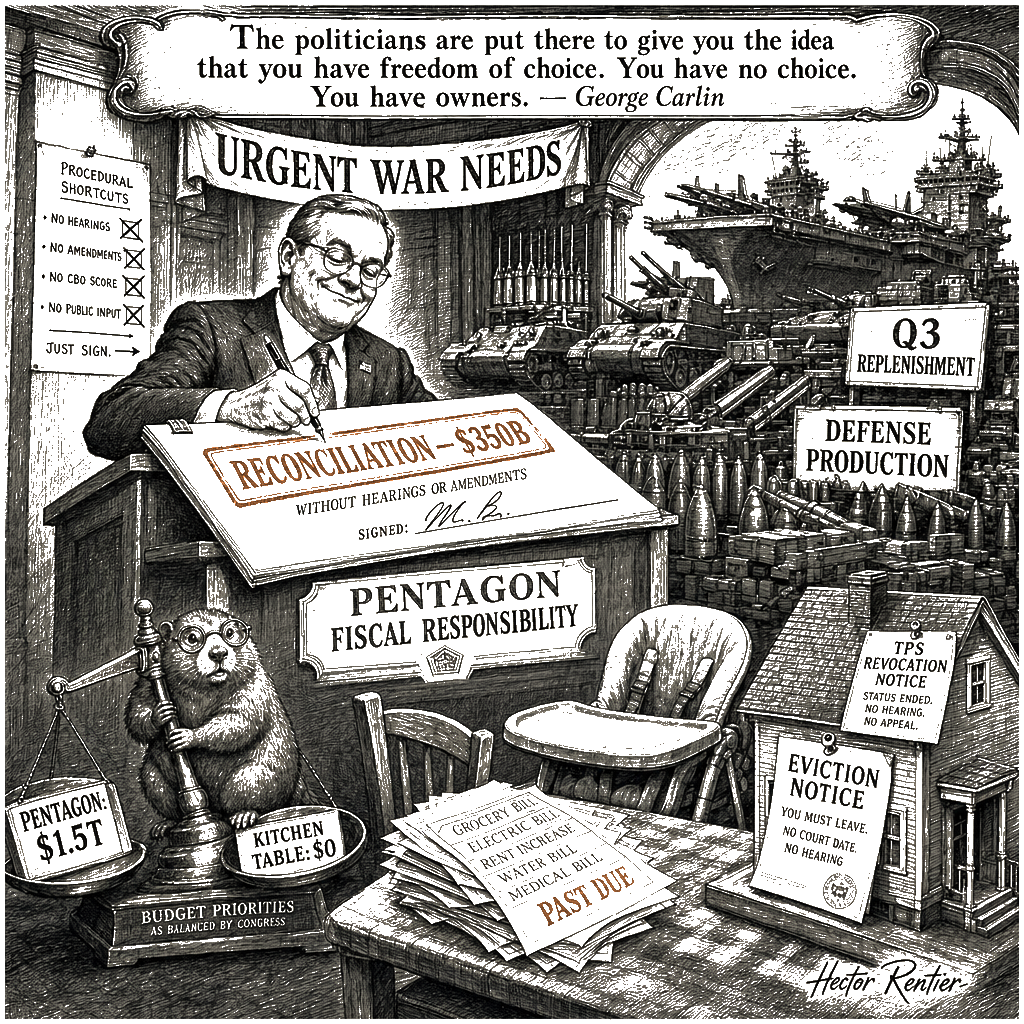
Trump and Hegseth are starving working families to fund a trillion-dollar military spree. While you were checking the price of eggs this morning, Defense Secretary Pete Hegseth was asking Congress for another $350 billion — quietly, through a procedural maneuver called reconciliation that lets him skip the normal floor fight. It’s the lead slice of a $1.5 trillion military budget he wants locked in before the year is out, on top of another $67 billion for Iran and “urgent” war needs.
The morning briefing laid out the arithmetic of the betrayal in plain sight. The Congressional Budget Office now projects the federal government will run a $1.9 trillion deficit in 2026 and again in 2027, climbing to $2.1 trillion in 2028. That’s not a number for a think tank white paper. That’s the gap between what Washington collects from your paycheck and what it spends — and the difference gets borrowed, every year, with interest compounded on top.
You pay that interest. You pay it at the grocery store, when inflation eats the purchasing power of the dollars your wages were paid in. You pay it at the mortgage renewal, when the Fed has to keep rates elevated to defend a currency being diluted by trillion-dollar deficits. You pay it in the property tax assessment, when your county scrambles to make up for the federal government’s chronic under-funding of schools, roads, and disaster relief. And your kids pay the principal — because every borrowed trillion is a mortgage signed in their name, due the day they’re old enough to inherit the bill.
Remember the “brief dalliance with austerity” the article mentions? That was for us. That was the domestic spending cuts, the child tax credit left to rot, the childcare subsidy bills that died in committee while the cost of a daycare slot in Philadelphia has climbed past what a single paycheck can cover. Remember DOGE? The brief 2025 fling with austerity is already a memory. When the political class talks about “austerity,” they mean the line on the kitchen-table spreadsheet that says I cannot afford to put my one-year-old in care without draining the emergency fund. When they talk about “spending,” they mean the Iran war and the Pentagon.
The morning briefing writes that the deficit is just “gravitational forces” — that it’s easier to spend money than to cut it, and then things happen, and Washington responds. Setting aside the bipartisan refusal to touch the mandatory entitlements that drive the baseline, the choice is still the choice: which discretionary spigots do we open, and which do we close? The deficit is a moral document. We are projected to run a $1.9 trillion deficit in 2026, borrowing money to replenish military stockpiles and upgrade fleets, while the same Congress claims the treasury is empty when it comes to the basic cost of raising a child.
Hegseth’s reconciliation push is the part that should make working families angriest. Reconciliation is the budget trick designed for tax cuts and entitlement reform — not blank checks to the Pentagon. Using it to push through $350 billion in defense spending means Congress skips the normal hearings, the normal amendments, the normal yes-or-no votes on whether this particular weapons system is worth it. The families who will pay for it don’t get a normal say either.
A real pro-family agenda would cap childcare costs at a fixed percentage of household income, fund universal pre-K as a public good, and make the expanded child tax credit a permanent floor rather than a political bargaining chip. The Pell Grant now covers less than a third of what it used to, and the state looked at the cost of raising a child in a decade where wages have barely tracked the cost of living, and shrugged.
Taylor Swift wrote a song for this exact condition. The title of the track is the literal mission statement of the American care infrastructure: You’re On Your Own, Kid. The song’s archive of missteps and near-misses isn’t a celebration of youthful independence; it’s a documentary record of the moment you realize the safety net you were promised is never coming. You’re on your own, kid. But the state is not on its own when it needs to move $67 billion for an urgent military need.
And while Hegseth shops for warships, the Supreme Court just greenlit another quiet hit to working-family stability. In a 6-3 ruling, the justices said the administration can immediately strip Temporary Protected Status from about 350,000 Haitians and 6,000 Syrians — workers, renters, parents, small-business owners, neighbors — without meaningful court review. TPS holders aren’t abstractions. They’re the second shift at the hospital, the night shift at the warehouse, the family next door whose kids go to school with yours. Pull 356,000 workers out of the formal economy in one stroke and you don’t just break 356,000 households. You collapse rent rolls, shutter storefronts, and shove the cleanup costs onto the counties and school districts already stretched thin by Washington’s other unpaid bills.
The spigots are wide open for the munitions that destroy cities, and clamped shut for the people fleeing the wreckage. I grew up in a parish where the corporal works of mercy weren’t a seminar topic; they were the Tuesday-night homework. Shelter the homeless. Visit the imprisoned. Feed the hungry. There is no doctrinal loophole that lets you fund a trillion-dollar war machine while revoking the shelter of people who are already here, already working, already part of the neighborhood. Fratelli Tutti warned that a society governed only by market criteria leaves no room for the vulnerable. We are watching that warning become the daily operating procedure.
The kitchen-table version of the $1.9 trillion deficit is the red ink on the credit card I used to pay for my kid’s ear infection last month, while the Pentagon gets its massive budget without a single hearing to justify the full, unchecked math. Washington calls this “fiscal responsibility” on the military side and “restoring the rule of law” on the immigration side. Working families know better. The gravitational forces the briefing describes are just the weight of a political class that has decided the military-industrial complex is the only thing worth saving. The rest of us are just supposed to manage the decline, staring at a daycare invoice while the spigots run dry everywhere but the Pentagon — finding out at the supermarket, every week, who the state was built for.