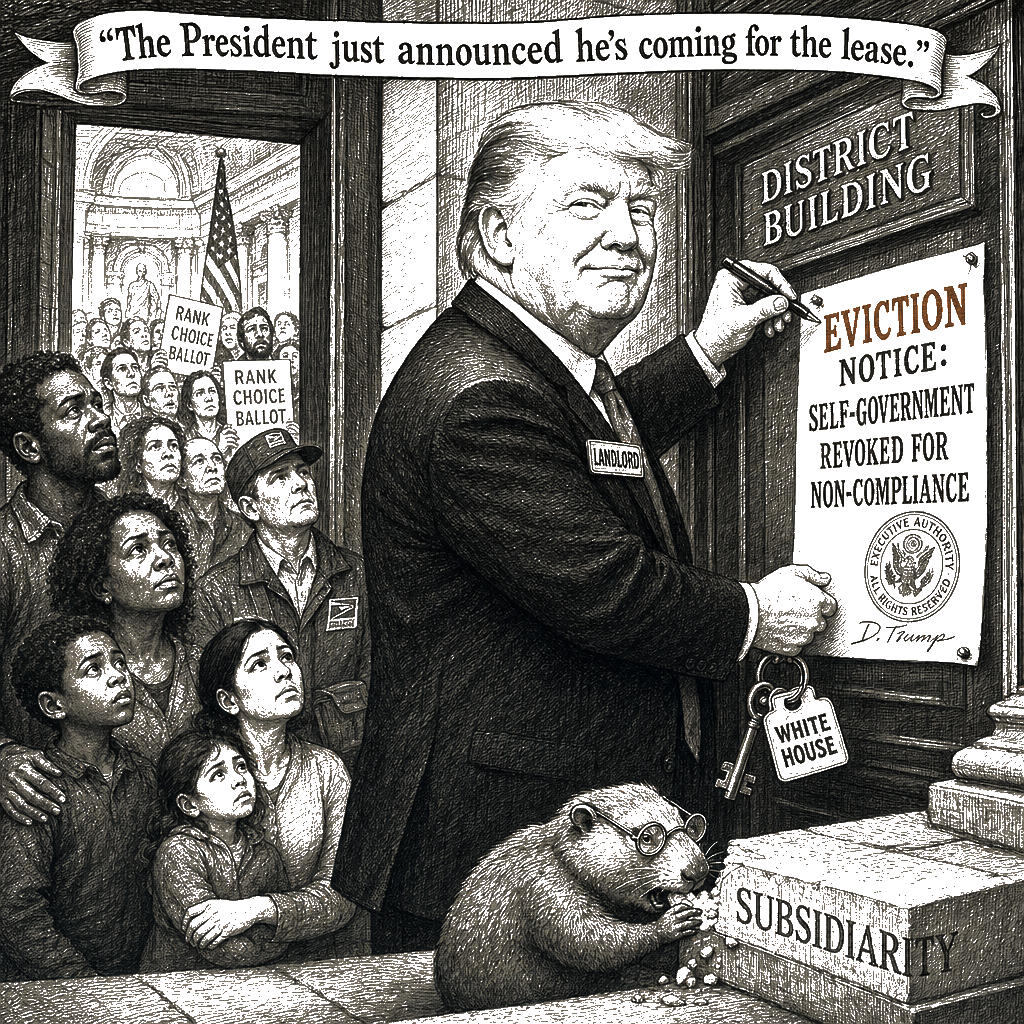
Donald Trump threatened to revoke DC’s self-government over its mayoral vote. “I wouldn’t like it,” he said of a Janeese Lewis George victory. “Maybe we take back Washington and run it on the federal basis. We won’t put up with it.” The President of the United States told 700,000 residents that their right to choose their own leader is conditional — conditional on choosing a leader he approves of.
Washington DC is a city of 700,000 people — more than Vermont or Wyoming — with no voting representation in Congress and self-governance that exists only at the pleasure of the federal government, a government that has kept troops on the district’s streets for months. Nearly half the city’s residents are Black — the district’s largest racial group — in a city where congressional oversight has historically constrained Black political power. They have lived under this arrangement since 1973, when Congress granted the district limited home rule, and they have lived under the knowledge that what Congress grants, Congress can revoke. Catholic Social Teaching names this the principle of subsidiarity inverted: decisions belong at the level closest to the people they affect, and higher authorities must not absorb what lower ones can do. What Trump proposed is the anti-subsidiarity move — the powerful stripping the vulnerable of the authority to govern their own lives.
The threat is not a policy disagreement. The threat is an eviction notice. And the question the mayoral primary asks is not which Democrat has the better plan for affordable housing. The question is which Democrat is, in the marrow, willing to fight a landlord who has just announced he is coming for the lease.
You need to see through the fog of a primary where both candidates tell narrow truths. Kenyan McDuffie, the former prosecutor and business-backed candidate, says 99.9% of his donations came from Democrats and independents — and yet his donor rolls contain a handful of Trump contributors. Janeese Lewis George, the democratic socialist and two-term councilmember, got fined $16,000 by the DC Office of Campaign Finance for coordinating with unions — a fine her campaign calls “reckless” and “riddled with factual errors,” dropped five days before an election in a city where the OCF functions as a municipal appendage of the same political class whose candidate is the one not named Lewis George. Both are, in the narrow sense, telling the truth. Neither is telling the whole of it.
The money tells a story: the people who want to break the city are putting money into the people who say they can work with anyone, and the people who can work with anyone are, in a city whose president has just threatened to revoke its right to govern itself, the people who will not say no when no is the only word that matters. Across the ballot, the same fog drifts into the congressional delegate race: Brooke Pinto, running to replace Eleanor Holmes Norton, has pulled in nearly $170,000 from donors who also gave to Trump and other Republican candidates. Her opponent Robert White has his own Trump-linked donors. Pinto calls it a “broad tent coalition” and says she can work with Republicans. The words are different but the structure is identical.
You need to see past the fog to the line that matters. The next mayor will decide whether the Metropolitan Police Department assists federal immigration officers — whether local cops serve their own city or ferry ICE agents through the streets of communities where families go to church, children walk to school, and neighbors watch out for one another. Lewis George has promised to rescind the executive order directing MPD cooperation with federal enforcement. “Our officers need to be focused on getting guns off our streets and solving crimes,” she says. “It is not their jobs to be alongside or babysitting or transporting federal immigration officers across the city to wreak havoc on our communities.” She does not say “the administration’s immigration enforcement, which some critics have argued may raise concerns.” She says what it does. She is the daughter of a union postal worker, a third-generation Washingtonian raised in Ward 4. The tradition that formed candidates like her — the Catholic Worker houses that fed the hungry in this city, the Black prophetic church that held funerals for children shot on these streets, the labor halls where the city’s working class learned to bargain — does not use the vocabulary of “may raise concerns” for what is being done. It uses the vocabulary of the thing itself.
McDuffie’s answer is different and it is, in its own way, honest about what it is not. He says he will appoint a police chief and a schools chancellor on day one. He says he will coordinate an interagency effort to tackle affordability. He does not say he will rescind the immigration-enforcement cooperation order. He does not say he will tell the federal government that its immigration officers are not welcome to use the Metropolitan Police Department as their transport service. He says he has “consistently opposed federal interference in DC’s local affairs” — the verb is “opposed,” not “stopped.” A fighter in the courtroom, not in the street. A fighter who files the brief, not the one who stands in the door.
Torah is not ambiguous about what happens when a society turns its enforcement apparatus against its most vulnerable residents: “You shall not oppress a resident alien, for you were aliens in the land of Egypt” — Exodus 22:21. The commandment to love the stranger appears among the most frequently repeated in all of Torah. God does not qualify the stranger’s worthiness, does not ask for papers, does not distinguish the deserving from the undeserving. And Martin Luther King Jr. wrote from a Birmingham jail that the greatest stumbling block to freedom was not the outright antagonist but the moderate who preferred order to justice. Trump’s threat is the antagonist’s move — the open declaration that a city’s self-governance is a privilege the powerful may revoke at will. But the stumbling block is the silence around it: the bipartisan acceptance, decade after decade, that DC’s residents should live under a system in which their vote can be overridden by a president’s mood, a congressional rider, or a federal budget provision.
The city is watching. The Washington Post and George Mason University’s poll has Lewis George up 11 points, and the margin is, in one sense, a preference for the candidate who says “non-negotiable” about the things the federal government is trying to negotiate away. In another sense, the margin is the city looking at two Democrats and asking which one will actually refuse to hand the keys to the landlord when the landlord comes for them. The answer the poll gives is the answer the city has been giving since the National Guard deployment showed no end in sight — uniformed soldiers in the streets for eight months and counting, a presence that is either a security measure or an occupation depending on which end of the rifle you are standing at, and the city knows which end it is on.
Heschel named the moral arithmetic: “Few are guilty, but all are responsible.” The system that allows a president to threaten a city’s autonomy is a system every Congress has maintained, and we who know what it means to live under the authority of those who do not share our interests have not always extended that solidarity to the people of the district. The failure is not one party’s. It is the failure of a nation that professes self-governance while denying it to the people who live in its capital. Francis called it the globalization of indifference — the habit of making ourselves “insensitive to the cries of others,” of living in “soap bubbles” while the structures around us crush the people Jesus called the least of these. DC’s immigrant families, its Black children, its working mothers who cannot afford childcare — they are not abstractions in a policy debate. They are the people in whose faces Christ is present, whether or not anyone in power has the courage to see it.
The election is 16 June — the first under ranked-choice voting, a reform that lets voters say “I prefer this one, but I will accept that one.” The reform is, in its own way, a confession: the city knows its political class is divided, knows the divisions are about more than who has the better plan for Union Station redevelopment, knows the question is not which candidate will build the transit hub but which candidate will, when the federal government comes for the city’s right to govern itself, say “no” and mean it. Ranked-choice voting is a mechanism for a city that is trying to hold together while the landlord is at the door with a crowbar.
Romero told the soldiers of El Salvador that no human order overrides the law of God, and that the voice of conscience must be heard before the voice of command. The residents of Washington DC are not asking for anything extraordinary. They are asking for what every American city takes for granted: the right to choose their own leaders and to have those leaders protect them.
On Tuesday, they will walk past federal troops on their own streets to cast ranked-choice ballots in an election the President has already told them he may not honor. The door is open. Whether anyone with the power to keep it open will choose to do so is a question this nation has not yet answered.