
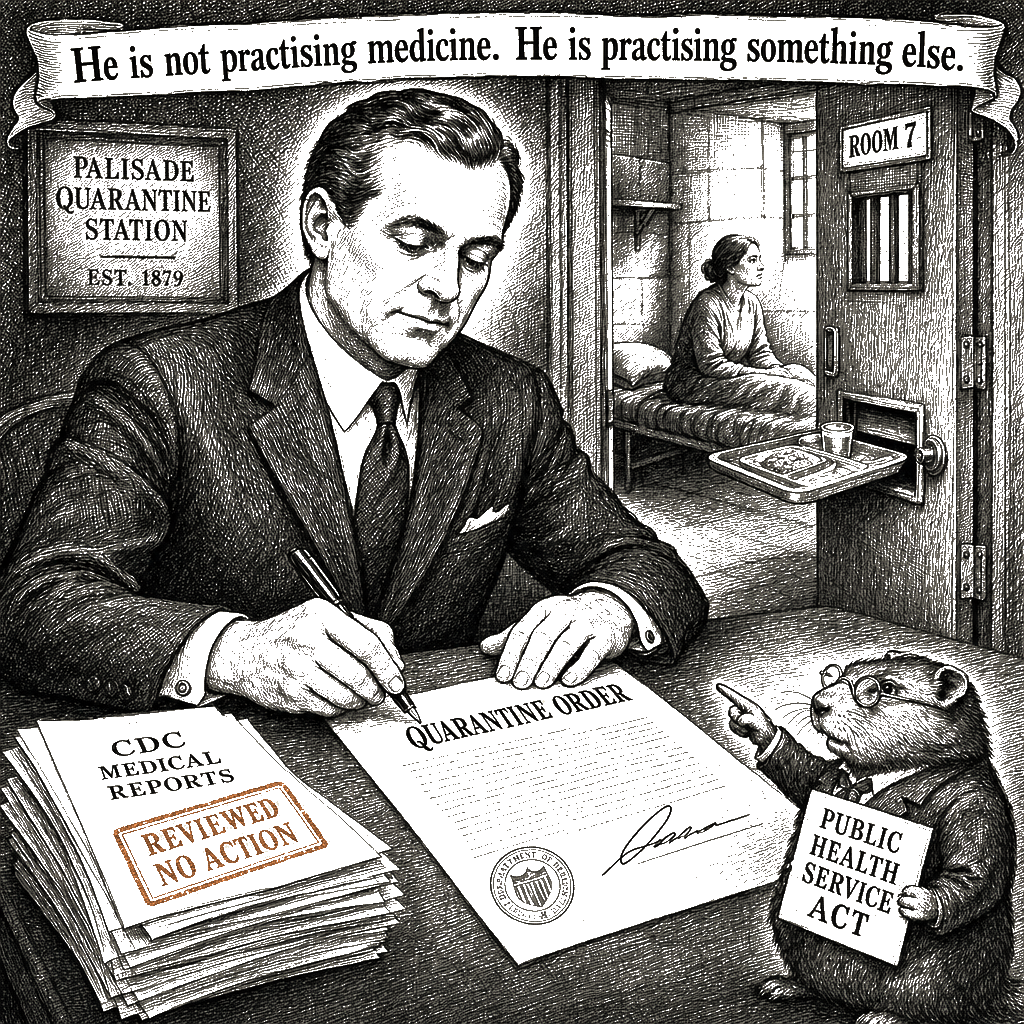
The quarantine order that Health Secretary Robert F. Kennedy Jr. slipped under Angela Perryman’s door in a Nebraska biocontainment unit Monday is not a public-health measure. It is a signed demonstration — on the record, with the full authority of the Department of Health and Human Services behind it — that the secretary does not need his doctors’ permission to detain you.
Perryman, 47, has spent more than forty days locked in a single room after being exposed to the Andes strain of hantavirus aboard a cruise ship this spring. Three people have died in the outbreak. The World Health Organization recommends a forty-two-day precautionary quarantine for high-risk exposures. On Sunday, her forty-two days will be up. The nine other quarantined passengers have been leaving for weeks — sent to home states that agreed to the administration’s monitoring requirements, including twenty-four-hour surveillance. Florida, where Perryman lives, refused. And so she remains, the only person in the unit held involuntarily, a distinction she carries alone in a facility where workers slide three meals through a door and she is permitted, on request, an hour on the roof in a chair spaced far from anyone else.
The medical facts are not ambiguous. The Centers for Disease Control and Prevention’s own infection-control experts concluded weeks ago that Perryman’s quarantine should end. An agency physician wrote last week that her risk of developing symptoms was decreasing with time and recommended she be allowed to isolate at home. Hantavirus, a rodent-borne disease, typically does not spread between humans. The Andes strain is the exception — hence the precaution — but the CDC has consistently maintained that the risk to the American public is extremely low. Kennedy overrode all of it. He overrode his own agency’s subject-matter specialists, overrode the physician who examined her records, overrode the standard this same administration applied to every other passenger whose home state played along. The secretary’s order states that Perryman is “reasonably believed to be infected with or exposed to the disease” — language that treated the CDC’s finding as though it had never been written.
At this point the story could be told as a tale of inconsistency: the nation’s highest-profile pandemic-era critic of lockdowns and government coercion, the man who thundered that CDC bureaucrats wielded too much power over individual liberty, is now holding a woman in forced isolation against the advice of the very agency he leads. And that inconsistency is real. The administration’s health-freedom rhetoric turns out to have an expiration date, and the date was hantavirus. For the public-health establishment, meanwhile, the shock is different: the government they accused of reckless indifference to infectious disease just imposed the most aggressive federal quarantine measures in recent memory for a virus that carries an infinitesimal risk to the general public. Both sides, in other words, are being confronted by the same fact: this White House will deploy the full coercive apparatus of the state when it decides the threat is real, and the decision about what qualifies is untethered from the medical consensus that used to supply the justification.
But the deeper, sharper question lives in the mechanics of the order itself, and it is the one most coverage will miss. The HHS secretary is not a physician. The quarantine power he invoked derives from the Public Health Service Act, a statute written on the premise that a health secretary would exercise that authority on the basis of medical judgment — the judgment of the physicians, epidemiologists, and infection-control specialists the agency employs. When the secretary overrules those physicians on a matter of individual detention and substitutes his own finding that a person is “reasonably believed to be infected,” he is not practising medicine. He is practising something else. The finding, in that circumstance, is not a medical determination. It is a decision to detain, dressed in the vocabulary of a medical determination so that a court will defer to it.
This is the technique. The quarantine power is among the most coercive instruments the federal government possesses short of criminal incarceration. It deprives a person of liberty on the say-so of an agency head, without a judge, without a jury, without the procedural protections that would attend even a misdemeanour charge. For decades, the justification for lodging that power in a health agency rather than a law-enforcement one has been that it would be exercised on medical grounds, by people trained to distinguish a genuine public-health threat from a person who has become inconvenient. Kennedy’s order severs that justification from the power. If the secretary can detain a woman his own doctors have cleared, on his own finding that she is “reasonably believed” to pose a risk, the finding is tethered to whatever the secretary decides. The form of the order — a medical finding signed by a non-physician, overriding the actual physicians — preserves the appearance of medical judgment while evacuating its content. The content is gone; the form remains, because the form is what insulates the decision from judicial review.
Perryman told the Journal she believed the extension was retaliation for her speaking to reporters about the conditions of her isolation. There is no confession from the administration, but the pattern is legible without one. The same health officials who spent years denouncing pandemic-era restrictions as tyranny have, when faced with a single woman they cannot offload onto a compliant governor, rediscovered the compulsory isolation power they once called government overreach. The inconsistency Perryman noted — “inconsistently applied from the very beginning” — is the point. Compulsion is for people who have no leverage and no compliant governor to take them. The CDC employees who confirmed that Florida’s refusal is what left Perryman stranded also confirmed, almost as an afterthought, that the agency’s own quarantine experts disagreed with forcing her to stay. The medical machinery that was supposed to act as a check on the political machinery had been reduced to a set of in-house dissenting memos that the secretary could ignore because the statute places the final signature in his hand.
Perryman is not a bystander to public-health logistics. Before she retired, she ensured the health and safety of oil and gas workers. She helped plan the Ebola response in Chad. She knows what a containment protocol looks like and she knows the difference between a medical precaution and a punishment. “He’s not following the doctor’s orders,” she said of Kennedy. She is the only person still being held involuntarily in a unit that has emptied around her, and the only variable that changed — the only one the secretary’s order does not address — is that the state of Florida told the federal government no, and the federal government decided that meant she would bear the cost.
A legal system that defers to agency medical judgment will have to decide, eventually, what it does with agency medical orders that contain no medical judgment. The answer will matter long after this outbreak fades. Every public-health power that depends on the premise that it will be exercised by doctors rather than by political appointees with grudges is weakened when a secretary demonstrates that the premise is optional. The next secretary — of either party, facing any pathogen, under any administration — will have Kennedy’s example to cite. The quarantine power will have been converted into a political instrument by the person currently wielding it, and the institutional memory of an agency that once resisted that conversion will prove shorter than anyone hopes.
Perryman said she plans to fly home to Florida on a commercial flight when she is released, walk barefoot in the grass, and touch a tree. Her primary residence is in Ecuador. She has spent forty-two days in a room in Nebraska because the Health Secretary of the United States decided his judgment superseded a CDC physician’s medical assessment. She is not good at all, she said, but she is talking to her family on the phone. Sunday is not far off. The larger reckoning, for the quarantine power and for the idea that a health secretary must answer to medical reality before he locks a door, is only beginning.