Dale Holness sat across from Debbie Wasserman Schultz with polling data and a plea. Run in the new 22nd, he told her. The Republicans drew it for you — it’s GOP-leaning now, yes, but you can win it. You’ve kept a home there for years. Leave the 20th, the safe Democratic seat carved out of northwest Broward and packed with Black and Caribbean voters, to someone who actually reflects the community that built it. A reasonable offer from a former Broward County mayor who understood the brutal math of representation.
Wasserman Schultz, white, former chair of the Democratic National Committee, the most powerful woman the Florida Democratic Party has ever produced, looked at him and said: “Dale, it’s not personal.”
Holness recalled his response: “It might not be, but we’re destroying the party. A lot of people in the community are angry.”
No. It is exactly personal. It is personal for the hundreds of thousands of Black voters in the 20th District who have been represented by a Black member of Congress since Alcee Hastings won the seat in 1992, one of the first Black Floridians sent to Washington since Reconstruction. It is personal for the activists and elected officials who spent the past year watching Florida Republicans systematically dismantle Black political power across the state — first by carving up Black communities with a scalpel during redistricting, then by watching a white incumbent grab the largest, safest Black-majority district left and call it her own. And it is personal for every one of the four Black candidates now running against her, each of them acutely aware that the white incumbent’s $2.5 million campaign account and the splintering effect of a crowded primary are the same old mechanisms that have been used to crush Black electoral ambition for generations.
“It’s not personal.” The sentence does more work than Wasserman Schultz intended. It is the structural tell — the phrase that names what the speaker is doing while insisting the doing carries no moral weight, the sentence that separates the act from its consequences, the decision from the people it lands on. It is the sentence the structure needs you to say, because once the act is declared not personal, the people it harms lose the language to name what happened to them.
It is, in the precise diagnostic King offered from a Birmingham jail cell, the white moderate’s sentence. The one that sets the timetable for another man’s freedom and calls the setting a courtesy. King wrote that the chief obstacle to Black freedom was not the white-hooded terrorist but the white moderate “who is more devoted to ‘order’ than to justice; who prefers a negative peace which is the absence of tension to a positive peace which is the presence of justice.” The white moderate who agreed with the goal and counseled patience on the methods. Who said representation matters and experience matters and it’s not personal — and walked into the seat the power structure had already cleared for her.
Debbie Wasserman Schultz is not a segregationist. Every Black community leader quoted in the Wall Street Journal’s account describes her as an ally. John Beckford, a Broward business leader who is Black and was raised in Jamaica, said she has “always been a part of the African-American, Black community, the Caribbean community. It’s not like she’s now a stranger trying to make herself known.” Willie Cameron, a 73-year-old Black voter from Pompano Beach, compared her to a neighbor: “I’m going to feel more comfortable with my uncle than my neighbor. It’s nothing against the neighbor.”
The neighbor analogy is kinder than the structure warrants. The neighbor is not moving into the uncle’s house uninvited. The neighbor is moving into the uncle’s house after the county condemned the block and rezoned the lot, and the neighbor is bringing her own furniture, and the neighbor is telling the uncle it’s nothing personal.
Here is the structure.
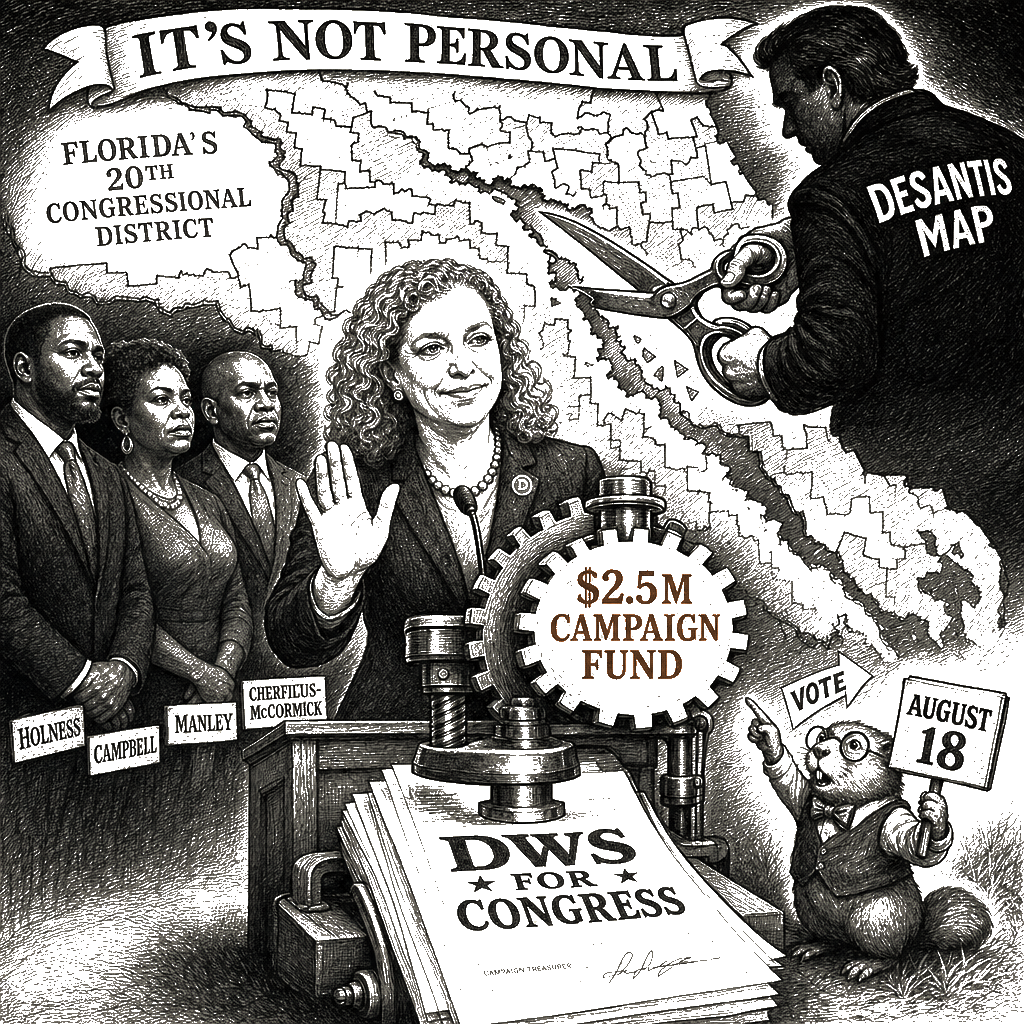
After the Supreme Court weakened the remaining Voting Rights Act protections that had constrained Southern redistricting for decades, DeSantis signed a redistricting plan that fractured the Democratic coalition in Broward County. The plan broke the compact, majority-minority district Hastings had held for three decades and carved out a new GOP-leaning seat stretching west into the Everglades and Republican-heavy southwest Florida. The map did not accidentally break Black political power. The map was built to break Black political power. That is what it does. That is what it was for.
Understand what happened here. Republicans eliminated Wasserman Schultz’s old district, a competitive but Democratic-leaning seat, and drew her into a Republican stronghold. At the same time, they created a new safe Democratic seat that was majority-minority by design — a district drawn to pack Black voters together, which in a perverse way insulated it from the worst of the GOP’s partisan sorting. The only thing standing between a Black representative and that seat was Debbie Wasserman Schultz’s decision. She had a choice. She could have fought the Republicans on their own turf: run in the 22nd, force them to spend resources defending a seat they thought they’d stolen, rally a multiracial coalition, and defend Broward’s clout by taking the fight to the enemy. Holness showed her the data. She could have won. Instead, she chose the safe path — literally, the path that led into the nearest Black district — and then she blamed the GOP for forcing her hand.
She brought $2.5 million in campaign funds, the institutional apparatus of a two-decade congressional career, and the name recognition of a former DNC chairwoman into a primary field of four Black candidates — Dale Holness, who lost a 2021 primary by five votes; Luther Campbell, the activist and former 2 Live Crew frontman who fought the obscenity charges that shaped First Amendment law in South Florida; Elijah Manley, a 27-year-old teacher and organizer who has been in this race since February 2025 and has raised $780,000 — real money for a working teacher, not enough to compete with two-and-a-half million and the Appropriations Committee; and Sheila Cherfilus-McCormick, the former representative who resigned amid federal charges and is now running again.
The field did not coalesce. It could not coalesce. Four Black candidates splitting a majority-Black electorate against a white incumbent with $2.5 million, institutional seniority, and the advantages of a two-decade head start — this is not a failure of Black political organizing. This is the structural outcome the map was built to produce. The conditions prevent consolidation because the map was drawn to ensure it.
This is the cui bono question applied to the Democratic Party’s own internal rot. When a white incumbent with a national fundraising network decides to colonize a Black seat, who benefits? Debbie Wasserman Schultz benefits — her career, her Appropriations Committee seniority, her donor list, her future ambitions. The white Democratic consulting class that depends on incumbency protection benefits. The broader party infrastructure that values experience over equity benefits. Who pays? Black voters in the 20th District. Black candidates who are told to wait their turn. The Democratic Party’s already tattered credibility on racial justice.
Ten of Florida’s fifteen DNC members said this plainly. They wrote: “Our party cannot credibly denounce the dismantling of Black political power by Republicans while treating one of Florida’s few remaining majority-Black districts as a political opportunity for an incumbent seeking a safer seat.” Hakeem Jeffries, the House Democratic leader, declined to endorse — an extraordinary break from the party’s standard practice of backing incumbents. Yvette Clarke, the Congressional Black Caucus chair, called it “not being received very well.” But neither Jeffries nor the party leadership imposed any institutional cost on the white incumbent. They spoke of the assault on Black political representation and then retreated to bland acknowledgment of her strong record. That retreat — the refusal to impose consequences on the white incumbent colonizing a Black seat — is the second mechanism. The first is donor-protected incumbency. The second is the party leadership’s silence in the face of its own members’ condemnation. Together they form a closed loop: the incumbent’s career is insulated from the consequences of the racial harm she is causing, and the party’s anti-racist rhetoric is insulated from any requirement of action.
She has mounted a defense, and it is a clinic in the bad-faith technique of frame-engineered relabeling — recasting a self-interested move as a community service. Her slogan is “representation matters, and experience matters as well” — a phrase that sounds reasonable until you strip the euphemism. “Experience” in this context means incumbency. It means a white candidate’s quarter-century in Congress entitles her to displace a Black voice because the alternative — a first-term Black representative, perhaps one not yet fully vetted by the donor network — is too risky. She has the connections, she has the committee assignments, she has the mammogram van. The subtle, deadly work of the relabeling is to recast a careerist land-grab as a selfless act of service. She’s not taking a seat that belongs to the Black community; she’s bringing them “a seasoned voice that can deliver immediately.” The corollary is the unstated presumption: that no Black candidate could possibly deliver as effectively.
The four Black candidates in this race are not novices. They include a former county commissioner who came within five votes of this seat, a celebrated First Amendment activist, a young progressive who has raised $780,000 on conviction alone, and a former congresswoman. But the party’s default is to treat the white incumbent as the safe, serious choice precisely because the system is structured to make her so. The same donor networks that fund her campaigns do not fund Black insurgents. The same institutional voices that demand “experience” have spent decades excluding Black politicians from the apprenticeships that build it. The same “seniority” argument presumes that Black districts can afford to wait another generation for representation while white gatekeepers cycle through. This is not neutral. It is the mechanism.
Debbie Wasserman Schultz is not an open enemy of Black civil rights the way the architects of the Florida gerrymander are. She is something more familiar and more insidious: a Democrat who treats Black political power as fungible, a constituency to be managed rather than a partner whose autonomous representation must be defended at any cost. She has a relationship with the Black community — she has fundraised in it, delivered services to it, stood with its members at Juneteenth festivals and Caribbean celebrations. And she is using that relationship to extract from it the one thing the community cannot afford to give: the seat that was supposed to be its own.
This is the difference between being an ally and being a settler. An ally works to protect a community’s own institutions even when doing so costs the ally something. A settler takes those institutions for herself and then demands gratitude for the resources she brings.
King, in that same Birmingham letter, drew the diagnostic that has not been improved upon: “Shallow understanding from people of good will is more frustrating than absolute misunderstanding from people of ill will.” The community’s frustration with Wasserman Schultz is not the frustration of encountering an enemy. It is the frustration of encountering a friend who cannot see that her friendship, in this structural moment, is the obstacle — that her experience, her money, her institutional advantages, her genuine record of allyship are the very instruments the structure is using to accomplish what the map was built to do. The community does not question her record. It questions her judgment. It questions whether a person who calls Hastings her mentor would, in Hastings’s absence, walk into the seat Hastings held and call it continuity.
What usually happens is that the Democratic Party asks Black voters to save it in November and then asks them to accept less in August. It expects the Black electorate to turn out at extraordinary rates to stop the latest Republican assault on democracy, and it expects those same voters not to notice that when the party’s own leaders could defend a Black seat, they chose a white incumbent’s career instead. The unspoken contract is that Black representation is a secondary good, expendable when the political cost of protecting it becomes inconvenient.
I will not grant the easy excuse that Republican aggression absolves her. It does not. The moment a white Democrat uses a Republican gerrymander as justification for colonizing a Black seat is the moment she has internalized the logic of the gerrymander itself. The map assumes Black political power is contingent and displaceable; she has acted as if it is. The only difference is that DeSantis does it with a pen and she does it with a campaign filing.
DeSantis drew the map. Wasserman Schultz is finishing the work.
August 18 is the primary date. The question the primary answers is whether the Democratic Party will do the structural work the map was designed to outsource to it — whether it will accept the outcome DeSantis’s redistricting was built to produce, or whether it will name the structure, fight the structure, and refuse the courtesy of calling the whole thing not personal.
King said the arc of the moral universe bends toward justice, and Malcolm X said freedom by any means necessary — but the means are the ballot, the campaign, the primary challenge, the refusal to accept that a white incumbent’s convenience ranks higher than a community’s right to choose its own voice. The arc bends only when specific people, in a specific moment, push it. The Black voters of the 20th District have that power in August. They can push this arc, or they can let it be pushed backward by a party that will ask them to vote in November while it has spent the primary season demonstrating that their representation is negotiable.
The alternative is to let the Democratic establishment internalize DeSantis’s logic and call it pragmatism. That would be a defeat deeper than any general election. It would be the quiet concession that Black political power, like Black labor, like Black loyalty, is a resource to be extracted and then discarded when it becomes inconvenient to the professionals who manage it. The party that would be the party of the multiracial coalition will have proven itself, instead, the party of the white fallback. Alcee Hastings held this seat for thirty years through the structural conditions that made holding it an act of defiance — because Black political power in Florida, built through Reconstruction, through Jim Crow, through the Voting Rights Act, through decades of organizing and voting and building, made it possible. The governor’s map is the instrument for un-building it. The arc requires that answer. It always has. I will not look away from that possibility, and neither should anyone who claims to believe in the democracy we are all supposed to be defending.