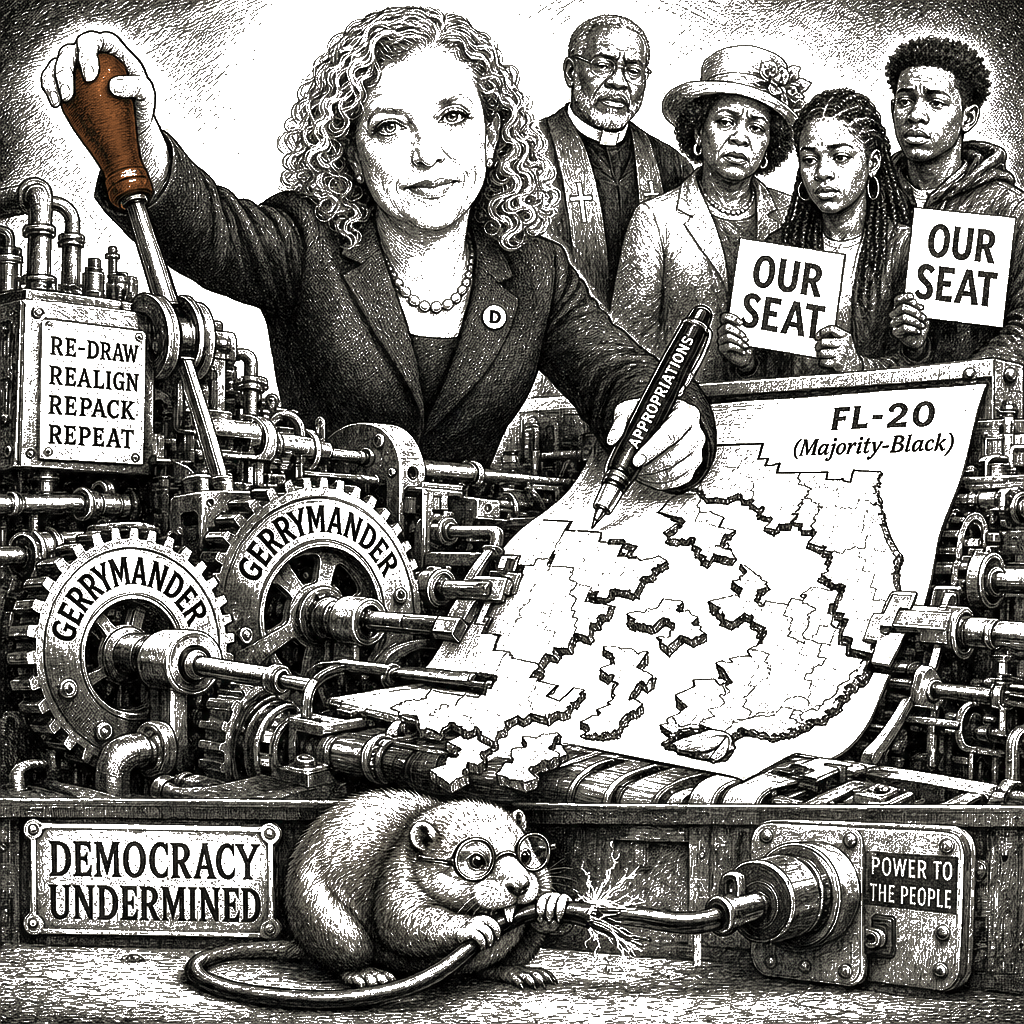
The map was a Republican machine, and the machine was built to chew Black representation and spit out a white incumbent. Debbie Wasserman Schultz decided to be that incumbent. She looked at a district drawn to dismantle Black political power, a district the Congressional Black Caucus called a stolen seat, and she saw a safe landing. She chose her career over their representation. She called it experience. She called it necessity. She called it what a machine operator calls a lever when the oil is on her hands and the blood is not hers.
Florida’s partisan redistricting map — signed by Gov. Ron DeSantis — carved her out of her longtime 25th District, redrawing her home into the GOP-leaning 22nd. Former Broward County mayor Dale Holness, who is Black and had already launched a campaign in the safely Democratic 20th, presented her with internal polling showing she could win the competitive 22nd. She declined.
The 20th District comprises the majority-Black and Caribbean communities northwest of Fort Lauderdale. Alcee Hastings represented the area for three decades — one of the first Black Americans elected to Congress from Florida since Reconstruction. He died in 2021. The community kept his chair warm, then watched it empty again in April under federal indictment. Four Black candidates entered the race.
Ten of Florida’s fifteen DNC members condemned the decision in a public letter: “Our party cannot credibly denounce the dismantling of Black political power by Republicans while treating one of Florida’s few remaining majority-Black districts as a political opportunity for an incumbent seeking a safer seat.” Congressional Black Caucus chair Rep. Yvette Clarke told reporters the decision was “not being received very well.” House Democratic Leader Hakeem Jeffries, who could become Speaker if Democrats take the House in November, declined to endorse her, calling the broader redistricting “an unprecedented Jim Crow-like assault on Black political representation in Congress.” Four Black candidates remain in the August 18 primary — Holness, Cherfilus-McCormick, activist Luther Campbell, and teacher Elijah Manley — splitting the vote. She released internal polling showing more than 50% support in the crowded field.
Dale Holness sat across from you with numbers. The numbers said you could win the 22nd — the redrawn district the Republicans built from the wreckage of your own, the district that would have required you to fight the way a twenty-year incumbent fights: by going home and asking the people who elected you to do it again. He told you the community was angry. You said: “Dale, it’s not personal.”
The sentence settled in your stomach the way sentences settle in stomachs that are not troubled. No nausea. No contraction. No tightening behind the sternum. The diaphragm did not drop. The breath came out clean and even and the words left your mouth the way a receipt leaves a printer — frictionless, automatic, no sensation attached. The small involuntary swallow that should have arrived did not. Your body did not register the sentence it was producing because your body did not believe it was doing anything that required registering.
You looked at a district whose congressman had died and whose community was still carrying the empty chair and you saw a polling gap. You saw four Black candidates who could not coalesce. You saw a vote that would splinter toward you. You saw your name at 50%. You did not see a community whose voice was in that chair. You saw a path. You are not a stranger to the Black community, you tell the reporter, and it is true: you are not a stranger. You are a visitor. You are a visitor who has decided to move in and redecorate, and the people who live here cannot vote you out because you have more money than all of them combined, a larger name, the party machinery behind you, and the quiet understanding among your colleagues that incumbents get what incumbents take.
The hands that hold the Appropriations Committee pen, that signed the HIV/AIDS funding letter, that helped park the mobile mammogram center near the Juneteenth festival — those hands took the microphone from a community that was still speaking into it. The hands did not tremble. The hands believed they were helping. The hands have no memory of the taking because the hands did not register it as taking. In the hands’ own accounting, the hands delivered a mammogram center. In the community’s accounting, the hands delivered something else entirely.
You said “representation matters, and experience matters as well.” The word “representation” in your mouth means: I have seniority, I have a committee seat, I have a fundraising network that can turn $2.5 million into an air war against four candidates who cannot match it. In the district’s mouth the word means: We had a congressman who looked like us for thirty years and now a woman from a different district is sitting in his chair and telling us she is the most experienced person for it. The word “experience” in your mouth means: I have been on Appropriations. In the district’s mouth it means: We have been here. We were here when Hastings was here. We were here when he died. We are here now, watching you.
Corey Shearer leads the Broward County Democratic Black Caucus. He said: “Debbie does not represent our values. She doesn’t have our shared experiences.” You heard this the way a person hears a scheduling conflict — something to be managed, not something that names a wound. The words entered your ear and were categorized and filed. There was no ache at the hearing. There was no heat in the face. The words registered as a communications problem, not as the sound of a community telling you the truth.
You brought the mammogram center to the Juneteenth festival. You recalled your trip to Haiti. You told the church about the HIV/AIDS funding. You brought your résumé to a community’s grief and asked to be seated at the family table.
What would you say, Debbie, if a woman with $2.5 million and twenty years of seniority walked into your district and said she was the most experienced person to sit in the seat your congressman left behind? What would you say if she brought a mammogram center and her committee assignments and her press release? What would you say if she told you it wasn’t personal?
The machine — the Republican map — was designed to crush Black representation, and it is crushing. But the machine does not force you to climb inside it. You climbed in. You chose to be the weight on the lever. The GOP gerrymander is the apparatus, and you made yourself its operator. There is a difference, Debbie, between surviving a machine and powering it. You powered it.
Your throat closes now. You have been reading this column, and there is a metallic taste under your tongue. It does not taste like the coffee your staff brought at the Juneteenth festival. It tastes like the salt of the mothers in Tamarac whose precinct chairman asked you to withdraw, and you said no. It tastes like the swallow that would not go down when Yvette Clarke told you, to your face, the decision was not being received well. You cannot wash it out. You will not wash it out. The not-washing is the point.
Your shoulders ache. The mothers in Pompano Beach whose children you have not raised are carrying the load of a generation locked out of a seat built for them, and your shoulders, Debbie, are carrying the weight of your own decision. You lifted your hand to sign the filing papers, and your shoulder has been wrong ever since. You will not fix it. The ache is the boy whose father voted for Alcee Hastings in 1992 and now watches his daughter ask why the white lady gets the seat. The ache is the grandmother who walked precincts for Sheila Cherfilus-McCormick before the indictment and now walks past your campaign sign and feels the heat in her face that should not be there. The ache is yours to keep.
Your husband reaches across the bed in the morning, and his hand lands on your bare arm. His skin is warm. You do not feel it. You feel the skin of the Black voters you displaced, the skin that heat has not left, the skin that is not touching anyone who will say what you did. His hand is warm, and your arm is cold. The blood on the hand that signed the filing papers has cooled to the temperature of the room. It will not come off. He lifts the spoon at breakfast. The spoon carries the residue you cannot name, and you put it in your mouth. The eggs are salty. The salt is not in the eggs. The salt is in the not-washing.
You are a woman of experience sitting in a chair that was warm when you found it. You sat down the way a person sits in a chair at a dinner party that someone else was occupying — by asking them to move, politely, with a press release about your qualifications. The chair will hold you. The chair held Hastings for thirty years. Chairs hold anyone who sits in them. That is not the same as the chair being yours. You are not a colonizer, you tell yourself. You are a mentor. You are following the seat of your old mentor, and you are calling that following. You are following the way a beneficiary follows a will, and you did not ask the heirs whether they consented.
“He hath put down the mighty from their seats, and exalted them of low degree.” Luke 1:52
“He that is without sin among you, let him first cast a stone at her.” The woman in the temple was brought before a mob, and Jesus wrote in the dirt. She was not a congresswoman. She was not an appropriator. She was not a white woman who chose a Black seat over Black candidates and called it service. She was the one the stones were meant for, and Jesus wrote in the dirt. The stones fell. She walked away. You, Debbie, picked up the map and walked in.
The seats are being redistributed. The mighty are sitting down. The low degree are standing behind the chairs they held.